Camping Near North Carolina OHV Trails
Camping near North Carolina OHV trails sounds simple until you discover that a nearby campground may not allow machines on its roads, a trailhead may not permit overnight parking, or your chosen site is a long, slow tow from the ride. This guide explains how to choose a legal, practical place to camp near Uwharrie, Brown Mountain, or Wayehutta—and how to plan for permits, weather, gear, and trail access.
Start by matching your campsite to your riding area
Camping near Uwharrie and Badin Lake
Uwharrie National Forest is a popular destination for riders, but “near Uwharrie” can mean several different things. The Badin Lake OHV Trail Complex, campgrounds, lakeside recreation areas, and small towns are spread across a broad part of the forest. A campsite that looks close on a map may still involve a substantial tow along local roads before you reach your staging area.
Arrowhead Campground is a familiar option for people planning a Badin Lake trip. Before choosing it, confirm that the campground’s current setup fits your group: site type, vehicle and trailer parking, access rules, available services, and any restrictions on bringing or storing an ATV or UTV. [Camping at Arrowhead Near Badin Lake] is a useful next step when you’re comparing this area with other places to stay.
Other established campgrounds and private camping options around Troy, Mount Gilead, and the wider Badin Lake area may work better if you need more room, hookups, or facilities. The tradeoff is that a developed campground may be farther from the OHV staging area, and its internal roads may not be open to off-highway machines. Plan to haul the machine to the legal trailhead unless the property owner and campground rules clearly allow another arrangement.
Camping near Brown Mountain and Wayehutta
Brown Mountain OHV Trail System sits in the Grandfather Ranger District, with Lenoir and Morganton among the useful nearby towns for services and trip planning. Camping choices may include developed forest campgrounds, private campgrounds, and other lodging in the surrounding foothills. The best choice depends on whether you prioritize a short drive to the riding area, a quieter overnight setting, family facilities, or room to park a trailer.
Don’t assume that a campground near Brown Mountain is inside the OHV area or that its access roads are riding routes. You may need to transport your machines to the designated staging area and follow the posted rules there. Check access and availability before building your whole weekend around one site; campground conditions, road access, and recreation-area operations can change. [Where to Camp Near Brown Mountain] can help you think through the nearby options and the practical distance between a place to sleep and a place to ride.
Wayehutta OHV Recreation Area is in Jackson County, near communities such as Cullowhee and Sylva. That makes it possible to combine trail riding with a stay at a developed campground, private campground, or other lodging in the area. The forest setting is appealing, but the winding mountain roads can make a short-looking route take longer than expected, especially when towing.
For any of these areas, treat “near the trail” as a starting point, not a guarantee of convenient access. Confirm the campground’s location, your route to the trailhead, trailer parking, and whether you can leave a tow vehicle overnight. Use [North Carolina ATV Camping Near the Trails] and [Camping Near a North Carolina Trailhead] to compare the kinds of overnight arrangements riders use around the state.
Choose the right kind of camping
Developed campgrounds
A developed campground is often the least stressful option for a first visit, a family outing, or a group that wants predictable facilities. Depending on the property, you may find marked sites, toilets, potable water, a staffed entrance, picnic tables, or hookups. Don’t assume every campground offers all of these, or that a listing with “RV sites” automatically means it can accommodate a long truck-and-trailer combination.
Think about the shape of your whole setup, not just the tent or RV. A campsite that comfortably fits a camper may leave little room for a tow vehicle, a separate machine trailer, and gear. Ask how parking works at the site and whether extra vehicles or trailers need separate spaces. If you arrive after dark, a narrow turn or tight campsite can turn unloading into a frustrating puzzle.
Developed sites are also useful when the group has different needs. One person may want a shower and a quiet evening, while another is focused on getting to the trail early. Check quiet hours, generator rules, fire restrictions, pet policies, and any rules for storing fuel or equipment before booking. These details matter more when you’re bringing noisy gear and machines that may be muddy at the end of the day.
Primitive and dispersed camping
Primitive camping can put you closer to the forest experience, but it asks more of you. A simple site may have no water, toilets, trash service, or reliable cell reception. You’ll need to bring what you need, pack out what you bring, and be ready to handle an unexpected change in weather without relying on campground staff or nearby facilities.
Most importantly, don’t interpret “public forest” as permission to camp wherever you find a flat patch of ground. Camping may be limited to designated sites or subject to area-specific restrictions. A site beside a road, trail, creek, or trailhead is not automatically legal for overnight use. Follow posted signs and the managing agency’s rules, and contact the relevant district office if the site status is unclear.
Primitive camping can also complicate machine security and morning departures. You might have a remote place to pitch a tent but no legal place to park a trailer nearby. Before choosing this style, identify your overnight parking spot, unloading plan, and route to the staging area. Carry enough water, food, lighting, and first-aid supplies to manage the night without assuming you can quickly drive to a store.
Private campgrounds and cabins
Private campgrounds, cabins, and other local lodging can make a riding weekend easier when public campground space is unavailable or your group needs more amenities. They can also offer a better fit for people who don’t want to sleep in a tent after a long day on a dusty or wet trail. The important detail is whether the property is genuinely set up for guests arriving with off-road machines and trailers.
Ask the owner or manager direct questions: Is trailer parking available? Can a machine be unloaded on the property? Are machines allowed to be moved between the site and the road? Is there a secure place to park a tow vehicle? Are there restrictions on washing muddy machines, storing fuel, or running a generator? A friendly “ATV-friendly” description may refer to nearby riding, not permission to operate on the property.
Private lodging can also be a good choice for mixed groups. Riders can head out early while other guests enjoy the area without joining the ride. But the machine still needs a legal route to the trail system; don’t ride on public roads or through a campground unless the rules specifically allow it. Compare the total trip logistics, not just the nightly accommodation, before paying a deposit.
Compare your main camping options
The table below is a planning aid, not a substitute for checking the specific campground’s rules. Facilities, access, and availability vary by location and can change.
| Camping option | Often works well for | Check before booking | Common tradeoff |
|---|---|---|---|
| Developed forest campground | Tent campers, families, and riders wanting basic facilities | Site availability, trailer parking, water, toilets, fire rules, and machine restrictions | May be some distance from the OHV staging area |
| Private campground | Groups wanting amenities or a defined reservation | Trailer dimensions, unloading rules, machine storage, quiet hours, and extra vehicle policies | Access to the trail may still require trailering |
| Cabin or local lodging | Mixed groups and riders seeking a more comfortable overnight stay | Parking, security, cleaning rules, and whether machines may be brought on the property | Less room for trailers or muddy gear |
| Designated primitive site | Self-sufficient campers who prefer a quieter setting | Whether camping is allowed there, road conditions, water, fire rules, and overnight parking | Few or no services and limited communications |
| Hotel or motel in a nearby town | Short trips or people who want restaurants and supplies nearby | Trailer parking, security, and where the machine can be stored | Daily driving and trailering may add time |
Before you settle on a site, compare it with your specific riding plan. [Finding a Campsite Near Badin Lake] may help if Uwharrie is your destination, while [North Carolina Forest Trail Maps] can help you understand how the trail system and surrounding roads fit together. A map can reveal distances, but it cannot confirm that a particular campground allows your vehicle or that a road is open to the public.
Plan the route from camp to the trailhead
Calculate the whole travel time
A campsite’s straight-line distance from a trail may be misleading. Roads can wind around lakes, ridgelines, or forest boundaries, and a truck towing a trailer won’t move like a small car. Add time for check-in, unloading, gear checks, parking, and any queue at the staging area. If your group includes new riders or children, allow extra time rather than planning a rushed departure.
For a Uwharrie weekend, compare your campground with the exact trailhead you plan to use instead of searching only for “camping near Uwharrie.” The same approach applies at Brown Mountain and Wayehutta. Confirm the driving route, road surface, trailer turning space, and whether your route crosses private property or restricted forest roads.
A navigation app may show several routes, but the fastest one is not always suitable for a large rig. Look for steep grades, narrow roads, low-clearance hazards, or places where turning around would be difficult. Download offline maps before leaving reliable service. Tools such as onX Offroad can help with route context and offline navigation, but use posted signs and official land-management information to confirm access and restrictions.
Make a deliberate unloading and parking plan
Decide where the machine will be unloaded before you arrive. Some trail systems have staging areas; others may have limited parking, specific entry points, or restrictions on overnight use. Don’t plan to leave a trailer at a roadside pull-off unless overnight parking is clearly permitted. A legal daytime parking spot does not automatically authorize leaving a vehicle there overnight.
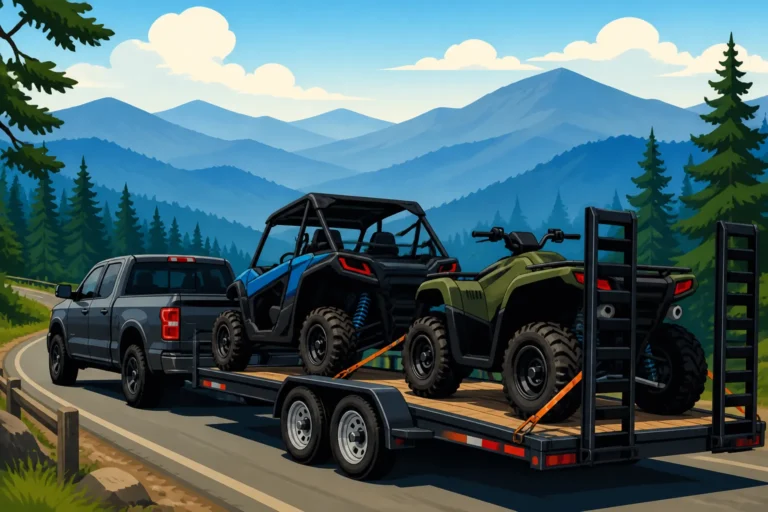
Also decide what stays at camp and what travels with you. A helmet, eye protection, water, tools, and emergency gear should be easy to reach. Loose items in an open trailer can shift during the drive, and muddy equipment may need to be kept separate from sleeping bags or food. Bring straps suitable for your load and inspect them before the trip, not at the trailhead.
If you’re meeting friends, agree on one staging location and a backup meeting point. Cell service can be inconsistent in forested areas, and a group can easily split between trailheads. Share the campground name, route, and expected arrival time with someone who isn’t riding. A simple plan prevents a late afternoon search for a missing truck or a rider who took a wrong turn.
Respect the difference between roads, trails, and campground paths
A road that looks rideable is not necessarily open to ATVs or UTVs. Forest roads, campground lanes, private drives, utility corridors, and OHV trails have different access rules. Don’t use a machine to ride from camp to the trail system unless that specific route is open to your machine and riding is allowed. It’s safer to assume you need to trailer between them until you have clear permission.
Campground roads are for getting to campsites, not for casual trail riding. Even a brief ride to a nearby store can violate property rules or road laws. The same applies to public roads around forest areas. Review [Are ATVs Street Legal in North Carolina?] and [North Carolina Rules for Riding a Public Street] if you’re unsure where a machine may be operated.
When you reach the trailhead, follow the signs and use the designated staging and trail network. Stay off closed routes and don’t cut around barriers. If a route appears washed out, blocked, or newly signed, turn around and check the official status instead of treating the obstacle as a challenge. Trail legality is not determined by whether a machine can physically get through.
Prepare for permits, seasons, and changing conditions
Treat permits and camping rules as separate questions
A camping reservation and an OHV permit solve different problems. A campsite booking does not necessarily authorize riding, trailhead parking, or operation on nearby roads. Likewise, having the required riding permit doesn’t give you permission to camp outside a designated area or leave your trailer overnight at a staging lot.
Check the rules for the specific trail system and for each machine in your group. Requirements can differ by location, and a group may need to plan around permits, rider safety requirements, machine equipment, and posted operating hours. The fact that a friend rode there last season is not a substitute for checking what applies to your planned visit. Start with [North Carolina Forest OHV Permits] and [Do You Need a Permit for North Carolina Forest Trails?].
Keep required paperwork and permits where you can find them. A glovebox buried under camping gear is not helpful when you need to show a document at a trailhead. Take care not to confuse a forest permit with a road registration or a title. For broader context about how North Carolina treats off-road machines, see [Why There Is No North Carolina Trail Sticker].
Plan around the season and weather
Trail access and campground conditions can vary with the season. Some riding areas have operating seasons or closures, and weather can make roads or trails difficult even when the area is open. Heavy rain may leave mud, standing water, or damaged approaches; a dry spell can mean dust and heightened fire concerns. Mountain weather can shift quickly, while Piedmont heat and humidity can make an exposed ride tiring.
Check the specific area’s operating information before you leave, then check again close to departure. Use [North Carolina's Trail Seasons] as a planning prompt, and review [North Carolina Trail Closures to Check] and [North Carolina Trail Conditions Before You Ride]. Don’t rely on an old social-media post or an outdated screenshot. If access information is ambiguous, ask the relevant district office or campground operator.
Build flexibility into the trip. If the trail system is closed or the approach road is damaged, you may need to change your riding day, choose a different legal riding area, or turn the weekend into a camping trip without the machines. Avoid booking nonrefundable extras around a trail schedule you have not confirmed. A backup plan is especially valuable when you’re driving several hours with a loaded trailer.
Check campground operations as carefully as trail operations
A forest campground and an OHV area may be managed separately. One could be available while the other is restricted, or a campground could have its own seasonal schedule and reservation conditions. Confirm that the site will be open for your dates and that your arrival time, vehicle size, and group setup fit its policies.
Ask about water, toilets, trash, firewood, and cell coverage rather than assuming these basics. If a campground has no potable water, bring enough for drinking, cooking, cleanup, and emergencies. If there is no trash service, plan to carry waste out. If fires are restricted, bring a cooking option that complies with the rules and don’t count on gathering wood.
Make a short list of the details you need to verify: campground check-in and check-out, quiet hours, trailer parking, extra-vehicle rules, fire restrictions, and any machine-specific policies. Keeping those details in one place reduces the last-minute confusion that often happens when several people are coordinating vehicles, reservations, and ride times.
Pack for camping with machines
Bring the right equipment for your campsite
Your packing list depends on whether you’re in a full-service campground or a primitive site. At a developed campground, you may be able to rely on some facilities, but you still need shelter, bedding, clothing layers, lighting, food, water, and a way to manage wet or dirty gear. At a primitive site, add more water, waste-management supplies, and backup lighting.
Keep camping equipment and riding equipment organized separately. One labeled bin for cooking and camp setup, one for riding gear, and one for tools and recovery equipment is easier to manage than a trailer full of loose items. Put frequently needed items near the door or tailgate so you don’t have to unload half the trailer just to reach a rain jacket.
Weather protection deserves extra attention. Pack rain gear, dry clothes, warm layers for cool evenings, and a way to keep bedding dry. A sunny afternoon at home doesn’t guarantee a comfortable night near a forest trail. If you’re camping in the mountains, expect temperatures and conditions to differ from the nearby town, especially after sunset.
Secure and maintain the machine
Before leaving home, inspect the trailer, hitch, tires, lights, tie-downs, and load balance. Check the machine’s tires, brakes, steering, fluids, and other items recommended in its owner’s manual. A loose strap or low tire is much easier to fix in your driveway than at a trailhead with a line of vehicles behind you.
Pack basic tools and supplies that match your machine and your experience. A compact tire repair kit, gloves, a flashlight, and a small selection of appropriate tools can help with minor problems. Don’t attempt a repair beyond your ability in an unsafe location; know when the right move is to stop riding and arrange assistance. Tell your group what recovery equipment is available and who knows how to use it.
At camp, park machines and trailers where the property allows, and don’t block roads, emergency access, or neighboring sites. Secure keys and gear when you leave the campsite. Never assume that a remote campground guarantees security. If the property has designated storage rules, follow them rather than improvising a parking spot.
Keep fuel, food, and waste under control
Fuel planning matters because stores and services may be farther apart than they appear on a map. Know your machine’s practical range for the type of riding you expect, and identify fuel stops along the towing route. Carry fuel only in containers and locations permitted by the campground and applicable rules; don’t store it beside a fire, cooking area, or sleeping space.
Store food so it doesn’t attract wildlife or create a mess for neighboring campers. Use the campground’s designated food-storage practices and secure trash in the manner required there. At forest sites, scattered scraps and unsecured garbage can create problems for animals and for the next campers. Pack out food waste if no disposal service is available.
Leave the campsite clean, including the area where you parked or unloaded the machine. Don’t wash mud into a creek or storm drain, and don’t use campground water or facilities for machine cleaning unless the operator allows it. A muddy machine may need to be cleaned before loading, so plan ahead for a legal wash location rather than assuming one will be available at camp.
Make the trip comfortable and safe for everyone
Build a realistic daily schedule
A good riding day begins before the group reaches the trail. Set a departure time that allows for breakfast, loading, the drive, unloading, and a quick machine check. If everyone waits until the last minute to find helmets, gloves, snacks, and permits, a relaxed morning can become a stressful one.
Set a turnaround time before you start riding. The goal is to return with enough daylight to load safely, drive back to camp, and prepare dinner without rushing. On unfamiliar trails, navigation errors and mechanical delays can stretch a ride. Don’t plan your return around the optimistic assumption that every loop will take exactly as long as it did for someone else.
Keep the plan appropriate for the least experienced rider in the group. A long or difficult route may sound appealing, but fatigue, heat, and anxiety can make a full day less enjoyable. Agree on a route, regrouping points, and a method for handling a separation before anyone starts the engine.
Plan for children and mixed-ability groups
Camping can make an ATV weekend more enjoyable for children, but it also means supervising them around hot engines, trailers, cooking equipment, and moving vehicles. Create a clear boundary around where children may play, and keep them out of loading and unloading areas. A child who is excited to see the machines may wander into a blind spot while an adult is backing a trailer.
Choose a ride plan based on age, experience, machine fit, and the area’s rules—not just on what the adults hope to ride. Explain that children should stay with the supervising adult and stop when asked. Make sure each rider has properly fitted protective gear and understands how the group will communicate on the trail.
If some people don’t ride, make sure they have a comfortable alternative. Nearby towns, lakes, hiking areas, or a quiet campsite may provide a good day for non-riders, depending on access and local rules. Agree on transportation and check-in times so no one is left without a way to get back to camp.
Reduce the impact of your visit
A well-planned camping trip helps protect the same places riders want to return to. Stay on marked routes, follow campsite boundaries, and avoid riding through streams, vegetation, or areas that are not open to machines. Do not create a new path around a closure or a muddy section. The shortcut can cause erosion and damage that outlasts the weekend.
Keep noise considerate, especially early in the morning and late at night. Campground neighbors may be there for a quiet family trip, and a loud machine or generator can affect the whole loop. Follow posted quiet hours and avoid unnecessary engine idling. If a machine develops a problem, move it only as allowed and address the repair in a suitable location.
Pack out trash, follow fire rules, and leave shared facilities in decent condition. If you notice a damaged sign, blocked access, or a safety concern, report it through the appropriate property manager or land-management office. Responsible behavior makes it easier for campgrounds and riding areas to welcome future visitors.
A practical planning checklist
Before you reserve
Choose the riding area first, then look for a campsite that makes the drive and trailer logistics manageable. Decide whether your group needs hookups, toilets, water, a cabin, or a primitive site. Confirm the campground’s location and whether the site can fit the entire vehicle-and-trailer combination.
Ask about machine-related restrictions in plain language. “Is it near trails?” does not answer whether a machine may be unloaded, parked, or moved on campground property. Confirm the rules for fuel, washing, generators, extra vehicles, pets, and quiet hours. Save the confirmation and the campground’s contact details where the driver can access them offline.
Check the trail system’s rules, permits, operating status, and staging arrangements separately. Look for the exact trailhead you intend to use, rather than relying on a broad area name. Keep a backup campsite or alternate plan in mind in case the preferred location is full or access changes.
Before you load
Inspect the tow vehicle, trailer, hitch, lights, tires, straps, and machine. Pack helmets, protective clothing, water, food, maps, tools, first-aid supplies, and emergency lighting. Charge phones and navigation devices, and download maps for places where service may be unreliable.
Share the schedule, route, and campground details with everyone in the group. Make sure each driver knows where to meet and what to do if the group gets separated. Confirm that the person responsible for reservations and permits has the necessary information available, rather than stored only in an email that may be hard to open on the road.
Check the forecast and the official access information again before departure. A camping reservation does not guarantee that trails are open, and a trail being open does not guarantee that the route or campground is in suitable condition for your rig. Adjust the plan if the conditions call for it.
At camp and on the way home
Follow check-in instructions, park where directed, and keep the campsite clear of trailers, machines, and gear that could obstruct others. Before riding, confirm the trailhead and current posted notices. On return, inspect the machine and trailer, secure loads, and make sure no fuel or loose equipment is left behind.
Leave the site clean and follow the campground’s check-out rules. If mud or debris needs attention, use an approved location and avoid washing it into waterways. Let the campground operator know about a maintenance or access issue that could affect the next visitor.
The most enjoyable camping trips near North Carolina OHV trails tend to be the ones with realistic drive times, confirmed access, and a backup plan. A little extra work before leaving home means less time sorting out trailer parking, campground rules, or trail closures after you arrive—and more time enjoying the ride and the evening around camp.
Disclaimer
This article is for general informational purposes only and does not constitute professional advice. Laws, prices and regulations vary by location and change over time. Consult a qualified professional for guidance on your specific situation.