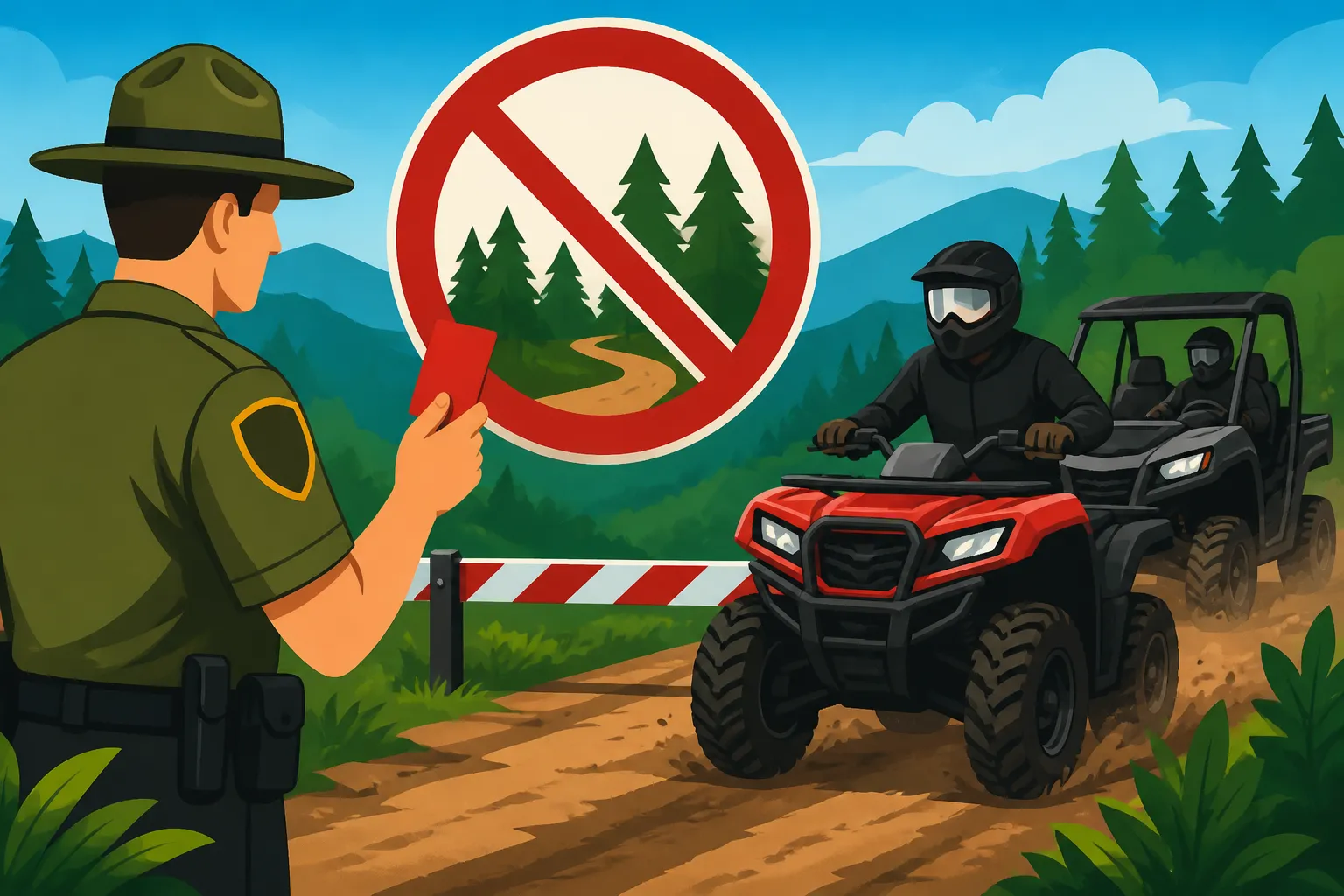
North Carolina Fines for Riding a Closed Trail
Riding a closed trail in North Carolina can bring more than a warning, but there is no single statewide fine that applies to every closure. The consequence depends on who manages the land, what rule or order was violated, and whether other violations occurred. Here’s how to understand the risks, check trail status, and respond if you are cited.
What Riding a Closed Trail Means in North Carolina
A trail can be closed temporarily or permanently. A closure may be posted at a gate or trailhead, announced through a land manager’s notice, or included in an official order. Storm damage, erosion, maintenance, fire danger, wildlife concerns, or a seasonal schedule may all lead to restrictions.
On national forest land, riding is not permitted simply because a route appears on a map or has tire tracks. The route must be open to the type of vehicle you are using, and riders must follow applicable road, trail, and closure restrictions. A road open to some motor vehicles is not automatically open to ATVs or UTVs.
This distinction matters in North Carolina’s national forests, including areas managed for off-highway vehicle riding. A forest permit, where required, does not override a trail closure. A permit authorizes access under the applicable rules; it does not give a rider permission to travel on a closed route. For permit basics, see Do You Need a Permit for North Carolina Forest Trails?
A closure can also apply outside national forests. State-managed land, a local park, a private off-road park, or land owned by an individual may each have its own access rules and enforcement process. Private property permission does not necessarily include permission to ride every road, path, or neighboring parcel. For background on private-land access, see Written Landowner Permission in North Carolina.
| Situation | What it can mean | What to check |
|---|---|---|
| A gate or sign marks a trail closed | Riding past it may violate a closure or access rule | The sign, posted order, and land manager’s current notice |
| A trail is shown on an older map but is closed now | The current closure generally matters more than an old map | Updated alerts, maps, and trailhead notices |
| A route is open to highway vehicles but not ATVs | The route is not necessarily open to off-highway machines | Vehicle-specific restrictions and the land manager’s map |
| A forest permit is displayed | It does not cancel a closure or open an unauthorized route | Permit conditions and current trail status |
| A trail crosses private or restricted land | Access may require separate permission | Property boundaries and written permission |
If the status is unclear, do not assume that a lack of a barrier means the trail is open. Closures may be posted at the trail entrance, on an access road, or in a land manager’s official notice. A sign can be easy to miss after a storm or at a junction, so checking before unloading is more reliable than relying on what another rider says.
For practical closure checks, see North Carolina Trail Closures to Check, North Carolina Trail Status After a Storm, and Checking a Forest Alert Before You Drive. If you are at a trailhead, the posted board may have more current information than a map saved on your phone. Reading the Gate Board at Badin Lake explains why it is worth pausing to read local notices before riding.
What Fines or Other Consequences Can Follow
There is no single fixed North Carolina fine for riding a closed trail. The amount and type of penalty depend on the land, the authority enforcing the closure, and the specific rule or order cited. A ticket or citation can also lead to a court process, so the amount written on a notice may not tell the whole story about what happens next.
On federal land, a Forest Service officer may enforce applicable federal regulations and closure orders. A rider could be cited for violating a closure or for related conduct, such as operating off an authorized route. The specific allegation matters: “riding a closed trail” is a plain-language description, not necessarily the exact charge printed on a citation. Federal cases may be handled through the relevant court process, and penalties depend on the cited provision and circumstances. Check the current official notice or ask the court or agency identified on the paperwork rather than relying on a general online estimate.
Other land managers can enforce their own rules. A state or local site may have separate regulations, while a private park may address unauthorized riding through its entry terms, access rules, or property rights. If a route crosses land you do not have permission to use, trespass concerns may also arise. The rules for one trail system do not automatically apply at another.
The situation can become more serious if other violations occur at the same time. For example, an officer might address a separate permit issue, equipment violation, or damage to a barrier in addition to the alleged closure violation. Whether additional allegations are made depends on the facts and the authority involved. A closure citation should not be treated as the only possible consequence if the ride included other prohibited conduct.
Financial consequences may also go beyond a fine. Depending on the case and applicable rules, a rider may face court costs or be held responsible for damage or restoration. Do not assume that every closure citation includes these amounts, or that they are automatic. The citation, official order, and relevant land manager are the right places to confirm what is actually alleged and what process applies.
A permit violation is a separate issue from riding a closed trail. If you rode without a required permit, that could be addressed independently. Likewise, having a permit does not make an otherwise closed trail legal to ride. The distinction is explained in North Carolina Fines for No Forest Permit.
A closure can also be narrower than it first appears. It may apply only to a particular segment, type of vehicle, time period, or area. But unless the official notice clearly shows that your machine and route are allowed, do not try to interpret a vague sign in your favor while already on the trail. Ask the land manager before riding. For more on off-route travel, see [North Carolina Rules for Riding Off the Trail].
What to Do If You Are Cited
A citation is not the same as a final court decision. Read it carefully, keep the original paperwork, and note any deadlines or response instructions. The document should identify the issuing authority, the alleged violation, and how to respond. If any part is unclear, contact the court or agency named on the citation rather than guessing about the next step.
- Stay calm and follow lawful instructions. Do not argue on the trail, interfere with an officer, or leave to avoid the stop. Ask questions politely and make a note of the officer’s name or identifying information if it is available.
- Read the exact allegation. The cited rule or order matters more than a general description such as “closed trail.” Check whether the paperwork identifies a closure, unauthorized travel, permit issue, or another allegation.
- Preserve useful information. Keep the citation, permit receipt, map, closure notice, and any messages or photographs that may show what information was available when you rode. Write down the date, time, trail junction, and conditions while you still remember them.
- Follow the response instructions and deadline. Missing a required appearance or response can create additional problems. Confirm requirements with the court or agency listed on the paperwork.
- Get qualified advice if the stakes are significant. A local attorney can review the cited rule, land jurisdiction, and evidence. This is particularly worth considering if the citation involves alleged damage, several violations, or a disputed closure.
If you believe the trail was open, focus on verifiable details. Was the sign at the trail entrance? Did the closure notice apply to that exact segment and date? Did the map distinguish between a road and an OHV trail? Were there signs that could reasonably have been missed? These questions do not guarantee a particular result, but they help clarify what happened and what information may matter.
Avoid altering or deleting photos, posts, messages, or location records after receiving a citation. Preserve them in their original form and ask a qualified professional whether they are relevant. Do not post confident claims about the case online while you are trying to understand the charge; public statements can be difficult to take back.
For a closer look at the enforcement process, see Getting Cited by a Forest Service Officer. If you are considering contesting a citation, Appealing an ATV Citation in North Carolina can help explain what to consider, but the instructions on your own citation control. Different authorities may use different procedures.
How to Avoid a Closed-Trail Citation
The most useful precaution is checking the status of the specific riding area shortly before departure. A map may be useful for planning, but it can lag behind a temporary closure. Check the land manager’s current alerts, trailhead signs, and any instructions for the OHV area. If the notice is unclear, contact the responsible office before driving to the trail.
At the site, pause before each junction. Follow closure signs, gates, and barriers even if the route looks passable or other tracks continue beyond them. Do not move a barrier or ride around it. The absence of a locked gate is not proof that the trail is open, and tire marks do not establish legal access.
Keep these habits in mind:
- Confirm the route is open to your machine. A road or trail can have different rules for cars, motorcycles, ATVs, and UTVs.
- Check for temporary closures after bad weather. Water damage, washouts, fallen trees, and unstable slopes can lead to restrictions. Use North Carolina Riding After Heavy Rain as a reminder that trail conditions and legal access can change together.
- Use current information at the trailhead. Read notices before riding and recheck them if you leave the designated area or return later in the day.
- Do not treat a permit as a trail pass for every route. Confirm which area the permit covers, whether a permit is required, and whether the route is open. Where North Carolina Forest Permits Are Sold covers permit purchasing, but the land manager remains the source for closures.
- Keep a usable map available. Download maps or save official notices before entering areas with weak service. A waterproof map sleeve from Amazon can help protect a paper map from mud and rain, but the map still needs to be current.
- Turn around when the status is uncertain. A short detour or a return trip is cheaper and safer than knowingly crossing a closure.
If you discover a closure while already riding, stop before entering the restricted section and turn back along the authorized route. Do not continue “just to see” how far it goes. If a storm or obstruction makes the return route unsafe, contact the land manager or emergency services as appropriate instead of taking an unauthorized shortcut.
The key point is simple: a closed-trail citation depends on the actual land manager and rule, not on one universal North Carolina fine. Check current notices, stay on routes open to your machine, and treat barriers and closure signs as binding until the responsible authority confirms otherwise.
Disclaimer
This article is for general informational purposes only and does not constitute professional advice. Laws, prices and regulations vary by location and change over time. Consult a qualified professional for guidance on your specific situation.