North Carolina Trails Reachable Without a Trailer
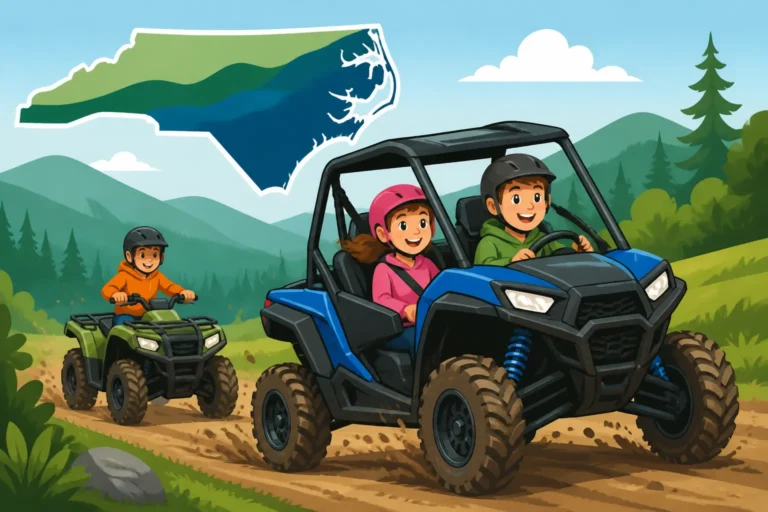
If you want to ride in North Carolina but don’t own a truck and trailer, the hardest part may be getting your machine to a legal trailhead. Most public OHV areas aren’t connected to roads you can simply ride on, so this guide explains the realistic ways to go trailer-free: rent near your destination, look for delivery options, or choose an appropriately road-registered machine and a route where road use is legal.
What “reachable without a trailer” really means
Most public trail systems are not connected by rideable roads
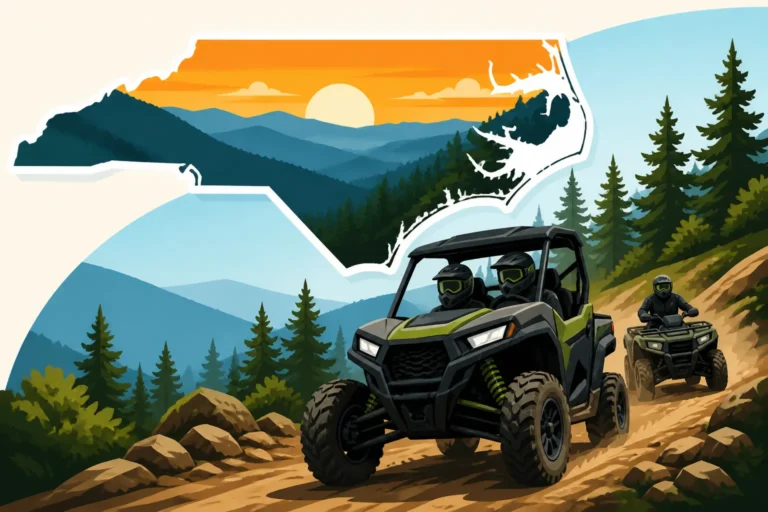
North Carolina has well-known riding areas in the mountains and Piedmont, including Brown Mountain, Badin Lake, and Wayehutta. But their trails generally begin beyond a staging area or forest access point. Getting there often means transporting your ATV or UTV to the trailhead rather than riding it from a nearby town, cabin, or campground.
That distinction matters because an ATV is not automatically legal on public roads just because the road leads to a trail. North Carolina restricts where ATVs can be ridden on public streets, and a machine that is not road-authorized cannot be used as a shortcut between lodging and an OHV area. The limited road-use exceptions do not turn a trail ride into an unrestricted road trip. For a broader overview, see [Where to Ride an ATV in North Carolina] and [Are ATVs Street Legal in North Carolina?].
For most riders, “without a trailer” therefore means choosing a different way to get the machine to the trail. You might rent one close to the riding area, ask whether a rental company can deliver it to your lodging or staging location, or visit a private off-road park with a rental arrangement. Each option depends on the provider’s policies and the park’s rules, so confirm the details before building your trip around them.
The three practical ways to skip hauling your own machine
Renting near the destination is usually the most straightforward option if you do not own a trailer. It avoids the need to tow, park, and secure your own machine, although you still need to confirm where the rental can be ridden and whether the required forest permit is included. Start with [Renting an ATV in North Carolina] or [Renting a Side-by-Side in North Carolina], then ask the outfitter directly about pickup location, trail access, and delivery.
A delivery arrangement may work if a rental company serves the area and is willing to bring the machine to your campground, cabin, or another approved location. Don’t assume delivery is available simply because a rental business is nearby. Ask where the machine can be dropped off, whether the drop-off point is legal and convenient for riding, and how the machine will be recovered if it has a mechanical problem or the trail closes.
The third option is a registered machine that qualifies for limited road use under North Carolina rules. This is not a dependable workaround for reaching every trailhead: the machine must meet the applicable requirements, and the particular road must be open to that kind of vehicle. Check the rules before planning a route around road access. The [North Carolina's Modified Utility Vehicle Route] explains a separate path for qualifying utility vehicles, but it does not make a standard ATV or side-by-side automatically street legal.
| Option | When it can work | What to confirm first |
|---|---|---|
| Rent near the riding area | You want to avoid towing your own machine | Pickup location, permitted riding area, permit coverage, and return requirements |
| Ask about delivery | A rental provider serves your lodging or staging area | Delivery availability, approved drop-off point, recovery arrangements, and extra charges |
| Use a road-authorized machine | The machine and the specific road both qualify for legal use | Registration status, equipment and insurance requirements, and the road’s restrictions |
| Choose a private off-road park | The park offers access or rentals that fit your trip | Whether rentals are available, where machines may ride, and whether advance booking is needed |
Trail areas to consider if you are not bringing your own trailer
Brown Mountain near Lenoir
Brown Mountain OHV Trail System is in the Grandfather Ranger District, within reach of Lenoir and other foothill communities. It is a public forest riding area rather than a trail network that you should assume is reachable from town on an ATV. If you are arriving without a trailer, the practical plan is to arrange a local rental or another authorized way to get a machine to the trailhead.
The terrain and distance from your lodging can make logistics more important than they first appear. A rental pickup point may not be at the trail entrance, and being close to Lenoir does not mean you can legally ride a machine along public roads from town. Before booking a room or rental, identify the trailhead you plan to use, check the route between that point and the rental location, and ask the provider how riders are expected to get to the riding area. Read [Brown Mountain OHV Trail System] and [North Carolina Rentals Near Boone] when comparing a mountain-based trip.
Forest access and trail conditions can change. Check the district’s current notices before you travel, especially after severe weather or during seasonal closures. Use a map to understand the location of trailheads and staging areas, but don’t treat a mapped road as permission to ride it. [North Carolina Forest Trail Maps] and [North Carolina Trail Conditions Before You Ride] can help you plan what to verify.
Badin Lake near Troy
Badin Lake OHV Trail Complex is in the Uwharrie area, near Troy. It can suit a weekend trip from parts of central North Carolina, but being within driving distance of the trail system does not eliminate the need to transport the machine. Riders who own an ATV typically need a trailer or another appropriate transport method to reach the staging area.
For a trailer-free visit, investigate rentals serving the Uwharrie area and ask whether machines must be picked up at a shop or can be delivered. Ask separately whether the rental includes the forest riding permit. A rental agreement and a forest permit are not necessarily the same thing, and it is better to know what you need before arriving at a trailhead. The practical questions include where you collect the machine, where you return it, what happens if the trail closes, and whether the provider allows the particular forest routes you intend to ride.
Badin Lake’s trails include varied terrain, so match the machine and your experience to the route rather than assuming every trail will suit every rental. Check the current map, trail ratings, and closure information before heading out. The [Badin Lake OHV Trail Complex] and [North Carolina Rentals Near Uwharrie] are useful starting points for sorting out both trail and transportation logistics.
Wayehutta near Cullowhee
Wayehutta OHV in Western North Carolina is another area to research if your trip is centered near Cullowhee or the surrounding mountain communities. As with other public forest OHV areas, proximity to lodging does not mean the trail system is connected to it by a route an ATV can legally ride. A machine may still need to be transported to the access point.
Because mountain roads and trail access can be affected by weather, closures, and local conditions, verify the route and operating status before you leave. If you are renting, ask the provider whether the machine is approved for Wayehutta and whether there are restrictions on transport, trail use, or return times. If the rental shop is not at the trailhead, get a clear plan for how you and the machine will reach the designated riding area.
For riders without a trailer, Wayehutta is most workable when the lodging, rental arrangement, and trail access have been coordinated in advance. Don’t plan to solve the transportation question after you arrive. See [Wayehutta OHV in Western North Carolina] and check the applicable forest notices before setting out.
How to plan a trailer-free riding trip
Choose the machine and access plan before booking lodging
Start by deciding whether you will rent, arrange delivery, or use a machine that is authorized for limited road use. Then choose a trail area that fits that plan. It is easy to find a cabin that looks close to a trail on a map, only to discover that there is no legal riding connection between the property and the forest access point.
When comparing rentals, ask questions that reveal the whole trip—not just the hourly or daily rental arrangement. Confirm the pickup and return locations, whether the rental company provides a trailer or delivery, what riding areas are permitted, and whether you need to supply your own helmet or other gear. Also ask what happens if a machine breaks down or a forest closure prevents you from using the planned area. For a more complete checklist, see [North Carolina Rentals That Include the Permit] and [North Carolina Rentals and Where You Cannot Go].
If you are considering riding a road-registered utility vehicle, verify the exact machine’s status and the exact road route before you count on it. A vehicle’s appearance, equipment, or ability to travel at road speed is not by itself proof that it can legally use public streets. The [North Carolina MUV Registration Requirements] can help clarify what to investigate, but local road restrictions still matter.
Check permits, trail status, and operating rules
Public forest riding areas may require a permit, and requirements can differ by forest or riding area. Confirm what applies to the location you are visiting and whether each machine needs its own permit. If a rental provider says a permit is included, ask what that covers and how you will show proof while riding. The overview [North Carolina Forest OHV Permits] can help you identify the questions to ask.
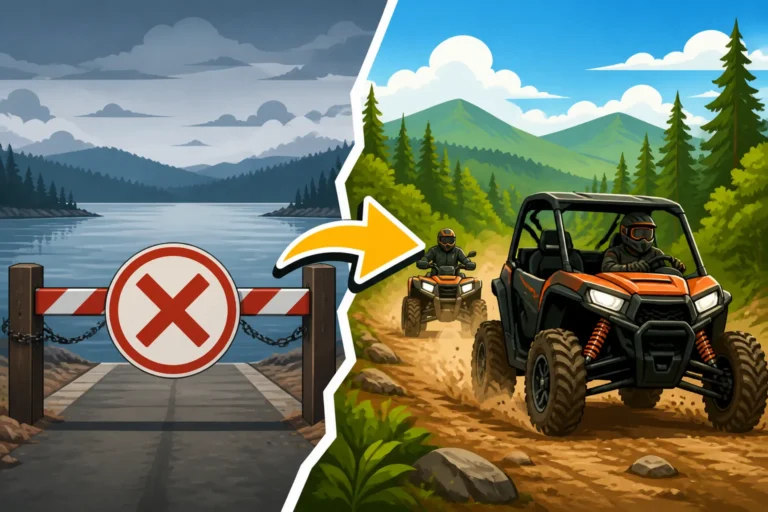
Before leaving home, check whether the trails are open and whether access roads, staging areas, or facilities are affected by a closure. A route that was open on an earlier trip may not be available now. It is sensible to have a backup plan—such as a different riding area or a flexible lodging arrangement—rather than assuming an open reservation guarantees an open trail.
A navigation app such as onX Offroad can help you review mapped roads and riding areas while planning. Use it as a planning aid, not as permission to ride every line shown on a map. Compare the route with official forest information, signs at the site, and the machine’s permitted-use rules. If a gate or posted notice conflicts with your planned route, follow the posted restriction.
Make the day workable without your own transport
A trailer-free ride still takes a little coordination. Confirm where the machine will be waiting, how you will reach the pickup point, and whether your lodging has a safe place to park the rental if it is delivered. If you are using a rental shop, allow enough time for paperwork, gear fitting, and instructions before the trail ride begins.
Keep essential details available offline or in a screenshot: the rental contact information, the trailhead location, the permit instructions, and the return plan. Mountain areas can have unreliable cell coverage, so don’t rely on being able to look everything up once you are on the trail. onX Offroad may help with offline navigation when you have prepared the map in advance, but it does not replace official closure information or local signs.
Finally, build your schedule around the machine’s return time and the possibility of slow travel. A difficult trail, a puncture, heavy rain, or a crowded staging area can turn a short ride into a longer day. Give yourself a margin rather than planning to arrive at the rental counter just before closing. If a private park better fits your transportation needs, compare its access and rental arrangements with forest riding options; [North Carolina's Private Off-Road Parks] is a useful place to start.
Common trailer-free planning mistakes
Assuming a nearby town means a nearby ride
A trail area may be described as being near a town, lake, or popular destination, but that usually describes its general location—not a legal route that connects the town to the trails. A few miles on a map can still mean a trailer, rental delivery, or a separate vehicle trip. Confirm the access route with the rental provider and the land manager rather than judging by distance alone.
Likewise, don’t assume that a campground or cabin permits riding from the property. Private land rules, road restrictions, and forest boundaries are separate issues. If your lodging host says the trails are “close,” ask whether that means a short drive to the trailhead or a legal ride directly from the property.
Treating map lines as permission
A mapped road or trail may be closed, restricted to another vehicle type, or outside the area where motorized riding is allowed. Apps, including onX Offroad, can support route planning, but check official maps and on-the-ground signs before riding. A line on a screen should never override a locked gate or closure notice.
For public forests, stay on designated routes and respect posted limits. Avoid cutting across private property or riding on an unmarked connector because it seems like the quickest way to reach a trail. A convenient shortcut can create a trespass or safety problem and may put access for other riders at risk.
Leaving permits and return logistics until the last minute
Don’t wait until you reach the staging area to learn that you need a separate permit, that a trail is closed, or that the rental must be returned somewhere else. Before you depart, confirm the permit requirement, the machine’s approved riding area, the latest trail status, and the shop’s return process.
A small checklist can prevent most avoidable surprises:
- Confirm the trail area is open and appropriate for your machine.
- Confirm where the rental is picked up or delivered.
- Ask whether a forest permit is included or must be obtained separately.
- Save directions, contacts, and maps for offline use.
- Clarify the return time and breakdown or recovery procedure.
- Keep a backup plan in case weather or a closure changes the day.
The simplest trailer-free trip is the one where transport is settled before you book the rest of the weekend. For many riders, that means renting near Brown Mountain, Badin Lake, or Wayehutta and arranging a clear, legal way to reach the designated riding area—not riding an ATV on public roads to get there.
Disclaimer
This article is for general informational purposes only and does not constitute professional advice. Laws, prices and regulations vary by location and change over time. Consult a qualified professional for guidance on your specific situation.