Why Hunting and Trapping Sit Outside the Chapter
It can feel incredibly confusing when you're trying to figure out what you can and can't do with your ATV or UTV in North Carolina, especially when you're planning a hunting or trapping trip. You've heard whispers that these activities somehow operate outside the typical motor vehicle laws, and you're left scratching your head, wondering if your machine needs to be titled or if you can even cross a public road. This guide is going to cut through that confusion, explaining why North Carolina’s rules for hunting and trapping with ATVs and UTVs are treated a bit differently, what that actually means for you, and where you still need to be extra cautious.
Understanding North Carolina's ATV Laws: The General Picture
North Carolina has a clear stance on ATVs and UTVs: they are, by their very design and definition, off-road machines. This isn't just a suggestion; it's baked into the very fabric of our state's motor vehicle laws. For many riders, this general rule is the source of endless frustration. You buy a powerful machine, capable of incredible feats, and then find yourself restricted to specific trails or private land, unable to simply drive it down the road to your buddy's house or the local store. It feels counterintuitive when you see tractors and other farm equipment on the roads, yet your nimble ATV is largely confined.
The Core Restriction: Off-Road Only
The foundational principle for ATVs and UTVs in North Carolina is that they are intended for off-road use. This means places like designated OHV trails in our national forests, private land where you have permission, or specialized off-road parks. The reason behind this isn't arbitrary; it's rooted in safety and the inherent design of these vehicles. ATVs and UTVs lack many of the safety features, like sealed cabins, airbags, or even traditional turn signals and brake lights in some cases, that are standard on street-legal vehicles. They're built for uneven terrain, mud, and climbing, not for sharing asphalt with cars and trucks going 55 mph. Their suspension, tire design, and handling characteristics are simply not suited for paved roads, making them less stable and more unpredictable in traffic.
When we talk about "off-road," we're generally referring to anything that isn't a publicly maintained road, street, or highway. This includes trails, fields, timber cuts, and even unimproved private drives. What it emphatically doesn't include are the roads you drive your car on every day—the ones with lane markers, speed limits, and traffic signs. This distinction is crucial, because misunderstanding it can lead to hefty fines, vehicle impoundment, and even serious accidents. Many riders get tripped up, thinking a gravel road or a seldom-used public lane qualifies as "off-road," but if the public has access and it's maintained by the state, county, or municipality, it's considered a public road.
Exceptions to the Rule: When ATVs Can Touch Pavement
Now, while the general rule is "off-road only," North Carolina, like many states, recognizes that life isn isn't always lived entirely off the pavement. There are specific, narrow exceptions where an ATV or UTV can legally touch or even travel on a public road. These aren't loopholes to exploit; they are carefully defined carve-outs designed for practical necessity or specific types of vehicles. For instance, you might be able to [North Carolina Rules for Crossing a Road] if you're moving from one section of private property to another, provided you do it safely and quickly, abiding by traffic laws. This isn't a free pass to cruise; it's a very limited maneuver.
Another common exception, which we'll delve into further, is for bona fide farm use. Farmers often need to move their machines from one field to another across a road, or drive them short distances to perform agricultural tasks. The law makes allowances for this, recognizing the utility of these machines in a working landscape. Then there's the specific category of a [North Carolina's Modified Utility Vehicle Route], or MUV, which is a highly modified UTV that can be registered and plated for street use, but it has very strict requirements for engine size, dimensions, and equipment. Lastly, some specific areas, like certain stretches of ocean beach, might have localized rules allowing ATV use. It's vital to remember that each of these exceptions comes with its own set of conditions and limitations. They don't negate the primary rule but rather provide very specific contexts where it doesn't apply.
Deciphering North Carolina's Chapter 20: Motor Vehicles
When you're trying to understand the nitty-gritty of ATV laws in North Carolina, you'll often hear references to "Chapter 20." This isn't some obscure legal text; it's the core of our state's motor vehicle laws. It’s a massive collection of statutes that dictates everything from how you [The North Carolina DMV and Off-Road Machines] to the rules of the road for cars, trucks, and motorcycles. It can feel like a labyrinth, with definitions, exceptions, and specific requirements that seem to apply differently depending on the type of vehicle.
What Chapter 20 Covers (and Doesn't Cover for ATVs)
Chapter 20 of the North Carolina General Statutes is comprehensive. It lays out the rules for vehicle registration, driver licensing, vehicle safety inspections, traffic laws, and even things like vehicle abandonment and salvage titles. For standard motor vehicles, it's the ultimate authority. When it comes to ATVs and UTVs, Chapter 20 defines them, primarily, as "off-highway vehicles." This classification immediately sets them apart from typical cars and trucks and dictates that most of the road-specific provisions of Chapter 20 don't apply to them when they are used off-road.
However, Chapter 20 isn't entirely silent on ATVs. It's where you'll find the optional [North Carolina ATV Title Paperwork] process described, allowing owners to prove ownership even if registration isn't required. It also dictates what happens if you're involved in an accident with an ATV on public property or if you need to transport one on a public road (which usually means trailering it). So, while Chapter 20 generally limits ATVs to off-road environments, it still has an overarching influence on their legal status, ownership, and how they interact with public infrastructure. It's not a complete hands-off approach; rather, it’s a framework that acknowledges the unique nature of these machines while still ensuring a degree of order and safety.
The Legislative Intent Behind Separating Use Cases
You might wonder why the legislature bothered to create these distinctions in the first place. Why not just have one set of rules for all vehicles? The answer lies in recognizing practical realities and the diverse ways vehicles are used in a modern society. Legislators understand that an ATV isn't just a toy; it's a tool. For many, it's an indispensable piece of equipment for work, whether that's farming, logging, or, indeed, hunting and trapping. If every single road-use rule applied indiscriminately to an ATV being used to check fences on a farm or retrieve a downed deer, it would create an impossible burden for many individuals and industries.
The legislative intent behind separating these use cases is often about striking a balance between public safety and practical utility. For activities like farming, there's a clear economic and societal benefit to allowing limited road use. The same logic often extends to hunting and trapping, which are long-standing traditions and, for some, vital parts of managing land and resources. By creating specific carve-outs, the law aims to facilitate these activities without undermining the general principles of road safety that Chapter 20 is designed to uphold. It acknowledges that the purpose for which a vehicle is being used can fundamentally alter the applicable regulations, allowing for more nuanced and realistic governance.
The Hunting and Trapping Carve-Out: Beyond the Road Rules
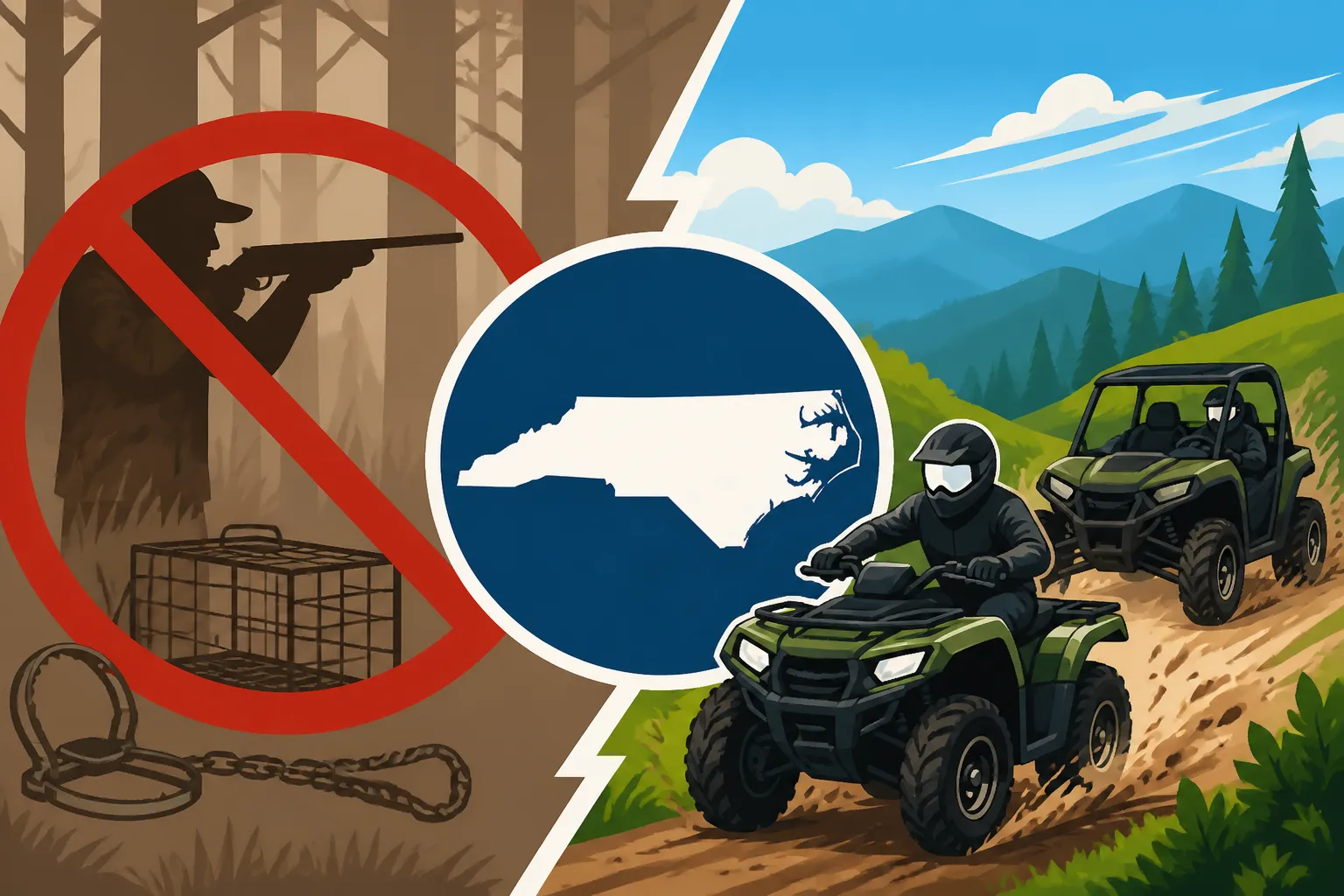
This is where things get particularly interesting for North Carolina ATV and UTV owners who are also avid hunters or trappers. You’ve likely heard it said that "hunting and trapping sit outside the chapter," or that "Chapter 20 doesn't apply." This isn't entirely a myth, but it's often misunderstood. It doesn't mean you can do anything you want with your ATV while hunting; it means that the specific provisions of Chapter 20 related to motor vehicles on public highways generally step aside when your ATV is being used strictly for legitimate hunting or trapping purposes on authorized land.
The Specific Language: What the Law Actually Says
North Carolina General Statute § 20-4.01, which defines many terms related to motor vehicles, includes definitions for "all-terrain vehicle" and "utility vehicle" (though the latter is more commonly referred to as UTVs by riders). Crucially, elsewhere in Chapter 20, or in other related chapters like Chapter 113 (Conservation and Development) which governs wildlife, you'll find language that explicitly exempts vehicles used for certain activities from specific provisions. When people say "hunting and trapping sit outside the chapter," they're often referring to a legislative intent or specific wording that makes clear that the state's stringent rules for operating motor vehicles on public roads are not meant to impede the lawful use of ATVs and UTVs for hunting and trapping on private property or designated game lands.
This isn't an outright exemption from all laws, but rather from the specific highway use regulations of Chapter 20. It acknowledges that an ATV being used to haul a tree stand or retrieve a deer is serving a utility purpose that doesn't fit neatly into the "recreational vehicle on a public road" category. It means that the Department of Motor Vehicles (DMV) isn't looking to ticket you for not having turn signals on your ATV when you're deep in the woods, tracking game. The lawmakers understand that these machines are tools, and when used as such within the context of legal hunting and trapping, they operate under a different set of expectations regarding road legality. This understanding also ties into the allowance for [North Carolina Rules for Riding While Hunting].
Practical Implications for Hunters and Trappers
For hunters and trappers, this separation is incredibly practical. It means you can use your ATV or UTV as it's intended: as a rugged utility vehicle to access remote hunting blinds, scout new areas, transport gear, check traps, or haul out harvested game. Imagine trying to drag a large deer out of a dense thicket without the aid of your UTV—it would be an arduous, if not impossible, task. This carve-out lets you perform these necessary functions without fear of violating a road-use statute, provided you are on private land with permission or on public game lands where ATV use is specifically authorized for these purposes. You can easily outfit your machine with durable accessories from companies like SuperATV, knowing you'll primarily be using it in rough, off-road conditions.
However, a critical distinction must be made: this doesn't grant you permission to drive your ATV down the main highway to get to your hunting property, even if your ultimate destination is a hunting stand. You're still expected to trailer your machine to the hunting location if it involves public roads. Once you are on the private land or a designated game land where ATV use is permitted for hunting, then the specific road-use rules of Chapter 20 generally recede. Instead, you'll be governed by the rules set by the landowner, the [North Carolina Rules for Riding a Game Land], and the North Carolina Wildlife Resources Commission (NCWRC) regarding hunting methods and vehicle use. Understanding this nuance can save you a lot of trouble and ensures you're [Riding While Hunting Outside the Chapter] legally.
What This Exception Doesn't Mean: Crucial Distinctions
While the "outside the chapter" concept for hunting and trapping is a significant relief for many North Carolina ATV and UTV owners, it's absolutely crucial not to misinterpret it as a free pass. This particular carve-out is narrowly defined and doesn't negate other important laws or responsibilities. It's a common trap for riders to hear "you're exempt" and then assume all rules go out the window, leading to unintended legal trouble or dangerous situations.
Not a License for Public Road Use
Let's be crystal clear: the fact that hunting and trapping activities operate outside some Chapter 20 road rules does not mean you can legally drive your ATV on public roads and highways to get to your hunting spot. The moment your wheels touch a publicly maintained road—unless it's for a quick, legal [North Carolina Rules for Crossing a Road] or as a registered [North Carolina's Modified Utility Vehicle Route]—you are generally subject to Chapter 20's full force, and you'll likely be in violation. The intent of this exemption is to allow the use of the machine for the activity on appropriate land, not to facilitate public road travel to get there.
Think of it this way: you wouldn't drive a bulldozer down a city street, even if you were using it for an essential construction project once you got to the site. You'd trailer it. The same logic applies here. If you're caught driving your ATV on a public road, even with a rifle in the gun rack and blaze orange on, you could face fines, have your machine impounded, and possibly even lose your driving privileges if the infraction is serious enough. This is one of the most common misunderstandings, and it's essential to plan your transport accordingly. You'll need to trailer your ATV or UTV to the private land or designated game land, where you then have the freedom to use it for your hunting or trapping activities.
Private Land and Game Land Rules Still Apply
Just because the road-specific statutes of Chapter 20 might not govern your ATV use for hunting doesn't mean there are no rules. Far from it. When you're on private land, the absolute golden rule is [North Carolina Landowner Permission Rules]. Without explicit permission, you are trespassing, and that's a serious offense, regardless of whether you're hunting or just joyriding. Landowners have the right to set their own rules for vehicle use on their property, and you must respect those. They might restrict night riding, mandate certain safety gear, or limit where you can drive.
Similarly, if you're hunting or trapping on a public game land or in a national forest, you are operating under the strict regulations of that specific land management agency. These rules cover everything from designated ATV trails (many game lands do not allow off-trail vehicle use at all) to operating hours, speed limits, and even [North Carolina Spark Arrester Requirement]. These are not Chapter 20 rules, but they are equally binding. You'll need to check with the NC Wildlife Resources Commission (NCWRC) or the U.S. Forest Service for the specific area you plan to visit. Ignorance of these rules is no excuse, and violations can lead to citations, loss of hunting privileges, and fines. So, while you might not need a speedometer, you might definitely need a spark arrester if you're on federal forest land, and a robust skid plate from SuperATV could save your undercarriage on rough, managed trails.
Safety and Equipment Requirements Still Matter
While you might be exempt from certain road-legal equipment requirements like turn signals or a horn when using your ATV for hunting off-road, fundamental safety and some equipment rules often still apply. For instance, [North Carolina Helmet Law for ATV Riders] and eye protection rules, particularly for riders under 18, are generally in force regardless of the activity or location. These rules are in place to protect riders from serious injury, and they don't magically disappear because you're retrieving a deer.
Furthermore, if you're on a national forest, even for hunting, specific equipment like a working spark arrester is usually mandatory to prevent wildfires. These regulations are often found in the rules specific to the land management agency, not necessarily Chapter 20. It’s also just plain common sense to operate your machine safely. Don't overload it with game, avoid excessive speeds on uneven terrain, and always be aware of your surroundings, especially during hunting season when others might be in the area. The "spirit" of safe and responsible operation always applies, even when the letter of some road laws steps aside.
Navigating the Intersections: Chapter 20 and Wildlife Regulations
The legal landscape for ATV use in North Carolina, especially when hunting or trapping, can feel like a complex map with different jurisdictions and overlapping authorities. It's not simply a matter of "Chapter 20 applies" or "it doesn't apply." Instead, it's a dynamic interplay between different legal frameworks, each designed to manage a specific aspect of our environment or public safety. Understanding this intersection is key to staying within the bounds of the law and enjoying your outdoor pursuits responsibly.
The Role of the North Carolina Wildlife Resources Commission (NCWRC)
While Chapter 20 of the General Statutes deals with motor vehicles in a broad sense, the North Carolina Wildlife Resources Commission (NCWRC) is the primary authority when it comes to hunting, trapping, fishing, and boating. This means that once you move beyond the public roads and onto game lands, private hunting preserves, or even during game retrieval on private property, the NCWRC's regulations take precedence regarding the activity itself and how vehicles are used within that context. They are the ones who publish the annual hunting and fishing regulations, which often contain specific rules for vehicle use on designated game lands.
For example, the NCWRC regulations will dictate specific trails where ATVs are permitted on game lands, the times of day you can use them, and any restrictions on carrying firearms on an ATV. They might even have rules about retrieving downed game with a vehicle, stipulating that you can only do so on designated roads or trails. These rules are designed to manage wildlife populations, ensure fair chase, prevent habitat damage, and maintain safety among hunters. So, while Chapter 20 may not be concerned with your ATV's turn signals in the woods, the NCWRC is very much concerned with whether you're using your ATV in a way that respects wildlife and other users.
When Different Laws Overlap: A Hypothetical Scenario
Let's paint a picture to illustrate this complex overlap. Imagine you're an avid hunter in North Carolina, and you own a robust UTV, perhaps equipped with a heavy-duty winch and storage solutions from SuperATV, perfect for navigating the rough terrain of the Uwharrie National Forest. Your goal is to reach a remote deer stand on private land that you have permission to hunt, which abuts a small segment of a county-maintained gravel road, then extends deep into the woods.
Here's how the laws might intersect:
- Driving to the Area: You cannot simply drive your UTV on the paved state highway to get to the county gravel road. Chapter 20 rules for public road use would apply, and your UTV, not being a registered MUV, would be illegal on that highway. You'd need to trailer your UTV to a parking spot near the private land or the gravel road.
- Crossing the County Gravel Road: If your private land is bisected by that county gravel road, and you need to cross it to get from one section of your property to another, the [North Carolina Rules for Crossing a Road] would kick in. You'd need to do so quickly, safely, and yield to any traffic, just like a pedestrian or a slow-moving farm vehicle.
- On Private Land for Hunting: Once you are entirely on the private land, actively using your UTV to carry your gear, scout, or retrieve a deer, the primary road-use provisions of Chapter 20 largely step aside. You're using your machine as a tool for hunting, and the specific equipment requirements for road vehicles don't apply. However, you'd still be subject to the landowner's specific rules for vehicle use.
- On Adjacent Game Land: If your hunting area extends into an adjacent game land, then the NCWRC's specific regulations for that game land would apply. This might mean you can only use your UTV on designated administrative roads or trails, only during certain hours, and you'd definitely need any required permits. [North Carolina Rules for Riding While Hunting] on these lands are very specific and supersede any general "outside the chapter" interpretation.
- DWI Rules: Regardless of where you are—public road, private land, or game land—the state's DWI rules for operating a vehicle still apply. [North Carolina DWI Rules for ATV Riders] are taken seriously, and operating an ATV under the influence is a major offense. Similarly, [North Carolina Helmet Law for ATV Riders] still protects minors.
This example clearly shows that "outside the chapter" isn't an all-encompassing blanket exemption, but rather a specific relaxation of certain rules for a specific purpose, nested within a broader framework of laws.
Why This System Exists: Balancing Recreation, Conservation, and Utility
This intricate system of overlapping laws, with Chapter 20 making allowances for specific uses and the NCWRC stepping in to regulate wildlife-related activities, exists to achieve a delicate balance. On one hand, North Carolina values the utility of ATVs and UTVs for legitimate purposes like farming, logging, and, critically, hunting and trapping. These activities are deeply ingrained in the state's heritage and economy, and the law seeks to facilitate them where possible. It recognizes that for many, these machines are essential tools, not just recreational toys.
On the other hand, the state has a responsibility to ensure public safety on its roads, protect its natural resources, and manage wildlife populations sustainably. This means that while an ATV might be a workhorse in the woods, it's generally not suited for high-speed public highways. Similarly, while hunters need access, that access cannot come at the cost of destroying fragile ecosystems or interfering with other outdoor enthusiasts. By having different chapters and agencies govern different aspects, North Carolina aims to create a regulatory environment that is both pragmatic for its citizens and protective of its collective interests. It allows for specialized regulation by those agencies best equipped to understand and manage their specific domains, leading to a more effective and nuanced legal framework overall.
Here's a table to help clarify the distinctions:
| Feature | General ATV/UTV Use (Recreational/Public Roads) | ATV/UTV Use for Hunting & Trapping (on Private/Game Lands) |
|---|---|---|
| Primary Legal Chapter | NCGS Chapter 20 (Motor Vehicles) | NCGS Chapter 113 (Conservation & Development), NCWRC Regulations, Landowner Rules |
| Road Legality | Generally NOT street legal; limited road crossings, MUV route exceptions | Generally NOT street legal on public roads; exemption applies to use on private/game lands |
| Registration | Not required for off-road use; optional [Titling an ATV in North Carolina Is Optional] | Not required for off-road use; optional titling to prove ownership still available |
| Equipment (Road) | Turn signals, brake lights, horn, speedometer usually NOT required, unless MUV | Turn signals, brake lights, horn, speedometer generally NOT required |
| Safety Equipment | [North Carolina Helmet Law for ATV Riders] & eye protection (under 18) applies | [North Carolina Helmet Law for ATV Riders] & eye protection (under 18) applies |
| Land Access | Designated OHV trails, private land with permission | Private land with landowner permission, designated Game Lands (with specific NCWRC rules) |
| Public Road Travel | Generally prohibited; must trailer machine | Generally prohibited; must trailer machine to/from hunting location |
| DWI/BUI Laws | Fully applicable | Fully applicable, even off-road |
| Purpose | Recreation, utility, sport | Utility for specific wildlife-related activities (e.g., game retrieval, scouting, trap checks) |
In the end, understanding why hunting and trapping sit outside the typical motor vehicle chapter in North Carolina is about recognizing the utility of these machines. It's a pragmatic approach to allow essential activities to continue without being overly burdened by regulations designed for a different context. However, this flexibility comes with the responsibility to know and abide by the other layers of law—those governing property rights, wildlife management, and common-sense safety. Always check the specific rules for the land you plan to use, respect private property, and operate your machine safely and responsibly, no matter the activity.
Disclaimer
This article is for general informational purposes only and does not constitute professional advice. Laws, prices and regulations vary by location and change over time. Consult a qualified professional for guidance on your specific situation.