North Carolina Rules for Towing With a UTV
It's a common sight across North Carolina to see folks using their UTVs for all sorts of tasks beyond just hitting the trails. From hauling firewood on the farm to moving brush around a large property, these machines are incredibly versatile. But when it comes to towing anything with your UTV, especially if you even think about touching a public road, the rules can feel as clear as mud after a good rain. This guide is going to untangle North Carolina's regulations on towing with a UTV, helping you understand where you can tow, what you can tow, and what you absolutely should avoid doing to stay on the right side of the law.
Understanding UTVs and North Carolina Law
First things first, let's clear up some confusion about how North Carolina actually views your UTV. While many of us use "ATV" and "UTV" interchangeably in casual conversation, the state's legal definitions can be a bit more nuanced. For many purposes, a UTV falls under the broader umbrella of "all-terrain vehicle," but its larger size and different design sometimes set it apart. The important distinction is usually whether it's intended for off-road use versus something that could potentially be street legal.
North Carolina, famously, doesn't require registration for off-road ATVs or UTVs used solely for recreation on private land. This is fantastic for enthusiasts, but it also means there isn't a clear "ATV registration" pathway to get your UTV onto public roads to tow things. Without that registration, and the implied inspections and safety standards that come with it, towing on public asphalt becomes a really tricky proposition. For most riders, this means your UTV's towing adventures are largely confined to private property or designated off-road areas. To delve deeper into how the state categorizes these machines, check out [What North Carolina Counts as an ATV]. If you're wondering why you don't have to register your recreational machine at all, you might find [Why North Carolina Has No ATV Registration] an interesting read.
The "Street Legal" Conundrum for UTVs
This is the biggest hurdle when you start thinking about towing with your UTV on public roads: most UTVs are simply not street legal in North Carolina. It's a tough pill to swallow for many, especially those who see their UTVs as perfectly capable utility vehicles that could easily manage a small trailer to the hardware store or across town. But the law is clear: unless your UTV undergoes a significant transformation and is registered as a Modified Utility Vehicle (MUV), it's not welcome on the pavement beyond a quick, direct crossing.
The MUV classification is the only official path in North Carolina to make a UTV street legal. This isn't just a matter of slapping a license plate on it; it involves meeting a stringent set of requirements for engine size, physical dimensions, and safety equipment. For instance, an MUV needs an engine over 2,400cc, a length no more than 142 inches, and a width no more than 58 inches. It also needs to be capable of at least 40 mph. For a detailed breakdown, you'll want to read [What Makes a Machine an MUV in North Carolina]. This classification is complex, and many standard side-by-sides simply don't fit the bill, which you can learn more about in [Why Most Side-by-Sides Miss the Mark]. Understanding [North Carolina's Modified Utility Vehicle Route] is crucial if you ever hope to tow with your UTV on a public road.
Farm Use Exemptions and Towing
Now, there's a big exception that often saves the day for our rural friends and those with substantial acreage: the farm use exemption. North Carolina is an agricultural state, and its laws reflect that reality by providing specific allowances for ATVs and UTVs engaged in legitimate farming operations. This is a common way you might see a UTV towing on a public road legally.
If your UTV is being used for "bona fide farm purposes" — think moving hay bales, hauling tools between fields, or transporting feed – then it may be permitted on certain public roads. The key here is "bona fide farm purposes" and usually, the roads must be local, unpaved, or low-traffic routes connecting parts of the farm or accessing supplies. You certainly won't be cruising down the interstate with a loaded utility trailer behind your UTV under this exemption. The intention is to facilitate agricultural work, not general transportation. If you're unsure what exactly counts as "farm business" or how far you can venture, the article [Riding a North Carolina Street on Farm Business] offers some vital specifics. This exemption is incredibly helpful for farmers, but it's not a blanket pass for everyone. To truly understand the limits and scope, consider checking out [North Carolina's Farming Operations Exception].
Towing on Private Land and Designated Trails
For most UTV owners, the vast majority of their towing activity will (and should) occur on private property or within designated off-road trail systems. This is where UTVs truly shine as workhorses, and where the legal headaches of public road use simply melt away. When you're on your own land, or land where you have explicit permission, you have a lot more freedom to utilize your UTV's towing capabilities without worrying about state highway patrol.
Think about the endless tasks a UTV can tackle around a homestead or hunting club. You might be pulling a small utility trailer loaded with firewood you just split, dragging a food plot cultipacker across a field, or using a small sprayer for weed control. Perhaps you're moving heavy gardening supplies, clearing storm debris, or hauling game back to the camp. In these scenarios, the UTV is a fantastic tool, and as long as you have the landowner's permission, you're generally good to go. For more on the importance of permission, read [Riding Private Ground in North Carolina].
Now, when it comes to designated OHV trail systems like those in the Uwharrie National Forest or at Badin Lake, towing is usually not permitted. These trails are designed for recreational riding, often with narrow passages, tight turns, and challenging terrain that isn't suitable for a UTV with a trailer in tow. Plus, allowing trailers could cause excessive trail damage and congestion. Always check the specific rules of any trail system before you go; some may have exceptions for maintenance vehicles or very specific, small attachments, but generally, assume no towing. If you're looking for places to ride, [Where to Ride an ATV in North Carolina] is a great resource, but remember to always verify the rules about towing.
Safe Towing Practices Off-Road
Just because you're off-road and away from the watchful eye of a state trooper doesn't mean you can throw caution to the wind. Safety should always be your number one priority, especially when towing with a UTV. These machines are incredibly capable, but they also have limits that, if exceeded, can lead to dangerous situations or costly damage.
One of the most critical factors is understanding your UTV's manufacturer-specified towing capacity. Every UTV has a maximum weight it can safely tow, often listed in your owner's manual. Exceeding this limit puts immense strain on your engine, transmission, brakes, and suspension. It can lead to overheating, premature wear, and a significant loss of control. Think about how much that load you're pulling actually weighs, and err on the side of caution.
Another consideration is the type of hitch you're using. Most UTVs come with a standard 2-inch receiver that can accommodate a ball hitch, perfect for small utility trailers. Some lighter tasks might use a simple pin hitch. Ensure your hitch is rated for the load and securely attached. Beyond the hitch, proper load distribution is vital. Too much tongue weight can lift the front of your UTV, reducing steering control and traction. Too little can cause the trailer to sway violently. Distribute the weight evenly over the trailer axle, with a slight bias towards the front (tongue).
Finally, consider the terrain. Towing on flat, stable ground is one thing, but adding a heavy load on steep inclines, declines, or loose surfaces completely changes the dynamics. Your UTV's braking power will be severely diminished, and traction will be harder to maintain. Always drive slower, allow more braking distance, and be extra careful on turns when you're towing.
Essential Gear for UTV Towing
To tow safely and efficiently with your UTV, you'll want to equip yourself with the right gear. It's not just about hooking up a trailer; it's about making sure everything is secure, visible, and capable of handling the job.
First up, a robust hitch and receiver are non-negotiable. Most UTVs come with a factory receiver, but if you're doing a lot of heavy hauling or want specialized hitches, aftermarket options are plentiful. Companies like SuperATV offer a range of hitches, including heavy-duty receiver hitches and specialty tow hooks, designed to integrate seamlessly with various UTV models and increase your towing versatility. Make sure the ball mount and hitch ball you choose are appropriately rated for your anticipated load.
Next, trailer lights and reflectors are crucial, even for off-road use, especially if you're anywhere near dusk or dawn, or operating on a large property with other vehicles. While not legally required for off-road towing, they vastly improve safety and visibility. Many small utility trailers come equipped with these. Always check that they're working before you head out.
Safety chains or straps are absolute must-haves. These act as a backup in case your primary hitch connection fails. They should be crossed under the trailer tongue to form a cradle, preventing the tongue from dropping to the ground if it detaches. This helps keep the trailer in line with your UTV.
Lastly, consider your tires. Stock UTV tires might be fine for light towing, but if you're regularly hauling heavy loads, especially on soft or uneven ground, you might benefit from tires with a more aggressive tread pattern for better traction and load-carrying capacity. Also, having adequate mirrors on your UTV is a smart move if your towed load is wide or obscures your rear view, allowing you to monitor your trailer and surroundings safely. SuperATV also makes durable mirrors that can be a great addition for improved visibility when you're maneuvering with a trailer.
When Towing a UTV on Public Roads (Not with a UTV)
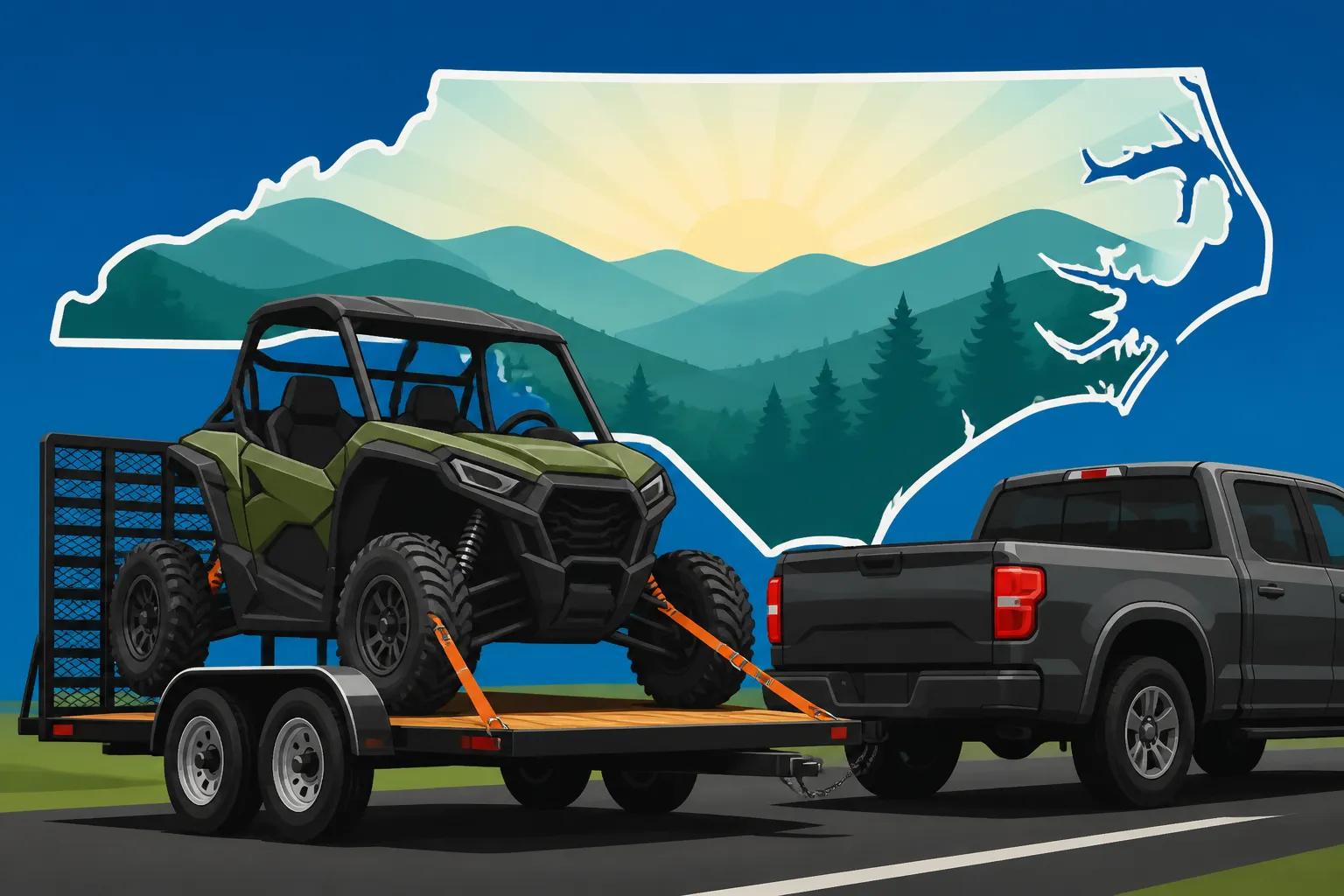
Here's a point of common confusion that we absolutely need to clarify: this article is about towing something with your UTV. What many people often ask about is trailering their UTV behind a truck or other tow vehicle on public roads. These are two very different scenarios with distinct legal frameworks. For the vast majority of UTV owners, transporting their machine on public roads means loading it onto a trailer and pulling that trailer with a highway-legal truck or SUV.
Unless your UTV is a legally registered MUV (which, as we discussed, is rare), you cannot legally drive it on public roads to get to your favorite trail, to visit a friend, or to tow anything. Instead, you'll need a dedicated trailer. This is a standard practice for riders across the state, from the mountains to the coast. You'll load your UTV onto a utility trailer or a specialized ATV/UTV trailer and then hitch that trailer to your truck or SUV. This ensures your UTV travels safely and legally to its destination. For more on what happens if you get caught transporting your machine incorrectly, see [Getting Stopped While Towing a Quad on a Trailer].
Securing Your UTV for Transport
Even when trailering your UTV behind a truck, proper technique is essential. You've invested a lot in your machine, and the last thing you want is for it to come loose on the highway.
The most critical step is using the right tie-downs. Ratchet straps are generally preferred over cam buckle straps for their superior holding power. You'll want at least four tie-downs, one at each corner of your UTV. Secure them to strong, non-moving points on the UTV's frame (avoid suspension components or A-arms that allow movement) and to sturdy anchor points on the trailer.
Compress the suspension slightly when you tighten the straps. This prevents the UTV from bouncing and loosening the straps during transit. Once secured, give the UTV a good shake. It should feel like it's part of the trailer, with minimal movement.
Also, ensure your trailer tires are properly inflated and in good condition, and that all trailer lights are functioning before every trip. A blown taillight or a flat tire on the trailer can turn a simple trip into a frustrating roadside stop. Properly distributing the UTV's weight on the trailer, usually a little forward of the axle, helps maintain stability during towing.
Legalities of Trailering in North Carolina
When you're trailering your UTV, it's the trailer and the tow vehicle that are subject to North Carolina's road laws, not the UTV itself. This means:
- Trailer Registration: Any utility trailer that weighs more than 4,000 pounds (or has a gross weight exceeding that) must be registered with the North Carolina DMV. Many smaller ATV/UTV trailers might fall under this threshold, but it's always best to check your trailer's Gross Vehicle Weight Rating (GVWR) and err on the side of caution.
- Trailer Lights and Safety Chains: Your trailer must have functioning taillights, brake lights, turn signals, and often side marker lights, all connected to your tow vehicle. Safety chains are also mandatory, providing a backup connection between the trailer and tow vehicle.
- Tow Vehicle Requirements: Your truck or SUV must be properly licensed and insured, and capable of safely towing the combined weight of your trailer and UTV.
- Driver's License: You need a valid driver's license for the tow vehicle you're operating.
Different rules can sometimes apply to trailers specifically hauling agricultural equipment, but for recreational UTV transport, assume standard trailer laws apply.
The Rare Case of an MUV Towing on Public Roads
Okay, let's circle back to the unicorn: the UTV that has successfully jumped through all the hoops and become a legally registered Modified Utility Vehicle (MUV) in North Carolina. If you're one of the few who has gone through this process, then congratulations – you can legally tow with your MUV on certain public roads. However, even with an MUV plate, there are still significant limitations and responsibilities.
Firstly, MUVs are generally restricted to roads with a posted speed limit of 55 mph or less. So, while you might be able to pull a small trailer down a rural highway, interstates and major four-lane roads are still off-limits. Your MUV also has to meet all the standard vehicle equipment requirements, just like a regular car or truck. This means working headlights, taillights, brake lights, turn signals, a speedometer, rearview mirrors, and seat belts. If you're towing, you'll particularly appreciate a good set of [North Carolina MUV Mirror Requirement] compliant mirrors, and functional [North Carolina MUV Turn Signal Requirement] is critical for signaling your intentions. Your MUV needs to have a [North Carolina MUV Speedometer Requirement] to ensure you're adhering to legal speeds, especially when towing. The detailed dimensional requirements for an MUV are outlined in [North Carolina MUV Dimension Requirements].
Crucially, any trailer you're towing with your MUV will also be subject to North Carolina's trailer laws, meaning it needs proper lighting, safety chains, and potentially registration depending on its weight. Just because your MUV is legal doesn't mean your trailer gets a free pass!
MUV Towing Capacity and Road Safety
Even with a street-legal MUV, you must respect its mechanical limitations when towing on public roads. A UTV, even a beefed-up MUV, is not a full-size pickup truck. It has a significantly lower towing capacity. Always adhere strictly to the manufacturer's recommended towing limits. Overloading your MUV, especially on public roads, creates serious safety hazards.
Towing affects braking, acceleration, and handling. Your stopping distances will increase dramatically with a loaded trailer. Your MUV will accelerate slower, making merging or passing (if allowed on that road type) more challenging. The overall stability of the vehicle changes. Always drive defensively, maintain greater following distances, and anticipate turns and stops much further in advance. You need to ensure your MUV is equipped with the necessary safety features, like a parking brake, to secure your vehicle and load when stopped.
Insurance and Liability Considerations
Since an MUV is registered for road use, it's also legally required to carry liability insurance, just like any other motor vehicle. This is a critical piece of the puzzle. [Insurance a Registered MUV Carries] is a topic worth exploring further. This insurance typically covers damages or injuries you might cause to others while operating your MUV on public roads.
However, when you add towing into the mix, liability can become more complex. If an accident occurs while you're towing a trailer, your MUV's liability policy will likely cover the damage you cause with the MUV itself, and potentially the trailer too, but it's vital to confirm with your insurance provider. You need to understand if there are any specific exclusions or limitations when towing. For example, if your towed item comes detached and causes damage, is that covered? What if the trailer itself is overloaded or improperly secured? These are questions you should clarify with your insurer before you ever hitch up a trailer to your MUV for a public road trip. Operating on public roads, especially while towing, elevates your responsibility and potential liability significantly.
| Towing Scenario | Legal Status of UTV | Permitted Roads | Typical Loads | Key Restrictions |
|---|---|---|---|---|
| Private Land/OHV Parks | Off-Road (No NC Reg) | Private property, designated OHV trails (check rules) | Firewood, tools, brush, game carts, small trailers | Landowner permission, OHV park rules, UTV capacity limits |
| Farm Use (Exemption) | Off-Road (No NC Reg) | Local roads for bona fide farm business | Hay, feed, farm implements, fencing, sprayers | Must be for farm business, no interstates, local roads only |
| MUV Road Use | Street Legal (NC Reg) | Public roads posted 55 mph or less | Small utility trailers, equipment, light cargo | MUV registration, all road legal equipment, UTV capacity |
Disclaimer
This article is for general informational purposes only and does not constitute professional advice. Laws, prices and regulations vary by location and change over time. Consult a qualified professional for guidance on your specific situation.