Meeting a Log Truck on a Pisgah Forest Road
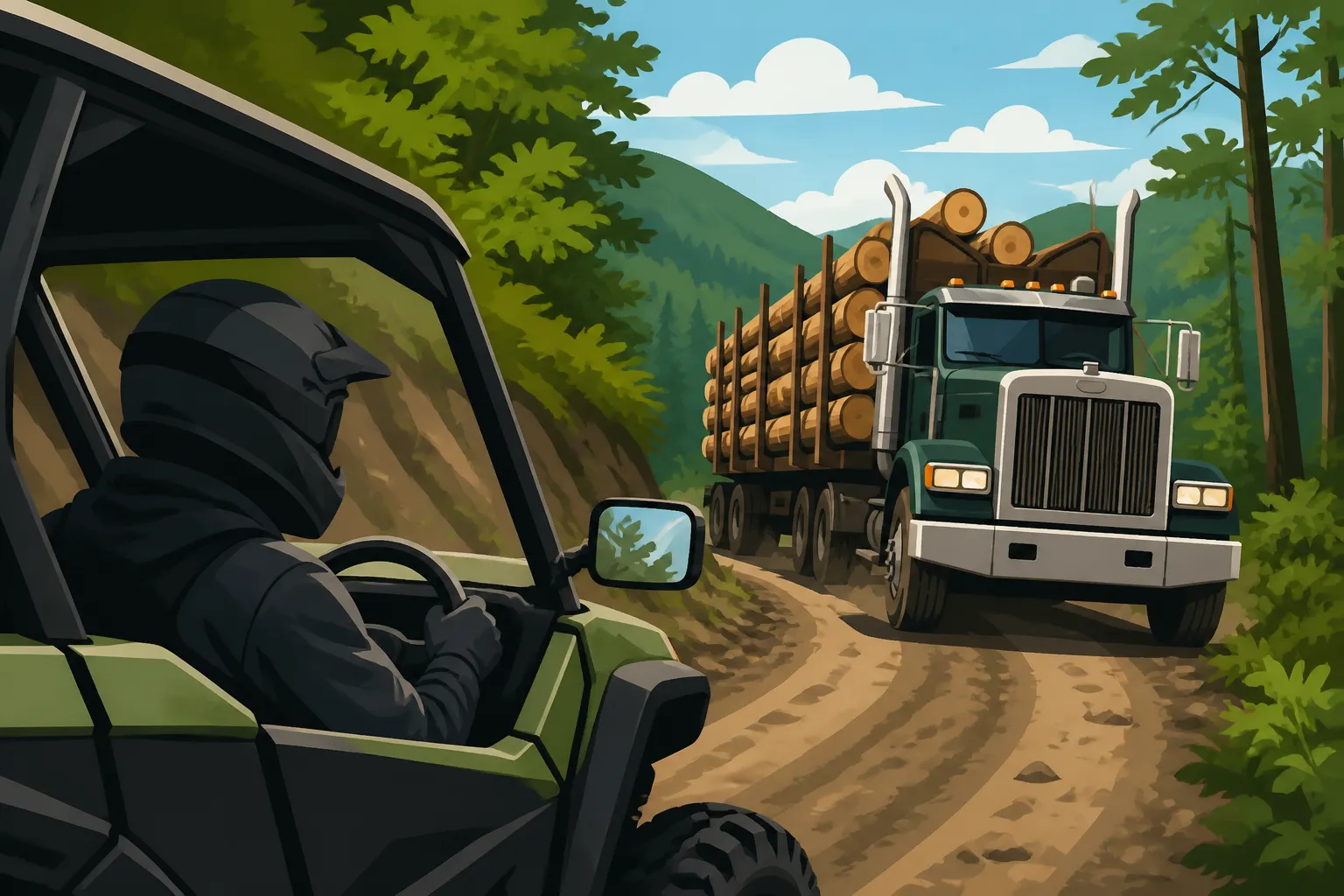
A log truck can fill a narrow Pisgah forest road before you have much room to react. Blind curves, loose gravel, steep grades, and dust make a close encounter stressful for ATV and UTV riders. This guide explains how to spot the risk early, choose a safe place to yield, and avoid assuming that every forest road is open to motorized riding.
Why log trucks and off-road riders meet on forest roads
Forest roads are working routes, not just riding routes
In and around Pisgah National Forest, a road that looks like a quiet gravel trail may also serve maintenance crews, emergency vehicles, utility workers, or timber operations. Some roads connect with public highways near communities such as Brevard, Mills River, and Canton; others may be gated, restricted, or privately managed. Road appearance alone does not tell you who uses it or whether your ATV or UTV is allowed there.
That distinction matters before you ever meet a truck. A road may cross national forest land without being open to public motorized travel, and access can vary by route, season, and current conditions. Check the route’s status before riding, and treat signs, gates, and closures as meaningful rather than as suggestions. Forest Roads Open to North Carolina Machines and Gated Roads in a North Carolina Forest are useful starting points for understanding why a road on a map is not automatically a road you can ride.
A logging truck may also be traveling between a work site and a public road, rather than using a route that riders think of as a trail. The driver may be working to a schedule and managing a long, heavy vehicle that handles very differently from a UTV. Give that vehicle plenty of room, even if you believe you have the right to continue.
Expect limited visibility and changing conditions
Pisgah’s wooded mountain roads can turn quickly around hillsides, into coves, or through dense tree cover. A rider may hear a truck only when it is close, especially if the road surface is noisy or the vehicle is approaching from behind a bend. Dust can make it harder to see both the truck and the edge of the road.
Conditions can shift after rain, road work, or a storm. Gravel may be pushed toward the shoulder, a drainage ditch may be hidden by leaves, or a familiar turnout may have become soft or rutted. On a narrow route, that can leave less usable space than you remember. Review North Carolina Trail Conditions Before You Ride and North Carolina Forest Trail Maps before heading out, and check current notices from the land manager for closures or access changes.
A navigation app can help you understand where you are and what routes appear nearby. For example, onX Offroad can be useful for planning and keeping track of a route, but a map display is not permission to ride on a closed or restricted road. Confirm access with the responsible agency or landowner, especially if your route crosses a gate, a work area, or a road you have not used before.
What to do when a log truck approaches
Slow down early and make yourself predictable
As soon as you hear or see a truck, reduce speed smoothly. Avoid a sudden stop in the middle of a blind curve, and do not accelerate toward the truck in the hope of slipping past before it arrives. The driver needs time and room to judge the road, while you need time to identify a safe place to wait.
If you are riding with others, signal the group to slow and stay together in a controlled way. Avoid spreading across the road or stopping at different points where the truck driver may have trouble seeing the full group. Keep headlights on when appropriate, and do not assume that brightly colored clothing will make you visible through dust, trees, or a turn.
Once you can see the truck clearly, assess the road rather than guessing. Look for a broad, firm turnout or a place where you can get fully out of its path without tipping toward a ditch or unstable shoulder. A small gap between trees may look like a pullout but may not have enough level ground for a machine. When there is no safe place immediately available, continue slowly to the nearest suitable spot if the truck is still far enough away and the route ahead is clear.
Yield in a place where both vehicles can stop safely
On a narrow road, the safest response is generally to yield and let the truck pass. Do not try to squeeze between the truck and a bank, tree, or drop-off. The truck may need most or all of the usable road, and a trailer can track differently from the cab as it turns.
Choose a spot with firm footing and as much distance from the travel lane as the road allows. Keep your wheels pointed away from the roadway, stop completely, and remain in control of the machine. Avoid parking with part of the ATV or UTV sticking into the lane. If the only possible stopping place is soft, sloped, or close to an exposed edge, prioritize a safer location a little farther along rather than making an abrupt maneuver into a dangerous shoulder.
Once stopped, keep riders and passengers seated or positioned safely and away from the truck’s path. Do not stand behind the truck or trailer, and do not walk beside it to get the driver’s attention. A heavy vehicle can have large blind areas, and the driver may not be able to see someone close to the cab or trailer. Wait for the entire truck and trailer to pass before moving back onto the road.
Let the driver manage the tightest part
A truck driver may slow, stop, or make a wide turn to negotiate a bend, grade, or narrow section. Do not assume that a pause means the driver is inviting you to pass. Wait until the truck is clearly moving away and you have an unobstructed view of the road ahead.
If the driver gives a clear signal or asks you to move, respond cautiously and make sure you understand what is being requested. Do not rely on a wave alone if the route remains unclear. If you need to reverse, do so slowly and only when you can see where you are going. On a group ride, one person can help guide the maneuver from a safe position, but nobody should stand behind a reversing machine or in the truck’s path.
If there is no safe way to pass or pull aside, stay calm and communicate only when it is safe to do so. A rider does not need to win a standoff on a mountain road. The practical goal is to avoid a collision and let the larger vehicle through without putting yourself, your group, or the driver at risk.
| Situation | Safer response | Avoid |
|---|---|---|
| You hear a truck near a blind bend | Slow smoothly and look for a safe turnout | Accelerating toward the bend |
| A truck is approaching on a narrow grade | Stop in a firm, level place out of its path | Trying to squeeze past |
| Dust blocks your view | Wait until visibility improves | Following closely behind the truck |
| The shoulder looks soft or steep | Continue cautiously to a safer stopping area if there is room | Dropping a wheel into an unstable edge |
| The truck pauses or signals | Wait for a clear, safe opportunity | Treating a brief wave as permission to rush past |
How to prepare before riding near active roads
Plan a route that is legal and appropriate for your machine
Before leaving home, confirm that each road and trail on your planned route is open to the type of machine you are riding. Pay attention to signs at entrances and junctions, and do not assume that an ATV or UTV can use a road just because a passenger vehicle can. The rules and access conditions can differ between forest roads, public roads, private timber roads, and designated OHV trails. For more background, see North Carolina Rules for Riding a Mountain Forest Road and [North Carolina Rules for Riding a Closed Trail].
A route-planning tool can help you spot nearby connections and reduce the chance of getting turned around, but use it as one part of your planning rather than your final authority. onX Offroad may help with route awareness and navigation; still, compare what you see with current agency maps, posted notices, and signs on the ground. If a road is marked closed, gated, or restricted, do not ride around the barrier or assume the closure is only for full-size vehicles.
It also helps to have a fallback route. If you reach an active work area, unexpected closure, or road that feels unsafe, turn back where there is room rather than pushing deeper into a narrow corridor. In unfamiliar terrain, tell someone where you expect to ride and when you plan to return.
Ride so you have time to react
Adjust your speed to the road’s visibility and surface, not just to what your machine can handle. On a wooded road, a comfortable pace on a straight section may be too fast approaching a blind curve, a steep drop, or a crest where a truck could appear. Leave room between machines in your group so riders can brake without piling into one another.
Keep your group compact enough to communicate but not so close that dust or sudden braking creates a chain reaction. If you are leading, slow before a blind section rather than after you see a hazard. If you are following, leave enough space to stop without relying on the rider ahead to warn you in time.
Use a route map or navigation app to help you stay oriented, but do not stare at a screen while moving. Stop in a safe place to check directions. onX Offroad can be handy for keeping track of a planned route, but a phone signal may be unreliable in mountain terrain, and digital mapping does not replace posted signs or current closure information. Save any needed information for offline use when that option is available, and carry a backup way to navigate.
Pay attention to signs, gates, and changing work activity
Logging and road work can change the safest way through an area. A road that was quiet on a previous visit may have active truck traffic, temporary signs, or equipment near the route. Follow posted instructions and do not enter a work zone simply because no worker is visible at that moment.
If you encounter a gate, a closure notice, or a sign indicating active operations, stop before entering and reassess your plan. Do not move a barrier or ride around it. For information about closures after severe weather or other disruptions, see [North Carolina Rules for Riding After a Storm Closure]. Agency updates can be especially important when a road or trail has been affected by fallen trees, washouts, or maintenance work.
When a route’s status is unclear, ask the appropriate land manager or landowner before riding it. That small check can prevent a frustrating turnaround, an unsafe encounter, or an access violation. [North Carolina Rules for Riding a Watershed] is another reminder that forest access can have specific limits beyond what a map alone reveals.
Common mistakes that make a truck encounter more dangerous
Stopping where the driver cannot see you
A rider who stops just beyond a bend may feel safely out of the way, but the driver may not see the machine until there is little room to react. Avoid stopping on the outside of a curve, at the crest of a hill, or just past a blind junction. If you have already stopped in a poor location, move only when you can do so safely and without entering the truck’s path.
Do not assume that the truck can move around you. Its cab, load, and trailer take up substantial space, and the driver may need to keep the vehicle positioned carefully on a steep or uneven surface. Choosing a proper turnout early is safer than waiting until the truck is close and then making a rushed move.
Riding through dust or following too closely
Dust can hide potholes, loose rocks, and other riders, as well as the truck itself. Let the dust clear before continuing if visibility is poor. Keep enough distance that you can stop if the road surface changes or the group ahead brakes suddenly.
If a truck has just passed, remember that the road may be scattered with gravel, branches, or debris. Check the surface before accelerating. Do not ride close behind a logging truck to save time; the driver may brake, turn, or stop with little warning from your perspective.
Treating courtesy as a substitute for access rules
Yielding to a truck is a safety practice, not permission to ride on any road used by logging traffic. Check whether your machine is allowed on that route and obey closures, restrictions, and posted directions. When in doubt, turn around and verify access before returning.
A cautious plan makes the encounter easier: know your route, ride at a speed that lets you stop, and give a heavy truck room to work. The same habits help whether you are on a gravel road near a forest boundary or traveling between designated riding areas. Keep an eye on official notices, follow signs on the ground, and treat every blind corner as a place where another road user may be approaching.
Disclaimer
This article is for general informational purposes only and does not constitute professional advice. Laws, prices and regulations vary by location and change over time. Consult a qualified professional for guidance on your specific situation.