Night Riding on a North Carolina Forest Trail
A working headlight does not automatically make a forest trail open after dark. In North Carolina, night riding depends on the rules for the specific trail system, its posted operating hours, and the permit requirements that apply to your machine. Here’s how to check those details and prepare for a ride without mistaking lighting rules for permission to be there.
Confirm the trail is open after dark
The first question is not whether your ATV or UTV has lights. It is whether the land manager allows riding on that trail at the time you plan to be there.
North Carolina’s forest riding areas do not necessarily share one schedule. A designated OHV trail system can have its own opening season, daily hours, temporary closures, and vehicle restrictions. Private parks set their own hours as well. A trail that is open for daytime riding may close at sunset, at a posted evening time, or when its seasonal operating period ends. Do not assume that a permit gives you permission to ride whenever the gate is accessible.
Before leaving home, check the official information for the specific forest and trail system. Look for operating hours and closures, not just a general statement that the area is open. If the hours are unclear, contact the managing ranger district or park operator. A locked gate, closed sign, or posted trail notice takes precedence over an old map, a social media post, or a ride plan made earlier in the season.
This matters at places such as Brown Mountain, Badin Lake, and Wayehutta, where operating details can differ and may change. Confirm the current notice for your destination rather than assuming that a schedule for one system applies to another. North Carolina Trail Closures to Check and North Carolina Trail Conditions Before You Ride can help you build a pre-trip check into your routine.
| What to verify | Why it matters | Where to check |
|---|---|---|
| Night operating hours | The trail may close before or at dark | Official trail-system or ranger-district notice |
| Seasonal opening dates | A trail may be closed for part of the year | Current forest or park information |
| Temporary closures | Storm damage, maintenance, or other issues can close routes | Official alerts and posted signs |
| Permit rules | A valid permit may be required for each machine | Trailhead instructions and permit information |
| Machine restrictions | Width, sound, or equipment limits may apply | Local trail rules |
| Gate and parking access | The access point may close separately from the trail | Trailhead notices or land manager |
Do not ride past a closure just because you see tracks, an open gate, or other riders. A route can be closed even when its surface looks passable, and riding around a barrier may create safety and access problems. If a closure leaves you short of your planned loop, turn back or use only a route that is clearly open.
The same care applies to private off-road parks. Their permission to ride at night may depend on the park’s schedule, event calendar, and rules for visitors. A forest permit does not authorize riding at a private park, and a private park pass does not replace a forest permit. Ask the operator specifically whether night riding is allowed on the date you intend to visit.
Sort out permits and rider requirements
A forest trail permit and permission to ride after dark answer different questions. A permit may satisfy an access requirement, but it does not override operating hours or a closure. Check both before you go.
Rules differ by riding area and can change. Review Do You Need a Permit for North Carolina Forest Trails? and North Carolina Forest OHV Permits for the permit basics, then confirm the instructions for the particular trail system. Pay attention to whether the permit is required for each vehicle, where it must be displayed, and whether the purchase method or permitted dates vary. Keep proof of purchase accessible in case a ranger or other authorized officer asks to see it.
A permit can also be easy to overlook when a trip crosses between separate areas. Do not assume that one permit covers every forest, park, or riding day. Check the destination’s current requirements, including whether it accepts a day permit, a season permit, or another form of authorization. The general information in North Carolina’s Forest Day Permit and The Forest Season Permit in North Carolina can help you understand the difference, but the current instructions for your destination are the final check.
Rider requirements matter at night just as they do during the day. North Carolina has an ATV safety-certificate rule tied to a rider’s birth year for certain public-land riding. If that requirement applies to you, carry the certificate while riding; do not count on a digital photo being accepted unless the land manager says it is. The birth-year rule and the documents to carry are covered in North Carolina ATV Safety Certificate Requirements and [Carrying a Safety Card on a North Carolina Ride].
If you ride in North Carolina with a certificate or registration from another state, do not assume it substitutes for a North Carolina requirement. Confirm what the state and the specific land manager require. Why North Carolina Has Nothing to Reciprocate explains why a visitor should check local requirements rather than relying on an out-of-state document.
Before loading the machine, make a short list for each rider and vehicle:
- Confirm the trail is open for the planned time and date.
- Check the correct permit and display or carry it as instructed.
- Make sure each rider meets applicable age, supervision, helmet, and certificate requirements.
- Check for vehicle restrictions, including equipment and width rules.
- Save the official contact or closure page so you can recheck it before departing.
Night riding is a poor time to discover that a permit is missing, a rider is not eligible, or a machine cannot use the route. Sorting out access while there is still daylight gives you time to change plans safely.
Make the machine visible and ready for darkness
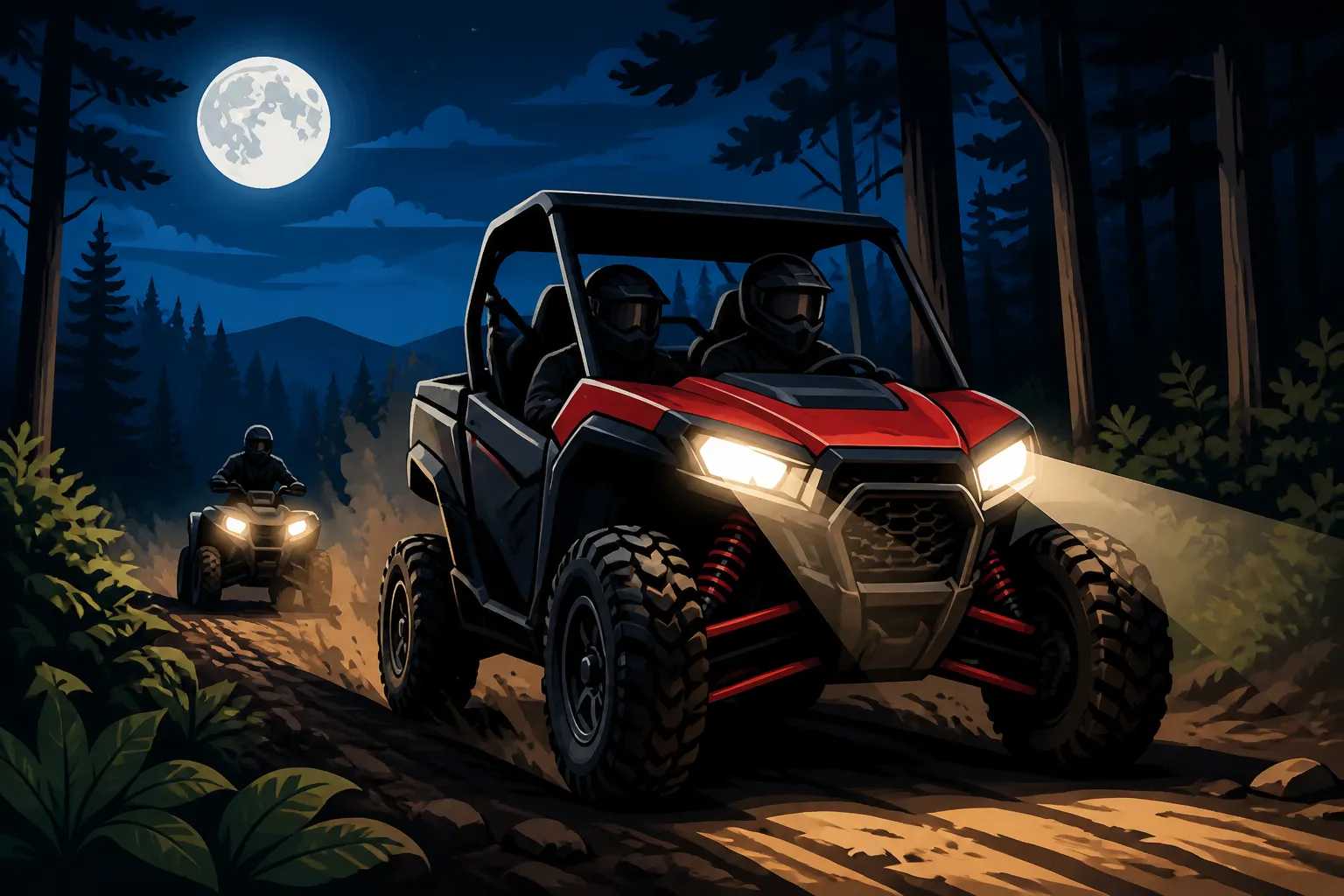
North Carolina’s equipment requirements and a trail’s operating rules are separate. A trail may require a headlight and taillight for riding after dark, but having those lights does not make a closed trail legal to ride. Check the applicable law and local trail requirements together. North Carolina Rules for Riding After Dark and North Carolina Lighting Requirements for ATVs provide more detail on the lighting rules.
Before a night ride, test the headlight and taillight with the engine running. Check that the headlight illuminates the ground far enough ahead to identify hazards at a speed you can safely manage. A light that works only intermittently, points too high, or leaves a dark patch directly in front of the machine is not ready for a remote trail. If the machine has more than one lighting setting, learn how to switch between them before the ride, not on a narrow trail.
A UTV may have a more substantial lighting setup than a small ATV, but that does not remove the need to check every light. Inspect the lamps, lenses, wiring, and switches. Mud, dust, and water can obscure a lens or interfere with a connection. Carry a backup light for each rider where practical, but treat it as an emergency aid, not a substitute for required vehicle lighting.
A helmet-mounted light can help a rider look toward a trail feature without turning the machine. It should supplement—not replace—the machine’s lights. Keep the beam from shining into the eyes of oncoming riders, and avoid relying on a small handheld light while steering or operating controls.
Darkness changes how quickly you can recognize terrain. A rock ledge, rut, root, loose gravel, washed-out section, or creek crossing may appear only when you are close to it. Reduce speed enough to stop within the area illuminated by your lights. Leave more space between machines so the dust from the rider ahead does not turn the trail into a whiteout. On a group ride, agree on a simple way to signal a stop or problem before setting off.
Protective equipment becomes especially important when visibility is limited. Wear the required helmet and eye protection, and use clothing that helps other riders see you. Review North Carolina Helmet Rules on Forest Trails before riding, particularly when young riders are in the group. A clean visor or goggles can be more useful than extra speed: dust, glare, and insects are harder to manage when there is no daylight.
Check the machine’s other safety equipment, too. Brakes, tires, steering, and the throttle should work properly, and the exhaust must meet applicable trail rules. Forest riding areas may have requirements such as a spark arrester. See North Carolina Spark Arrester Rules on Forest Land and check the rules for the destination rather than assuming that a machine accepted at one trail system will meet every area’s requirements.
Plan the ride around limited visibility
A sensible night ride is shorter and more conservative than a familiar daylight route. If you have not ridden the area before, get to know it during daylight first. A trail that looks straightforward on a map can become confusing after dark, particularly where routes split, markers are hard to see, or several paths meet.
Plan a route that leaves room to turn back well before the posted closing time. Allow extra time for slower travel, stops, and a mechanical problem. Do not set your return time based on a daytime estimate: uneven ground and reduced visibility can make even an easy section take longer. If the trail system does not clearly allow riding during your planned hours, choose a daytime trip instead.
Carry a charged phone, but do not rely on cell service in a forest. Share your route and expected return time with someone who is not riding with you. Bring basic recovery and repair supplies suited to the machine, a first-aid kit, water, and a way to contact help if service is available. Keep those items secured so they do not shift or interfere with the controls.
Riding alone at night adds risk. A breakdown, injury, or stuck machine can be much harder to handle when no one is nearby. If you ride with others, agree on a meeting point and a plan for separating from the group. Keep the group small enough to manage safely, and do not leave a rider behind after a stop or mechanical issue.
Stay on the marked route. At night, it may be tempting to cut across a shoulder or follow a track that seems to reconnect with the trail. That can take you onto a closed route, private land, or fragile ground. North Carolina Rules for Riding Off the Trail explains why staying on designated routes matters. If you cannot tell which way the trail goes, stop in a safe place and check your map or route information rather than guessing.
Rain, fog, and trail damage make darkness more difficult. Recheck conditions before loading, and cancel or shorten the ride if the weather or surface makes it hard to see hazards. Avoid creek crossings or steep sections if you cannot assess them clearly. A night ride should not become a test of how much risk the group can tolerate.
Use this final check before starting:
- The specific trail system is open for the full planned ride.
- No closure or posted restriction conflicts with the route.
- Each rider has the required permit, certificate, and protective equipment.
- Headlights and taillights work, and lenses are clean.
- The group has a route, a turnaround time, and a way to regroup.
- The ride can end before the access point closes.
If any answer is uncertain, pause and confirm it with the land manager. The safest decision may be to ride in daylight or choose a place that explicitly allows evening riding. A working light helps you see; only the trail’s current rules tell you whether you may be there.
Disclaimer
This article is for general informational purposes only and does not constitute professional advice. Laws, prices and regulations vary by location and change over time. Consult a qualified professional for guidance on your specific situation.