North Carolina Lighting Requirements for ATVs
It can feel incredibly confusing trying to figure out what kind of lights your ATV or UTV needs here in North Carolina. Between the trails, the farm, and those rare instances you might touch pavement, the rules for headlamps, taillamps, and everything in between seem to shift more often than the mountain weather. This guide is here to clear up that confusion, explaining exactly what lighting is required for your machine depending on where and how you ride in the Tar Heel State.
Understanding Lighting for Off-Road Riding in North Carolina
When you're out on the trails, whether it's tearing up the red clay at the Uwharries or navigating the more technical terrain of Wayehutta, your primary concern for lighting is usually visibility and safety for yourself. North Carolina's laws differentiate between pure off-road use and any interaction with public roads, even briefly. For the most part, off-road lighting requirements are focused on ensuring you can see and be seen when the sun isn't shining.
Basic Headlamps and Taillamps for Trail Use
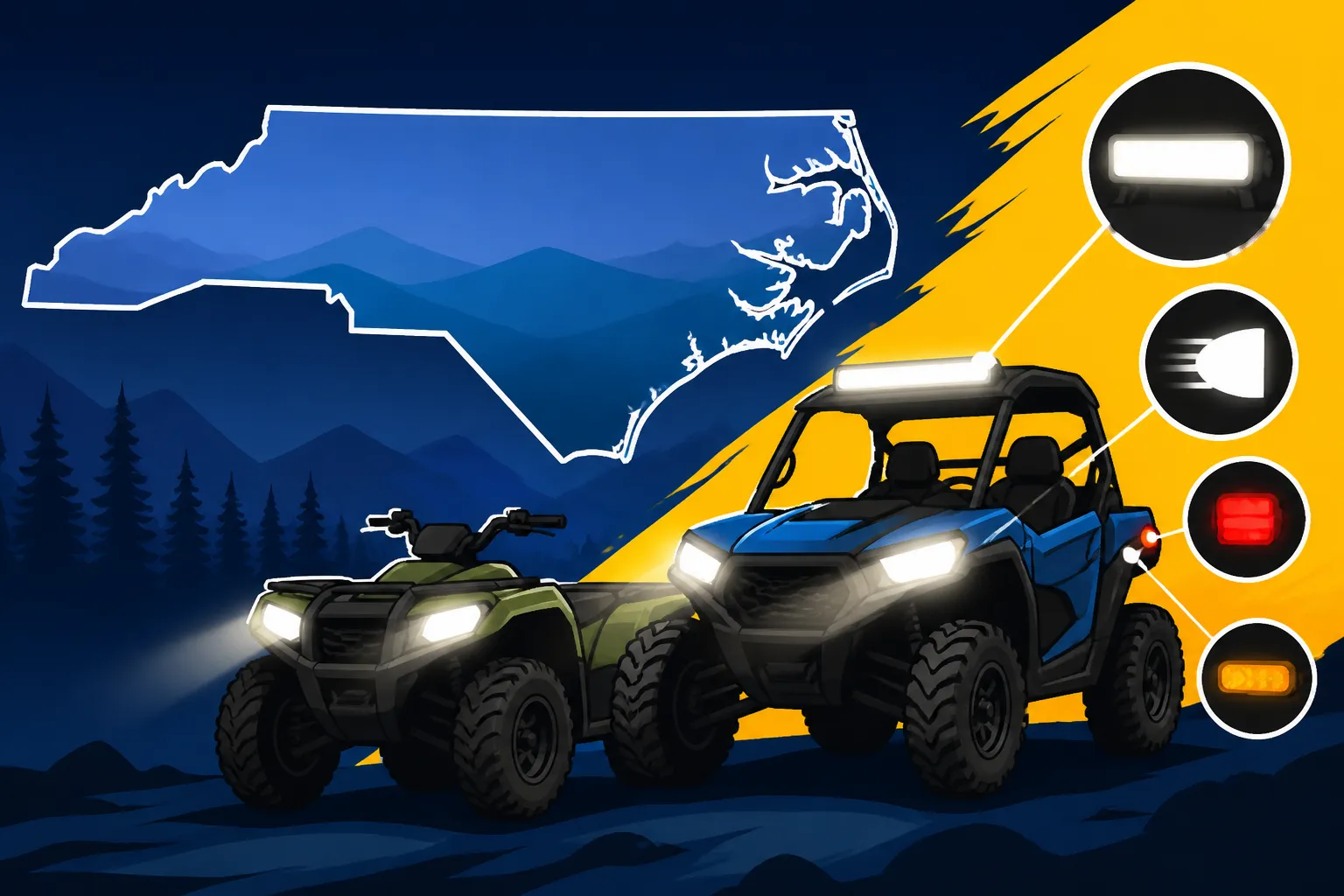
For general off-road riding, especially on designated trails like those at [Badin Lake OHV Trail Complex] or [Brown Mountain OHV Trail System], you'll definitely need functioning headlamps and taillamps if you plan on riding after dark. Most ATVs and UTVs come from the factory with these basic lights, and for good reason. Imagine trying to navigate a winding, rooted trail in the pitch black without them – it's an accident waiting to happen. These lights are essential not just for you to see the path ahead, but also for other riders to see you, especially if you're riding in a group or coming around a blind corner.
The expectation for these lights is simply that they work and provide adequate illumination. You're not typically worried about specific brightness levels or beam patterns that would be required for street legality. However, don't underestimate the value of a good set of bright lights. Many riders opt for aftermarket upgrades, adding LED light bars or spot lamps to their machines to improve visibility far beyond what factory lights offer. This is particularly useful in dense forest areas or when riding on moonless nights, making the experience safer and more enjoyable. Think of it as investing in your own peace of mind and the safety of those around you.
Riding After Dark and Equipment Considerations
If your plan involves any kind of riding after the sun goes down, whether on a private hunting lease in the Piedmont or finishing up a late trail ride in the Nantahala National Forest, adequate lighting becomes a legal and practical necessity. North Carolina law generally requires a headlamp and a taillamp if you're operating an ATV after dark. This isn't just a suggestion; it's a rule designed to prevent collisions and ensure everyone can see what they're doing. A malfunctioning light could not only lead to an unsafe situation but also a citation if encountered by a game warden or forest officer.
Beyond the basic requirements, consider additional lighting if you frequently ride at night or in low-light conditions. Auxiliary lights, often mounted on the front or roof of your UTV, can dramatically increase your field of vision and help spot obstacles that standard headlamps might miss. Some riders even add rock lights or underglow to help illuminate the ground immediately around their machine for technical terrain, or simple side marker lights for better visibility from other angles. The goal is to eliminate dark spots and enhance your situational awareness, making nighttime riding as safe as possible. [North Carolina Rules for Riding After Dark] provides more context on these requirements.
When Your ATV Might Need Road-Legal Lighting
This is where things can get a bit tricky and where many riders find themselves scratching their heads. For the vast majority of ATVs and UTVs, riding on public roads in North Carolina is generally prohibited. However, there are very specific, limited exceptions where your machine might briefly encounter or operate on a public road, and these situations often trigger specific lighting requirements. It's crucial to understand these distinctions to avoid fines and ensure safety.
Crossing a Public Road
North Carolina law does allow for ATVs to cross a public road, but this is a very brief maneuver, not sustained travel. Imagine you're riding private land, and there's a small, quiet country road you need to cross to get to another section of your property or a connected trail. In such instances, your ATV must have at least one headlamp and one taillamp. These lights are essential for making you visible to any traffic that might be approaching on the road, even if you're only on the pavement for a matter of seconds. The intention is clear: you need to be seen.
While the law doesn't specify turn signals for a simple crossing, using hand signals to indicate your intention is always a smart and safe practice. Remember, the road crossing is meant to be direct and immediate. You're not allowed to drive down the shoulder or use the road to get to a gas station. It's a quick pivot from one off-road section to another. A headlamp and taillamp ensure that even during this brief interaction with public thoroughfares, you meet the minimum visibility standards required by law for any vehicle operating in low-light conditions or even during the day for visibility. [North Carolina Rules for Crossing a Road] delves deeper into these specific allowances.
Farming Operations Exception
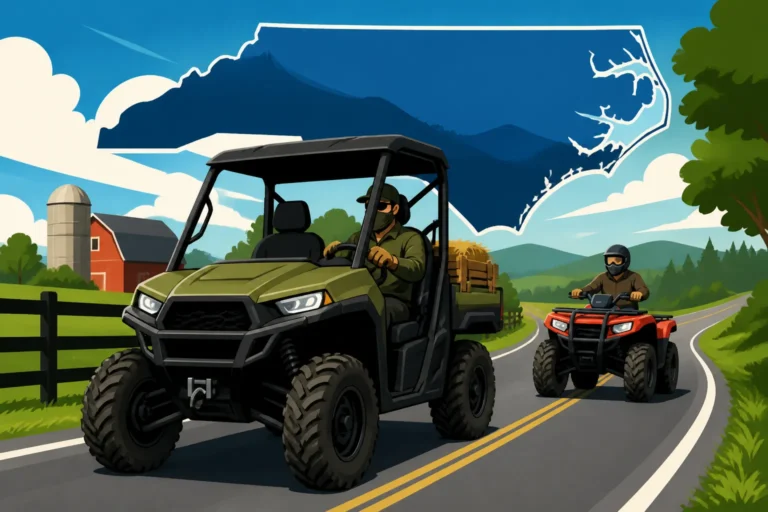
Another key exception where an ATV or UTV might legally operate on a public road, and thus need proper lighting, is when it's being used for a farming operation. This isn't a free pass to ride your quad to the grocery store, but it does allow farmers to use their machines on public roads to conduct legitimate agricultural business, like moving between fields or hauling equipment. For example, a farmer might use their UTV to check fences on properties separated by a two-lane road in Duplin County.
When operating on a public road for farming purposes, your ATV or UTV is subject to the lighting requirements of other slow-moving vehicles. This generally means having at least one headlamp and one taillamp, and often requires a slow-moving vehicle emblem displayed on the rear of the machine. Depending on the time of day and visibility, additional lighting, like flashing amber lights, might be wise or even required to ensure you're highly visible to faster-moving traffic. It’s all about making sure you’re as conspicuous as possible to prevent accidents. These rules are put in place to protect you and other motorists sharing the road. [North Carolina Farming Exception for ATVs] provides more details on this important exemption.
The Strict Lighting Rules for Modified Utility Vehicles (MUVs)
Now, this is where North Carolina sets up a pathway for certain utility vehicles to actually become street legal. It’s not for every side-by-side, and it’s a rigorous process, but if you meet the specific criteria to classify your machine as a Modified Utility Vehicle (MUV), you unlock a whole new set of lighting requirements that are much more akin to a traditional car or truck. This is the only way a typical ATV or UTV can truly operate on most public roads in North Carolina.
Headlamps, Taillamps, and Brake Lights
For an MUV to be truly street legal, its lighting system must be comprehensive and fully functional, mirroring that of a conventional vehicle. This means having properly aimed headlamps that meet specific brightness and beam pattern standards, capable of illuminating the road ahead for a specified distance. These aren't just your standard trail lights; they need to comply with Department of Transportation (DOT) standards. Furthermore, you'll need two separate taillamps, one on each side of the rear, which must be visible from a considerable distance. These taillamps often incorporate reflectors to further enhance visibility, especially at night or in low-light conditions.
Crucially, an MUV must also have fully operational brake lights. These lights, typically integrated with the taillamps, must illuminate brightly whenever the brake pedal is pressed, clearly signaling to drivers behind you that you are slowing down or stopping. This is a fundamental safety feature for any road-going vehicle, and MUVs are no exception. Without these basic lighting components working perfectly, your MUV won't pass inspection or be considered safe for public road use. This is non-negotiable for road safety.
Turn Signals and Hazard Lights
Beyond the basic headlamps, taillamps, and brake lights, an MUV must also be equipped with functional turn signal lamps. These are essential for communicating your intentions to other drivers on the road. You'll need amber-colored turn signals on both the front and rear of your machine, capable of flashing distinctly to indicate a left or right turn. These signals must be easily visible from both the front and rear of the vehicle, day or night. Many riders turn to aftermarket kits from trusted brands like SuperATV to integrate street-legal turn signals onto their side-by-sides, ensuring they meet the necessary specifications.
In addition to individual turn signals, an MUV must also have a hazard warning system. This means that all four turn signal lamps (front and rear, left and right) must be capable of flashing simultaneously. This feature is vital for alerting other motorists to a disabled vehicle on the roadside or a dangerous situation ahead. The ability to activate hazard lights provides a critical layer of safety when operating on public roads, especially if you encounter an unexpected breakdown or road hazard. It’s all part of making your MUV as predictable and safe as any other vehicle on the road.
Other Required Lighting: License Plate and Reflectors
The lighting requirements for MUVs extend to other details that might seem minor but are legally essential. Just like any other registered vehicle, an MUV must have a white lamp that illuminates the rear license plate. This light ensures that your license plate is clearly visible to law enforcement and other drivers, even after dark. Without a properly illuminated license plate, you could face a citation, as it's a fundamental aspect of vehicle identification on public roads.
Furthermore, MUVs often need to have additional reflectors strategically placed on the vehicle to enhance passive visibility. These reflectors, typically red on the rear and amber on the sides, don't require power but bounce light back, making your machine more visible to other drivers, particularly from angles where your active lights might not be as prominent. These small details collectively contribute to the overall safety profile of your MUV on North Carolina's roads. Meeting all these criteria is part of the extensive process to make your machine a [North Carolina's Modified Utility Vehicle Route].
Here's a quick overview of the different lighting requirements:
| Scenario | Headlamps | Taillamps | Brake Lights | Turn Signals | Hazard Lights | License Plate Light | Other Notes |
|---|---|---|---|---|---|---|---|
| Off-Road/Trail Use | Yes (if after dark) | Yes (if after dark) | Not typically req | Not typically req | Not typically req | No | Recommended for visibility; aftermarket upgrades common. |
| Road Crossing (Brief) | Yes | Yes | Not typically req | Not typically req | Not typically req | No | Must be direct & immediate crossing. |
| Farming Operations (Road) | Yes | Yes | Not typically req | Not typically req | Not typically req | No | Slow-moving vehicle emblem often required. |
| Modified Utility Vehicle (MUV) | Yes (DOT compliant) | Yes (2, DOT compliant) | Yes | Yes (front & rear) | Yes | Yes | Comprehensive, street-legal lighting required for registration. |
The Importance of Functioning Lights and Maintenance
Regardless of whether you're riding off-road or have gone through the painstaking process of making your side-by-side an MUV, regularly checking and maintaining your lighting system is paramount. A burned-out bulb on the trail can leave you fumbling in the dark, and a non-functional brake light on an MUV could lead to a dangerous rear-end collision. It's not just about compliance; it's about your safety and the safety of everyone around you.
Before every ride, especially if you know you'll be out around dusk or after dark, do a quick walk-around. Test your headlamps, taillamps, brake lights, and if applicable, your turn signals and hazard lights. Check for any cracked lenses, loose wiring, or dim bulbs. Replacing a bulb is a small investment of time and money compared to the potential consequences of a lighting failure. Brands like SuperATV offer a wide range of replacement parts and upgrade kits, making it easier to keep your machine in top shape. Proactive maintenance will ensure your lighting system is always ready to perform when you need it most. This simple habit can prevent a lot of headaches and keep you enjoying your North Carolina adventures safely.
Disclaimer
This article is for general informational purposes only and does not constitute professional advice. Laws, prices and regulations vary by location and change over time. Consult a qualified professional for guidance on your specific situation.