Born in January 1990 and Needing One
If your birthday falls in January 1990, North Carolina’s ATV safety-certificate rule applies to you: the cutoff is January 1, not the end of the month. This can be easy to confuse with trail permits or a driver’s license, which serve different purposes. Here’s how to tell what you need before riding and what to check for the place you plan to go.
Why a January 1990 birthday meets the cutoff
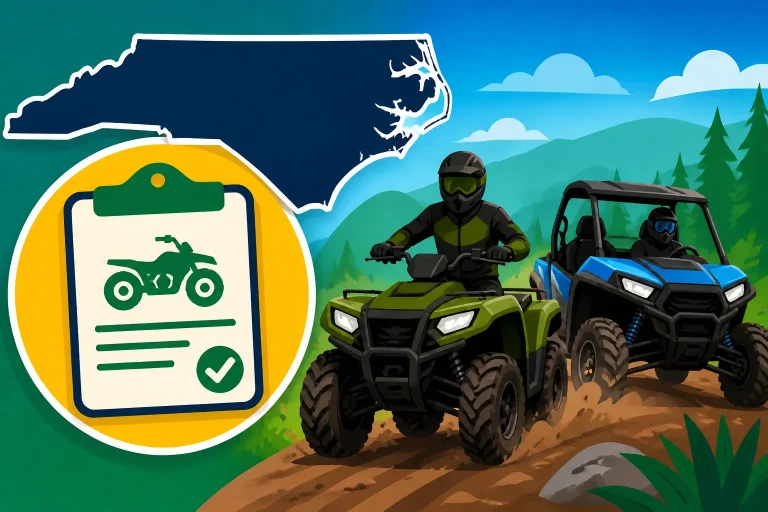
According to the North Carolina General Assembly, all-terrain vehicle operators born on or after January 1, 1990, must possess a safety certificate. That includes someone born on any day in January 1990. A birthday later in the month does not put you outside the rule.
The requirement took effect on October 1, 2006, according to the North Carolina General Assembly. The practical question is your date of birth: if it is January 1, 1990, or later, you fall within the birth-date group covered by the certificate requirement when operating an ATV.
| What you may need | What it does | Who sets the rule |
|---|---|---|
| ATV safety certificate | Shows you meet the state’s safety-training requirement if your birth date falls on or after January 1, 1990 | North Carolina General Assembly |
| Area-specific OHV pass | Provides access to a particular designated riding area | Forest Service |
| Driver’s license | Must be available to show during a Forest Service law-enforcement compliance check | Forest Service |
These items are not interchangeable. An OHV pass does not replace a safety certificate, and a certificate does not grant access to a trail system that requires its own pass. A driver’s license also does not stand in for either one.
If you want the broader eligibility rules, see Who Needs a North Carolina Safety Certificate and North Carolina ATV Safety Certificate Requirements. For a closer look at why the cutoff is based on birth date, Why the Certificate Binds by Birth Year explains the distinction.
One point worth keeping clear: the certificate rule concerns ATV operators. Other rules may apply depending on the machine, the rider’s age, and where the vehicle is being operated. A rule that applies on a Forest Service trail, for example, is not automatically the same as the state certificate rule.
How to meet the safety-training requirement
The North Carolina General Assembly says an ATV safety course must be sponsored or approved by the All-Terrain Vehicle Safety Institute, or approved by the Commissioner of Insurance. Choosing a course based only on its name or the fact that it is offered online is not enough to establish that it meets the state’s requirement. Confirm that the specific course is approved under one of those routes before enrolling.
The North Carolina Community College System is authorized to provide approved ATV safety training to people under 18, according to the North Carolina General Assembly. That authorization does not mean every course from every provider automatically counts. Check that the training is approved and that you will receive the certificate needed to document completion.
Before signing up, it is sensible to confirm three things with the training provider:
- The course is sponsored or approved by the All-Terrain Vehicle Safety Institute or approved by the Commissioner of Insurance.
- The provider will issue a safety certificate upon successful completion.
- The certificate will identify you clearly enough for you to show that you have met the requirement.
Keep the certificate somewhere you can access it when arranging a ride. If you have misplaced it or are unsure whether an older document qualifies, ask the course provider how to obtain a replacement or verify completion. For questions about whether a course is recognized, use Which Safety Courses North Carolina Accepts as a starting point.
The certificate requirement is about completing approved safety training; it does not make an otherwise prohibited ride lawful. North Carolina law separately prohibits operating an ATV on a public street, road, or highway except to cross it, and prohibits operation on an interstate or limited-access highway, according to the North Carolina General Assembly. The same agency says an operator must not ride carelessly or recklessly in a way that endangers people or causes injury or property damage.
Protective equipment is another separate matter. The North Carolina General Assembly requires eye protection and a helmet meeting United States Department of Transportation standards for motorcycle helmets when an ATV is operated on a public street, highway, or public vehicular area. It also requires those protections for anyone under 18 operating off such public areas. Forest Service trail rules require ATV and motorcycle operators and passengers to wear compliant helmets and eye protection, according to the Forest Service. Meeting the course requirement does not waive any of these equipment rules.
What else to check before riding
A safety certificate is only one part of preparing for a ride. The machine’s classification, the location, the rider’s age, and the site’s access rules can all affect what is required. An ATV, in the Forest Service definition, has a seat the operator straddles, handlebars for steering, three, four, or six wheels, and a width under 60 inches. A different machine may be subject to different rules, so do not assume that every UTV follows every ATV rule.
Check the riding area’s pass rules
The Forest Service requires a valid pass for the specific area where you are riding, and says trail riders must carry that pass while on the trails. Passes for riding in the National Forests in North Carolina are sold through Recreation.gov, according to the Forest Service. The Forest Service also says a state driver’s license must be available to show during a law-enforcement compliance check, and a pass remains valid until midnight of the date written on it.
Those site requirements are separate from your state safety certificate. Before loading the machine, verify that you have the pass required for the specific area and that you understand how to display or carry it. North Carolina Forest OHV Permits covers the area-pass side of trip planning.
The Forest Service also says ATVs cannot be registered and therefore are not allowed on Forest Service roads. It requires OHVs to be trailered to the trailhead, and riders must stay on designated trails. Plan your route so you do not need to ride an ATV along a Forest Service road to get to the trail. A valid trail pass does not grant permission to use roads or routes closed to that vehicle.
Pay attention to age and supervision rules
The Forest Service sets additional operating limits for children. It says children under 8 may not operate ATVs or motorcycles; children under 12 may not operate an ATV 70cc or larger; and children under 16 may not operate an ATV 90cc or larger. The Forest Service also requires children under 16 to remain under continuous visual supervision by an adult over 18.
Those age limits are distinct from the certificate cutoff. A young rider may be subject to age, supervision, and protective-equipment rules even if the birth-date certificate rule is not the issue. The Forest Service says ATV and motorcycle operators and passengers must wear helmets and eye protection that meet United States Department of Transportation motorcycle safety standards. It also prohibits carrying a passenger unless the manufacturer specifically designed the vehicle for that purpose.
Don’t treat a pass or certificate as a blanket permission
Rules can vary by site. The National Park Service, for example, requires an Off-Road Vehicle permit to drive on the beach at Cape Hatteras National Seashore. That permit is for that site’s access rules; it is not the North Carolina ATV safety certificate. Likewise, having a safety certificate does not mean an ATV may be used in every beach area or on every road.
Before a trip, check the rules for the specific riding area, confirm that your machine is allowed there, and make sure any required pass is valid. For an overview of the separate certificate issue, see Does a North Carolina Safety Certificate Ever Expire? and [Carrying a Safety Card on a North Carolina Ride]. If your question is whether another state’s credential will do, Does North Carolina Accept an Out-of-State Certificate? is the relevant topic to review.
A quick pre-ride check can help prevent a frustrating turn-around:
- Confirm that your birth date falls on or after January 1, 1990, and that you have the required safety certificate.
- Verify that the course you completed meets the approval standard set by the North Carolina General Assembly.
- Check the specific trail or riding area for its pass, vehicle, and route rules.
- Carry the site pass and have your driver’s license available where the Forest Service requires it.
- Review rider age, supervision, helmet, eye-protection, and passenger restrictions for the location.
The key takeaway is straightforward: a January 1990 birthday is within North Carolina’s safety-certificate cutoff. Get the approved training and certificate, then check the separate access and operating rules for where you intend to ride.
Sources
- Forest Service — National Forests in North Carolina | Off-Highway Vehicles (OHV) | Forest Service (checked November 3, 2026)
- OSFM — ATV Safety | OSFM (checked November 3, 2026)
- Forest Service — National Forests in North Carolina | Black Swamp OHV Trailhead | Forest Service (checked November 3, 2026)
- Forest Service — National Forests in North Carolina | Brown Mountain OHV Trail System | Forest Service (checked November 3, 2026)
- Forest Service — National Forests in North Carolina | Off-Highway Vehicles (OHV) | Forest Service (checked November 3, 2026)
- USDA Forest Service — National Forests in North Carolina | Off-Highway Vehicles (OHV) | Forest Service (checked November 3, 2026)
Disclaimer
This article is for general informational purposes only and does not constitute professional advice. Laws, prices and regulations vary by location and change over time. Consult a qualified professional for guidance on your specific situation.