Reading the Gate Board at Badin Lake
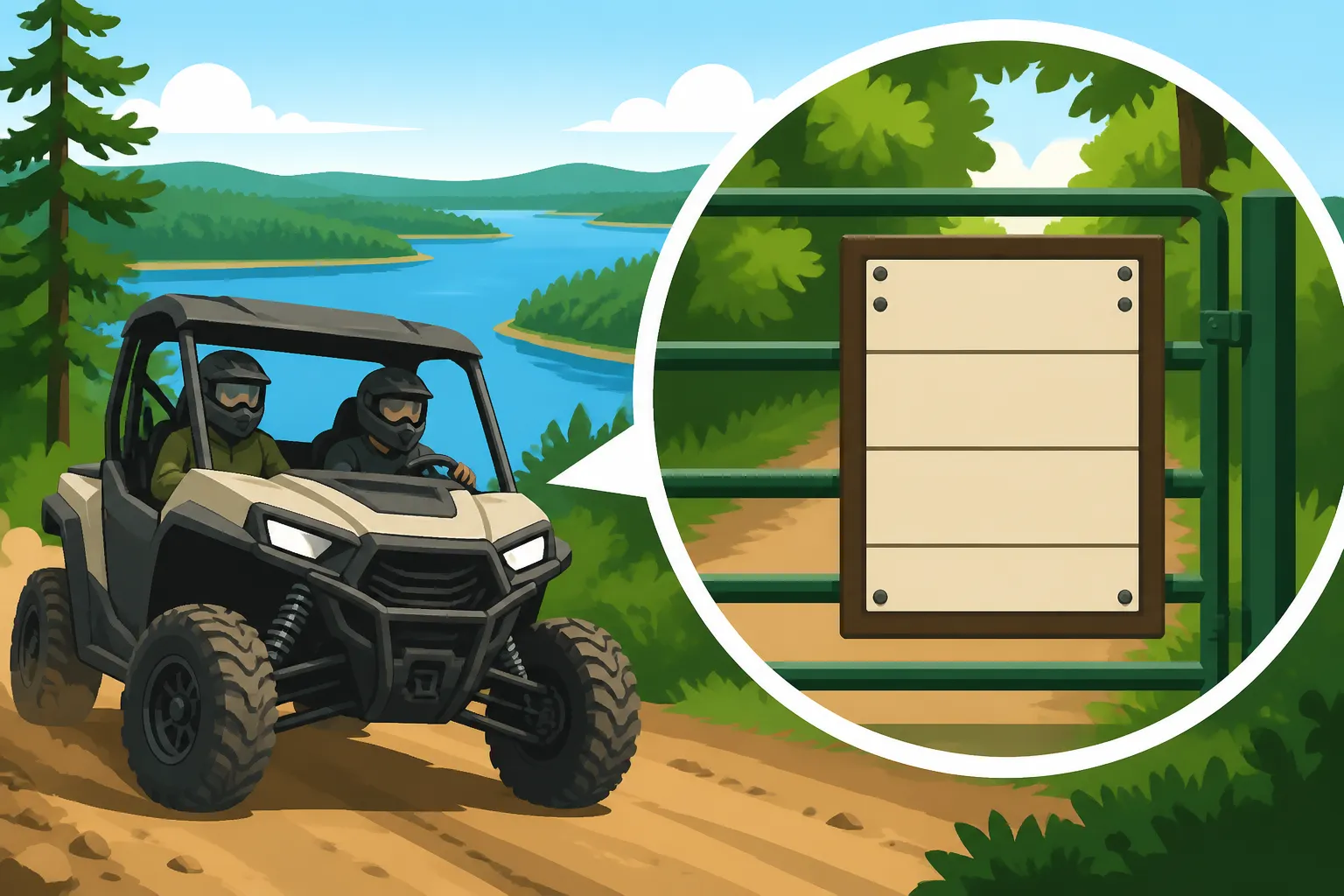
At Badin Lake, it is tempting to unload as soon as you reach the trailhead and follow the first open-looking route. Take a few minutes to read the gate board first. It can help you confirm which trails are open, understand posted warnings, and catch permit or safety reminders before you ride. Here’s how to use it without treating it as a substitute for current official updates.
Start With Trail Status, Not the Map
The gate board is a useful first check, but its most important job is to tell you what you may ride that day. Look for posted closures, temporary restrictions, and notices about trail conditions before choosing a route. A trail shown on a map is not automatically open, and a familiar trail name does not mean its status has stayed the same since your last visit.
Badin Lake OHV Trail Complex has multiple trails and access points. If you arrive at one trailhead and see a closure notice, don’t assume it applies only to the exact stretch beside the sign. Read the full notice for trail names, boundaries, dates, and any alternate route details. A closure may affect a connection needed to complete a loop, even if the rest of the loop appears open.
Read the notice as a whole
Check each posted notice for:
- The trail or area named. Make sure you understand whether the notice applies to one trail, a connector, a staging area, or a broader part of the riding area.
- The type of restriction. A closure, a warning, and a recommendation are not the same thing. Follow restrictions as posted, and take warnings seriously when deciding whether conditions suit your machine and group.
- Any timing information. A notice may be temporary or tied to a specific condition. Don’t assume an old-looking notice has expired unless the notice or an official update says so.
- The reason, if given. Storm damage, maintenance, or trail conditions can affect more than the named section. Use the reason to plan conservatively, not to guess that nearby routes are unaffected.
If a notice is unclear, don’t interpret uncertainty as permission to ride. Ask a forest employee when one is available, or check current official information before setting out. For a broader pre-trip routine, see North Carolina Trail Closures to Check and North Carolina Trail Status After a Storm.
The board may not capture every change that happens after you leave home. Conditions can change because of weather, maintenance, or a new safety concern. Check North Carolina Trail Conditions Before You Ride before driving to the complex, then read the notices again at the trailhead. The two checks serve different purposes: online updates help with trip planning, while the posted information gives you a final local check.
Match the map to the sign
Use the map and the posted notices together. A map helps you understand where trails connect; a closure notice tells you which connections you must avoid. If your planned route depends on a trail that is closed, choose a different route rather than trying to make the loop work by riding around the barrier or taking an unmarked path.
Pay attention to trail names and numbers as they appear on the board. Similar-looking names or nearby trail entrances can be easy to confuse, especially when several people are planning the ride together. Before leaving the staging area, make sure everyone understands the intended route and any closed sections. Reading a North Carolina Forest Trail Map can help you make sense of marked routes and trail connections.
| What you see on the board | What to do |
|---|---|
| A trail marked closed | Keep off it, including any closed connector or section named in the notice. |
| A warning about conditions | Consider your machine, experience, group, and the route before proceeding. |
| A trail rating or difficulty note | Use it to choose a route that fits the least experienced rider and the capabilities of the machines. |
| A map showing an open route | Confirm it against current closure notices before riding. |
| Information that is hard to read or interpret | Don’t guess; seek clarification or choose a route you can confirm is permitted. |
Trail ratings are planning information, not a promise that a route will feel easy in every condition. Rain, washouts, loose rock, and other changes can make a familiar section more challenging. Use the ratings as one factor, and check North Carolina Trail Difficulty Ratings if you need help interpreting them.
Check Permit and Rider Notices Before Unloading
The gate board may also remind visitors about permits, rider requirements, and other rules. Read these notices even if you have visited before. A previous trip does not guarantee that you have the right permit for this visit, that each machine is covered, or that every rider in your group has met the applicable requirements.
North Carolina forest OHV permits are separate from registering or titling a machine. A state title does not serve as a forest riding permit, and a permit for one riding area should not be assumed to work everywhere. For details about the broader system, see North Carolina Forest OHV Permits and Where to Buy a North Carolina OHV Permit.
At the board, look for instructions that explain whether a permit is required, where it must be displayed, and whether the notice refers to a day or season permit. Follow the wording for the area you are using. Permit availability and instructions can vary by location, so check the official information for Badin Lake before your trip rather than relying on a detail remembered from another forest or trailhead. Badin Lake’s Season Permit covers the season-permit question for this riding area.
A permit should be easy to show if an officer or forest employee asks to see it. Keep proof accessible rather than buried under cargo or left at home. If a permit must be displayed on the machine, follow the posted instructions for where and how. A receipt in a phone may be convenient, but don’t assume a photo or receipt replaces a required physical display unless the official instructions say it does.
Remember that permits are generally required for each machine, not just for the group leader. Confirm that every ATV or UTV in your party is covered. Every Machine Needs Its Own Trailhead Box Permit explains why it is important not to treat one vehicle’s permit as covering the whole group.
Look for safety and age-related reminders
A gate board may also direct riders to carry proof of a safety course or follow age-related rules. North Carolina has a safety-certificate requirement tied to birth year for certain riders using public riding areas. The board can be a helpful reminder, but don’t rely on a sign alone to determine whether a particular rider is covered by the rule. Check North Carolina ATV Safety Certificate Requirements and Why the Certificate Binds by Birth Year before the trip.
If someone in your party is required to have a certificate, make sure they bring the accepted proof and can produce it if asked. A course certificate and a forest permit answer different questions: one concerns the rider, while the other concerns use of the riding area. Having one does not replace the other. For what to expect if a card is requested, see When a Safety Certificate Is Checked at the Gate.
The board may also show reminders about helmets, spark arresters, trail conduct, or staying on marked routes. Treat these as practical prompts to check your gear and behavior before riding. Requirements can depend on where you ride and who is riding, so review the relevant rules for the group rather than assuming one notice covers every situation.
Turn the Board Into a Simple Pre-Ride Routine
A quick, deliberate check can prevent a frustrating mistake. Make the board part of unloading, not something one person scans while everyone else is already gearing up. If you ride with a group, assign one person to read notices aloud and have another compare them with the planned route. That small pause can prevent a rider from following the wrong trail or missing a restriction.
Use this sequence:
- Read every current notice. Check for closures, warnings, and any instructions that apply to the parking or staging area.
- Find your intended trails on the map. Confirm names and connections rather than relying on memory.
- Cross-check the route against closures. Remove any closed trail or connector from the plan.
- Confirm permits for each machine. Check the required type and display instructions for Badin Lake.
- Review rider requirements. Make sure anyone who needs safety-course proof has it with them.
- Tell the group the final route. Agree on where to stop, what to avoid, and what to do if the group gets separated.
If trail information is posted at more than one access point, read the board where you actually plan to enter. A notice at one location may be more specific to that trailhead, while a central map may give a wider view. Don’t assume a photo of a board taken on a previous visit reflects current conditions.
For a group ride, take a moment to make sure each person has seen the closure information. A lead rider should not assume that the rest of the group knows a trail is closed simply because the leader does. If you are carrying a printed map, keeping it in a waterproof sleeve can make it easier to consult during the ride; sleeves are available from outdoor retailers and Amazon. A printed map is a backup aid, not proof that a trail is open.
If the board and another source appear to disagree, pause before riding. Don’t choose whichever version is more convenient. Look for the newest official notice, ask staff if available, and avoid any route whose status you cannot confirm. This is especially important after heavy rain or a storm, when a route may be damaged or restricted even if the map still shows it.
Finally, keep the board’s information in context. It helps riders understand local conditions and requirements, but it does not authorize travel on a closed trail or make an unsuitable route safe. Stay on marked, open routes, follow posted instructions, and be willing to change the plan. For details about the riding area itself, see Badin Lake OHV Trail Complex.
Disclaimer
This article is for general informational purposes only and does not constitute professional advice. Laws, prices and regulations vary by location and change over time. Consult a qualified professional for guidance on your specific situation.