North Carolina Rules for a Machine With No Title
It's a common scenario across North Carolina: you've got a fantastic ATV or UTV, maybe you picked it up privately, or it's been in the family for ages, and then you realize… there's no official title. This situation can throw a wrench into your plans, whether you're trying to sell it, insure it, or wondering if you can even legally ride it on certain paths. This guide is here to walk you through the nuances of owning and riding an ATV or UTV in North Carolina when that critical piece of paper, the title, is missing or has never existed, and how to navigate the challenges that come with it.
The Harsh Reality: Why a Title Matters (Even When Not Required)
You might be scratching your head, thinking, "But North Carolina doesn't require ATVs to be registered, so why would I need a title?" It's a fair question, and one that trips up many riders. While it's true that the Tar Heel State has a relaxed stance on off-road vehicle registration compared to some others, the absence of a title can create a surprising amount of headaches down the road. It's a classic case of what's not required isn't necessarily what's wise or convenient.
The Legal Landscape: No Mandatory Registration or Title for Off-Road Use
Let's clear up the biggest point of confusion right away: For purely off-road use, on private land or designated trail systems, North Carolina does not mandate that your ATV or UTV be registered with the DMV. This means you won't be slapping a license plate on your quad just to hit the trails at Badin Lake or Brown Mountain. Because there's no registration requirement, many folks naturally assume that a title isn't needed either. This assumption is where the trouble often starts.
You might hear someone say, "My buddy's been riding his quad for years, never had a title, never had an issue." And for a long time, that might have been true for them, as long as the machine stayed on private property and was never sold or stolen. But this approach is essentially operating without a safety net. The moment you step outside that narrow definition of pure, isolated off-road use, or if any complication arises, you quickly discover the immense value of that simple piece of paper. It's not about being forced to get one; it's about the security and legitimacy it provides that you just can't get any other way.
Proof of Ownership: The Critical Gap Without a Title
Imagine this scenario: you've bought a sweet used side-by-side from a guy you met on an online marketplace. He gave you a handwritten bill of sale, and off you went. Fast forward a year, and your pride and joy disappears from your shed one night. When you call the sheriff's department, they ask for the VIN and proof of ownership. You hand them the bill of sale, but the officer looks skeptical. It's not notarized, the seller's information is a bit vague, and it certainly doesn't look like an official state document. Suddenly, proving that machine is yours becomes a Herculean task. This is precisely [Why a Title Matters After Your Quad Is Stolen].
Without a state-issued title, you lack the definitive proof of ownership that governmental bodies, insurance companies, and even future buyers recognize and trust. A simple bill of sale, while a good start, can be easily challenged, lost, or even fraudulent. If there's ever a dispute about who legitimately owns the machine, a title is your strongest defense. This is especially true if you're dealing with a machine that has changed hands multiple times without proper documentation being maintained along the way. Lenders, for example, are rarely willing to finance a machine without a clear title, because they need that security interest to be formally recorded. This is [Why a Lender Insists on a Titled Machine]. Even for simple things like getting comprehensive insurance, some providers might hesitate or require extra steps if there's no official record of ownership. They need to know that they're insuring your property, not someone else's.
Navigating the Challenges: Riding and Owning an Untitled Machine
So, you've got an ATV or UTV without a title. Does this mean your riding days are over in North Carolina? Not necessarily, but it does mean you need to be acutely aware of where and how you operate your machine. The rules change dramatically depending on the type of land and your intentions for the vehicle.
Public vs. Private Land: Where You Might Get Away With It
Let's break down where an untitled machine can, or cannot, roam. If you own a sprawling piece of land in the Uwharries, or you have explicit, written permission from a landowner, you can generally ride your untitled ATV or UTV on that private property without immediate legal repercussions related to the lack of title. The owner has given you permission, and as long as you're not breaking any other laws (like reckless endangerment or noise ordinances), the state isn't going to step in and demand proof of title for riding there.
However, the moment you venture onto public lands, such as our beautiful National Forests like Pisgah or Nantahala, or a managed OHV trail system, the landscape changes. While North Carolina doesn't require ATV registration, these public lands often have their own permit systems and regulations. Even if they don't explicitly demand a title to buy a trail permit, the underlying expectation is that the machine is legally owned. If you're ever involved in an incident on these trails, or if an officer asks for proof of ownership (which they absolutely can), a lack of title could complicate things significantly. For visitors coming from states where ATVs are titled and registered, this can be a particular point of confusion. Remember, [Why a North Carolina Forest Permit Is Per Vehicle] means the permit is tied to your machine, and proving ownership of that machine, even for a day pass, is a foundational principle. Similarly, many private off-road parks, while not state-run, may ask for proof of ownership as part of their liability waiver process, making an untitled machine a potential sticking point.
The Slippery Slope of "No Papers": Buying and Selling Headaches
If you've ever tried to sell a car without a title, you know the struggle. The same applies, perhaps even more so, to ATVs and UTVs. Trying to sell an ATV or UTV with "no papers" immediately raises red flags for potential buyers. They'll worry about its origins, potential liens, or whether it's stolen. You'll likely receive lower offers, and many buyers will simply walk away. This is because, without a title, they face the exact same problems you're currently navigating. They can't easily prove ownership, get insurance, or ever consider making the machine street-legal.
On the flip side, [Buying a Used ATV in North Carolina] when it has no title is a huge gamble. You could unknowingly purchase a stolen machine, or one with a hidden lien from a previous owner. Even if you get a bill of sale, if the seller wasn't the legitimate owner, that bill of sale might be worthless. Always insist on proper documentation. Even if there's no existing title, a reputable seller should at least provide a detailed bill of sale, and you should always perform a VIN check. This critical step, [Checking a VIN Before a North Carolina Purchase], can sometimes reveal if the machine has been reported stolen, even without a formal title in the DMV system. While a bill of sale helps in private transactions, its power is limited without an accompanying title or a clear path to getting one.
When a Title Becomes Necessary: MUVs and Road Use
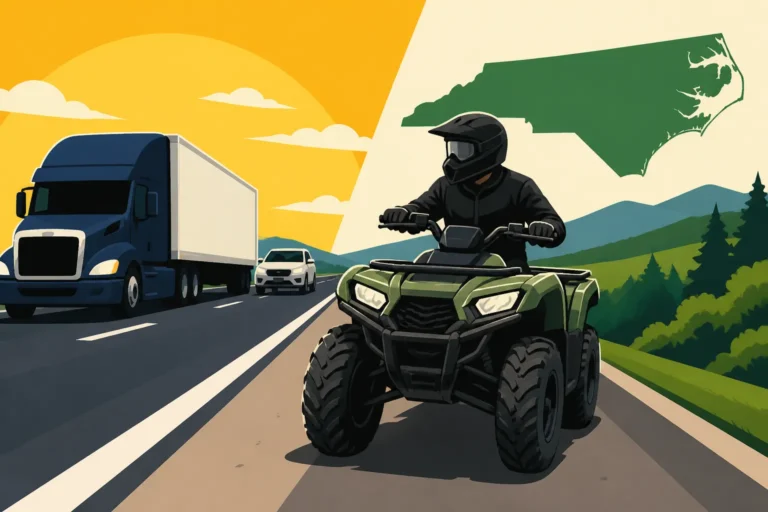
Here's where the "no title" situation goes from inconvenient to a complete roadblock. If you ever have aspirations of making your ATV or UTV street-legal in North Carolina, you must have a title. North Carolina offers a specific pathway for this through the "Modified Utility Vehicle" (MUV) designation. This allows certain UTVs, if they meet stringent criteria for size, speed, and safety equipment, to be registered and driven on public roads (under specific conditions, like certain speed limits and secondary roads).
However, to become an MUV, the vehicle must first be titled with the North Carolina DMV. There's simply no way around it. You'll need to go through the whole process: proving ownership, getting a VIN assigned by the North Carolina DMV if it doesn't have one, paying the [North Carolina ATV Highway Use Tax], and applying for the title. Only after your UTV is officially titled can you even begin the process of meeting the additional requirements for MUV registration, such as adding turn signals, a speedometer, and ensuring it meets specific dimensions. Without that foundational title, your dream of cruising your side-by-side down a country road near Charlotte, even with all the cool accessories from a company like SuperATV, remains just that – a dream. This path is entirely dependent on having your machine legitimately recognized by the state, starting with the title. For more on this, check out [North Carolina's Modified Utility Vehicle Route] and [Registering an MUV for the Road].
Strategies for Taming the "No Title" Beast
It might feel like you're stuck between a rock and a hard place, but there are definitely strategies and pathways to resolve the "no title" dilemma in North Carolina. It often requires some legwork and patience with the DMV, but the peace of mind and added value a title brings are well worth the effort.
Proving Prior Ownership: The Affidavit Approach
If you have a machine that's never been titled, or you've lost the original title and have no record of it, North Carolina provides a mechanism to establish ownership: Form MVR-60, the "Affidavit of Ownership." This form is specifically designed for situations where a conventional title transfer isn't possible because the prior owner isn't available, or a title simply never existed. Think of it as your official statement to the state, under oath, asserting that you are the rightful owner.
To complete [North Carolina Form MVR-60 Explained], you'll need to provide as much detail as possible about how you acquired the machine. This includes dates, names of previous owners (if known), purchase price, and any supporting documentation you might have. Did you get a bill of sale years ago, even a simple one? Do you have canceled checks or bank statements proving payment? Did you inherit it, and have estate documents? All of this helps build your case. The DMV clerk will review your affidavit and supporting evidence to determine if you've provided sufficient proof. While it's not a guaranteed path, it's the primary avenue for establishing ownership when formal title paperwork is absent. This form is often required for [Who Has to File a North Carolina ATV Affidavit] when they want to get a title for a machine that hasn't had one before.
Getting a New Title: The Path to Peace of Mind
Once you've established ownership, either through the MVR-60 affidavit or by having a valid bill of sale from a titled owner, you can proceed with applying for a new North Carolina ATV title using Form MVR-1. This is the standard application for a certificate of title. You'll fill out your personal information, the machine's details (VIN, make, model, year), and attest to its ownership.
Be prepared for the associated costs. When you title an ATV or UTV in North Carolina, you'll be subject to the state's Highway Use Tax, which is a percentage of the purchase price or fair market value, as well as a small title fee. While these costs might seem like an extra burden, consider it an investment in the long-term security and value of your machine. For specific figures, you'll need to check with the DMV, but know that these fees are part of the process. You can find more details on [North Carolina ATV Title Cost] and [North Carolina ATV Highway Use Tax]. Many riders find that having a clear title makes future transactions, insurance claims, or any modifications (especially for MUV conversion, perhaps using parts from SuperATV) much smoother. A titled machine is a legitimate asset, and that's a powerful thing. It genuinely provides [Why a North Carolina Title Is Worth Having].
Proactive Steps: Bill of Sale and VIN Verification
Even if you're comfortable riding without a title, it's crucial to always protect yourself with a robust bill of sale for any ATV or UTV purchase. This document should include:
- The full names and addresses of both buyer and seller.
- The date of sale.
- A clear description of the machine, including make, model, year, and VIN.
- The purchase price.
- A statement that the machine is sold "as-is" (if applicable) and that the seller attests to being the legal owner.
- Signatures of both parties, ideally notarized.
Always verify the VIN on the machine itself against any paperwork. This helps ensure you're not buying a "franken-quad" with mismatched parts or a stolen identity. You can often find the VIN stamped on the frame or chassis, usually near the front suspension, handlebars, or under the seat. A quick call to your local DMV or sheriff's office with the VIN can sometimes reveal if there are any red flags, even if the machine isn't formally titled in NC. By taking these proactive steps, you can significantly reduce the risks associated with buying a machine that lacks formal title paperwork. And remember, if you're looking to upgrade or customize your machine with premium aftermarket parts, companies like SuperATV can provide fantastic options – but ensure your machine's legal standing is solid first!
An untitled ATV or UTV in North Carolina might seem like a simple matter given the lack of mandatory registration for off-road use. However, the absence of this crucial document can lead to a host of complications, from proving ownership in cases of theft or dispute to hindering resale value and making any attempt at street-legal conversion impossible. While the process of obtaining a title for an older machine or one without prior paperwork can be a bit of a bureaucratic journey, the security, legitimacy, and peace of mind it provides are invaluable. It's always a good idea to ensure your off-road machine is properly titled, even if it's not strictly "required" for every single ride.
ATV/UTV Title vs. No Title: A Quick Comparison
| Feature | Machine with No Title (North Carolina) | Machine with Title (North Carolina) |
|---|---|---|
| Proof of Ownership | Relies on bill of sale, affidavit, or circumstantial evidence. | Official, state-recognized document. Strongest proof of ownership. |
| Theft Recovery | Challenging to prove ownership without formal documentation. | Easier to prove ownership and reclaim if stolen. |
| Resale Value | Significantly lower; many buyers are hesitant or demand discounts. | Higher; buyers have confidence in legitimate ownership. |
| Insurance | May be difficult to obtain comprehensive coverage; some insurers hesitate. | Easier to obtain full coverage as ownership is clear. |
| Financing | Extremely difficult or impossible for lenders. | Readily available from lenders as title serves as collateral. |
| Street Legal (MUV) | Impossible to register as an MUV. | Prerequisite for MUV registration and road legality. |
| Disputes/Liens | Highly vulnerable to ownership disputes or hidden liens. | Protects against ownership disputes and clearly shows lien status. |
| Inheritance/Gifting | Complex to transfer; requires MVR-60 Affidavit of Ownership. | Straightforward transfer of ownership. |
Disclaimer
This article is for general informational purposes only and does not constitute professional advice. Laws, prices and regulations vary by location and change over time. Consult a qualified professional for guidance on your specific situation.