North Carolina Rules for Night Riding on a Trail
It's an age-old question for North Carolina ATV and UTV riders: can you hit the trails after the sun goes down? There's a certain appeal to night riding – the quiet, the cool air, the challenge of navigating by headlamp. However, many riders quickly discover that while the idea is tempting, the reality in North Carolina often brings with it a tangle of rules, restrictions, and safety considerations that make impromptu night excursions on public trails far more complicated than they might seem. This guide will shine a light on North Carolina's specific regulations for riding off-road after dark, helping you understand where you can and cannot go, what equipment you'll need, and how to stay safe and legal.
The Harsh Reality: Official Trail Rules for Night Riding in North Carolina
Let's get right to it, because this is where many riders face disappointment: the vast majority of designated OHV trails in North Carolina's public lands are simply not open for night riding. It's a common misconception that if you have lights, you can ride whenever you want, but that's rarely the case on regulated trails.
National Forests and Designated OHV Trails: Strict Operating Hours
When you plan a trip to a public OHV trail system, like the ones found in the Uwharrie, Pisgah, or Nantahala National Forests, you'll notice that the official operating hours almost always coincide with daylight. These trails, such as those at Brown Mountain or Badin Lake, have specific opening and closing times, and those closing times are typically at dusk or a set hour before dark, often 5:00 PM or 7:00 PM depending on the season and location. Attempting to ride these designated trails outside of posted hours, even with a full lighting setup, is considered riding on a [North Carolina Rules for Riding a Closed Trail] and can lead to significant fines and penalties.
It’s easy to feel frustrated by this, especially when you've invested in a fantastic lighting setup for your machine. You might look at your rig, decked out with a powerful LED light bar and auxiliary pods, and think, "What's the point if I can't use these at night on the trails?" And it's a valid question. The reality is that these rules are in place for a multitude of reasons, from safety to environmental protection and resource management, which we'll dive into next. But for the most part, if you're thinking of hitting the official dirt bike, ATV, or UTV trails in a North Carolina National Forest after sunset, you'll need to rethink your plans.
Why Public Trails Close at Sunset
The reasons behind these strict night riding prohibitions on public trails are quite extensive. First and foremost, safety is a massive concern. While you might be a skilled rider with excellent lights, the trails themselves present increased hazards in the dark. Roots, rocks, sudden drops, and unexpected obstacles become far more difficult to spot, even with powerful illumination. Add in the possibility of other users—hikers, campers, or even wildlife—and the risk profile rises sharply. Emergency services, like search and rescue, also face considerably greater challenges responding to incidents in remote areas at night.
Beyond safety, environmental protection plays a big role. Night riding can disrupt nocturnal wildlife patterns, leading to increased stress for animals or even collisions. It can also encourage riders to venture off marked trails, accidentally damaging sensitive habitats that might be harder to identify in low light conditions. Finally, resource management and enforcement are simpler when trails operate during daylight hours. Forest Service staff and local law enforcement can more effectively monitor trail usage, enforce rules, and maintain the areas when operations are confined to specific times. It's not about punishing riders; it's about balancing access with responsibility. This is why you'll find that [North Carolina Fines for an ATV Violation] for riding on a closed trail can be steep, as they're meant to deter activities that could lead to accidents or environmental harm.
Understanding Basic Lighting Requirements for Any After-Dark Operation
Even though designated trails are mostly off-limits at night, there are still scenarios where you might find yourself operating your ATV or UTV after dark in North Carolina. Whether it’s on private property, for specific farm operations, or simply crossing a public road at dusk, having proper lighting isn't just a good idea; it's often a legal requirement.
Mandatory Headlamps and Taillamps
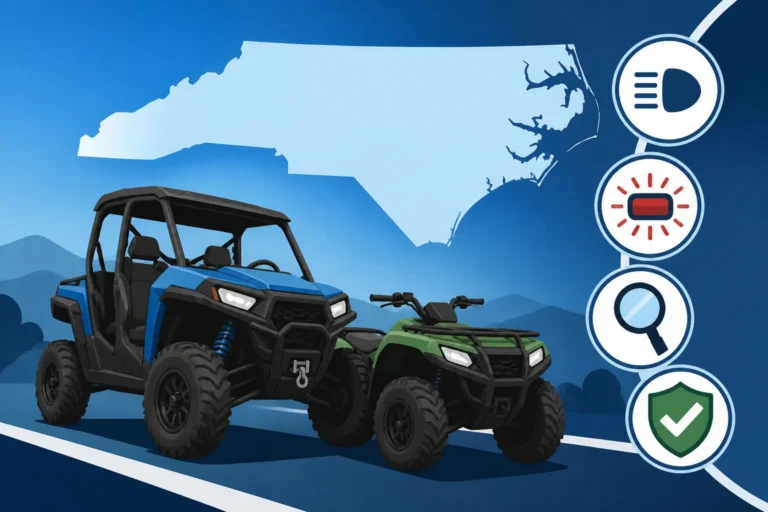
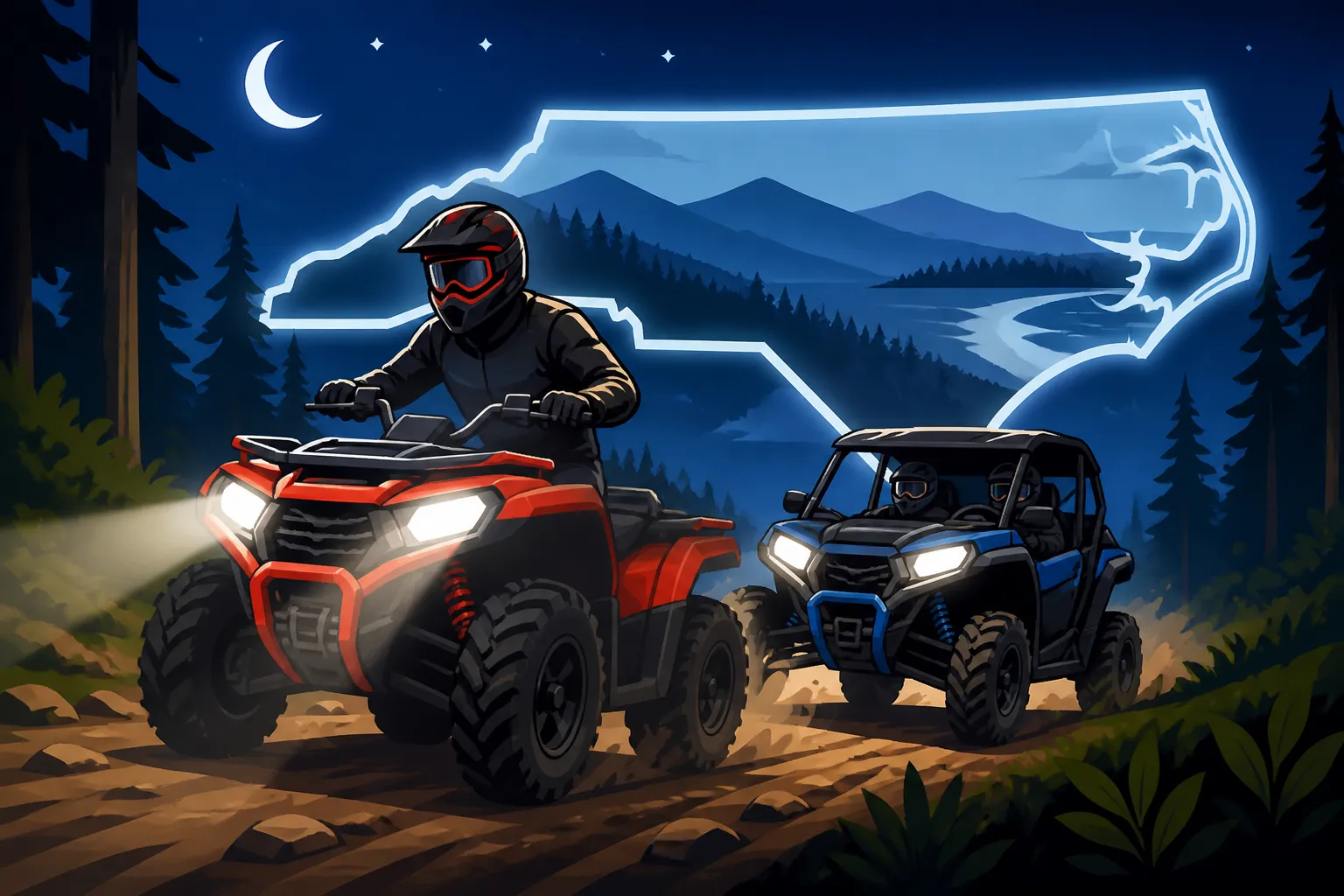
North Carolina law has clear expectations for machines operating after dark. Any ATV or UTV, regardless of where it's being ridden, needs to be equipped with specific lighting if it's going to be used during periods of low visibility, which essentially means from sunset to sunrise, or whenever natural light is insufficient. The foundational requirement is a functional headlamp that projects a white light and a red taillamp visible from a certain distance. This isn't just for seeing; it's fundamentally about being seen by others. [North Carolina Lighting Requirements for ATVs] are in place for a reason – to prevent accidents and ensure all operators are visible to others.
While the exact specifications for brightness and visibility distances can get technical, the spirit of the law is clear: your machine must be adequately lit. This usually means a single white headlamp, or two if designed that way, at the front, and a red taillamp at the rear. These lights need to be in good working order, properly aimed, and free from obstructions. Many factory-equipped machines meet these basic requirements, but it's always wise to check if your lights are fully operational before heading out in low light conditions. Remember, you might see perfectly well, but if others can't see you, you're putting everyone at risk.
Enhancing Visibility: Beyond the Bare Minimum
Meeting the minimum legal requirements for lighting is a good start, but for serious after-dark operation, especially in challenging environments, it's often not enough. Many riders quickly realize that factory lighting, while adequate for basic visibility, doesn't cut it for illuminating tough terrain or high-speed maneuvers. This is where aftermarket lighting really shines. Companies like SuperATV offer an incredible array of auxiliary lighting options, from powerful LED light bars that turn night into day, to ditch lights, rock lights, and even whips with integrated LEDs for 360-degree visibility.
Adding supplemental lighting isn't just for show; it's a critical safety upgrade. A wide beam light bar can illuminate obstacles far off to the sides, while spot beams can pierce through the darkness to show you what's ahead on a long straight. Rock lights mounted underneath your machine can help you see tricky terrain during technical climbs. Moreover, reflective elements on your machine or even a high-visibility flag with an integrated light can drastically improve how well you are seen by others, especially if you're sharing space with other vehicles or people. Don't just think about what you can see; think about how others see you. This proactive approach to visibility is key to safe operation after dark, even in areas where night riding is permissible.
Where You Might Be Able to Ride After Dark in North Carolina
Given the restrictions on public OHV trails, many riders wonder where they can actually ride their ATVs or UTVs after the sun sets in North Carolina. The answer largely comes down to private land and a few very specific, limited exceptions.
Private Property and Permission-Based Riding
The most common and least restricted place to enjoy an ATV or UTV after dark in North Carolina is on private property, provided you have explicit permission from the landowner. If you own the land, or have a clear agreement from the owner, you essentially set your own rules for night riding, as long as you adhere to general safety practices and don't create a public nuisance (e.g., excessive noise disturbing neighbors). This is where those powerful SuperATV light bars and auxiliary pods truly come into their own, allowing you to explore your own trails and property with excellent visibility.
Riding on private land offers flexibility that public lands simply cannot. You can design your own night courses, practice navigating challenging terrain, or simply enjoy a quiet evening ride without worrying about posted closure times. However, this freedom comes with personal responsibility. Just because it's legal doesn't mean it's without risk. Always know your terrain, ride within your limits, and ensure your machine is well-maintained and properly lit. Even on private land, you should still follow sound safety practices, including wearing proper protective gear like a helmet and eye protection. Remember, [North Carolina Rules for Riding Private Land] still emphasize the need for landowner permission to avoid trespassing charges, regardless of the time of day.
The Limited Scope of Farm Operations and Designated Roads
Beyond private property, there are very specific and limited circumstances where ATVs or UTVs might be operated after dark on public access ways, primarily related to agricultural use. North Carolina law allows ATVs and UTVs to operate on public roads or highways for farming operations during daylight hours, and these rules extend to low light conditions provided the machine is properly lit. This means if you're genuinely moving between fields or performing necessary farm tasks, and your machine is equipped with legal headlights and taillights, you might be covered. However, this is not a blanket permission for recreational night riding on public roads; it's strictly for farm business. You can read more about this in [North Carolina Farming Exception for ATVs].
It’s crucial to understand that this exception is narrowly defined. It does not allow for joyriding or recreational travel on public roads, even if you own a farm. Furthermore, if you’re using your ATV or UTV to cross a public road, such as a paved county road to get from one part of your property to another, the same [North Carolina Rules for Crossing a Road] apply at night as they do during the day, meaning you must yield to traffic and do so as directly and quickly as possible. These exceptions are never an invitation for extensive public road use, and night riding on roads without a clear, specific legal exemption for registered vehicles is generally illegal and highly dangerous. Always ensure your machine has the necessary [North Carolina Lighting Requirements for ATVs] for these specific scenarios.
Here's a quick overview of night riding scenarios:
| Location Type | Night Riding Permitted? | Key Considerations |
|---|---|---|
| Designated OHV Trails | Generally NO | Strict operating hours, typically closing at sunset. Riding after hours is a violation and can incur fines. |
| National Forest Roads | Limited & Specific | Some unpaved forest roads (not designated OHV trails) might be open 24/7 for general public use. Always check specific signage and forest district rules. If allowed, must follow all general [North Carolina Rules for Riding a Mountain Forest Road] for lighting and speed. |
| North Carolina Game Lands | Generally NO | OHV use is often highly restricted, even during daylight. Night use is usually prohibited or requires special permits for hunting/trapping, which are rarely for recreational riding. Consult specific game land regulations. |
| Private Property | YES (with landowner consent) | Most permissible location. Requires property owner's explicit permission. Adhere to local noise ordinances. Full responsibility for safety and risks lies with the rider/landowner. |
| Public Roads (Farm Use) | YES (farm operations only) | Only for legitimate [North Carolina Farming Exception for ATVs] during essential tasks. Requires proper headlights and taillights. Not for recreational use. |
Essential Safety Measures and Equipment for Low-Light Riding
Riding an ATV or UTV in low light or complete darkness introduces a host of new challenges, even in familiar terrain. Beyond just having legal lighting, a truly safe night rider needs to think about enhanced visibility, personal protection, and thorough ride planning.
Upgrading Your Machine's Lighting System
As mentioned earlier, factory lighting is often sufficient for basic legal compliance but can be severely lacking for effective visibility and terrain illumination during serious night riding. This is where a strategic upgrade to your machine's lighting system becomes paramount. Investing in a high-quality LED light bar is often the first step, providing a broad, powerful beam that dramatically expands your field of vision. Consider a combination beam pattern that offers both flood (for wide, close-range visibility) and spot (for distant illumination) to cover all your bases.
Beyond the main light bar, think about auxiliary lights. Ditch lights, mounted on the A-pillars or sides of your machine, can help illuminate what’s directly to your left and right, essential for spotting obstacles just outside your main beam or navigating tight turns. Rear-facing amber or red chase lights are also vital, especially if you’re riding in a group, ensuring that riders behind you can see your position and dust trail. Even small rock lights, mounted strategically under the chassis, can be invaluable for technical terrain when you need to see exactly where your tires are going. SuperATV, for instance, offers a comprehensive range of lighting solutions specifically designed for the rugged demands of off-road night riding, ensuring you can tailor your setup to your exact needs and riding style.
Personal Protection and Ride Planning
Your machine isn't the only thing that needs to be visible and prepared; you do too. Personal protective equipment (PPE) becomes even more critical in low-light conditions. A proper [North Carolina Helmet Law for ATV Riders] is always a must, but for night riding, consider one with a clear visor or ensure you have [North Carolina Eye Protection Requirement] that doesn't hinder your vision in the dark. Reflective tape on your helmet, jacket, or even your backpack can significantly increase your visibility to others, whether they're on another machine or a search and rescue team.
Beyond gear, meticulous ride planning is non-negotiable for night excursions. Never ride alone after dark. Always go with at least one other person, and preferably a group. Inform someone not on the ride about your planned route and estimated return time. Carry essential tools, a first-aid kit, a fully charged cell phone (though be aware of [North Carolina Trails With Cell Coverage] issues in remote areas), and a way to signal for help. GPS devices, spare batteries, and even a headlamp for yourself (should your machine's power fail) are all vital. Knowing the terrain inside and out is crucial, as familiar trails can look entirely different and present new challenges in the dark. Always check weather forecasts, as rain or fog can turn an already challenging night ride into a genuinely dangerous situation. A well-planned and well-equipped night ride is a safer night ride.
Common Pitfalls and Legal Considerations
Even with the best intentions and equipment, night riding in North Carolina can lead to problems if you're not fully aware of the legal landscape and potential risks. Ignorance of the law is never an excuse, and certain violations can be costly.
Avoiding Fines and Trail Closures
The number one pitfall for night riders is violating posted trail hours. As we've discussed, most designated OHV trails in North Carolina's national forests and other public lands close at dusk. Riding these trails after hours will almost certainly result in a citation. These aren't minor infractions; forest service rangers and local law enforcement are vigilant about enforcing these rules, and fines can quickly add up. Beyond monetary penalties, repeated violations could lead to temporary bans from the trails or even impoundment of your machine in severe cases. Always check specific trail schedules and alerts before you even load your machine, especially if you're planning a ride that might run close to sunset.
Another legal consideration, particularly when upgrading your machine's exhaust for better performance, involves [North Carolina Sound Limits on Forest Trails]. While you might be focusing on lighting for night riding, an excessively loud exhaust can also lead to a citation on public lands, regardless of the time of day. It's about respecting the environment and other users. If you're riding on private property, remember that local noise ordinances might still apply, especially late at night, and could lead to complaints from neighbors. Always aim for a balance between performance, visibility, and legal compliance.
When Night Riding Becomes Risky Business
Beyond legal troubles, the inherent risks of night riding are amplified when riders are unprepared or overconfident. One major risk is misjudging terrain. What looks like a shallow puddle in daylight can be a deep, hidden mud hole at night, leading to rollovers or getting stuck. A seemingly minor rock or root becomes a much greater hazard when visibility is reduced, increasing the chance of injury or machine damage. Furthermore, the ability to quickly assess and react to changing conditions—like a sudden drop-off, an unexpected turn, or even wildlife crossing your path—is severely diminished in the dark.
Then there's the issue of recovery. Getting stuck or breaking down during the day is one thing; doing so in the dead of night, potentially in a remote area without cell service, is an entirely different beast. Cold temperatures, disorientation, and the emotional toll of being stranded can quickly turn an adventurous outing into a survival situation. This is why tools like a winch, offered by companies like SuperATV, are not just convenient but critical pieces of safety equipment for any serious off-road rider, especially at night. It's paramount to be realistic about your capabilities, the capabilities of your machine, and the conditions of the trail. If in doubt, err on the side of caution. No ride is worth risking your safety, your machine, or potential legal ramifications.
Disclaimer
This article is for general informational purposes only and does not constitute professional advice. Laws, prices and regulations vary by location and change over time. Consult a qualified professional for guidance on your specific situation.