Crossing a Two-Lane and Nothing More
It's a familiar scenario for many North Carolina ATV and UTV riders: you've got amazing private land or a sweet section of trail to ride, but between you and the good stuff lies a pesky two-lane road. You just need to get across it, not ride down it for miles, and you wonder, "Is that even allowed?" This guide will clear up the rules for making those quick, necessary road crossings in the Tar Heel State, ensuring you stay legal and safe.
The Strict Reality of ATVs on North Carolina Roads
Let's be real: North Carolina isn't exactly a free-for-all when it comes to riding your ATV or UTV on public roads. In fact, the general rule is quite the opposite. This isn't because the state wants to make life difficult for riders; it's rooted in safety concerns and the distinct design of these machines. Understanding this baseline is crucial before we even talk about exceptions like crossing.
Why the General Rule Says "No Roads"
Most ATVs and UTVs are designed from the ground up for off-road performance, pure and simple. Think about it: knobby tires for grip in dirt and mud, a high center of gravity for clearing obstacles, suspensions built for rough terrain, and generally no turn signals, rearview mirrors, or even speedometers in many cases. These characteristics make them fantastic on trails but decidedly less safe and predictable on paved roads shared with cars, trucks, and motorcycles. The state of North Carolina, like many others, recognizes this fundamental difference. They're not looking to regulate recreational vehicles as if they were cars, because they're not. They're regulating them for the environment they were built for. This is why you'll often hear that [Are ATVs Street Legal in North Carolina?] is a resounding "no" for most machines.
This general prohibition extends to almost all public highways, streets, and rights-of-way. It's not just the major interstates; it includes those quiet country roads you might assume are fair game. Even riding the shoulder or ditch line alongside a paved road is typically considered operating on the public right-of-way and is therefore prohibited. This can be frustrating when your favorite riding spot is bisected by a public road, or when you own two separate parcels of land and need to move your machine from one to the other. You're trying to minimize your time on the pavement, but the law still sees it as a public thoroughfare.
The Narrow Window for Crossing
Despite the strict general rule, North Carolina law does provide a very specific, narrow exception for ATVs and UTVs to cross a public road. This isn't an invitation to take a joyride down the street, even for a block or two. It's a provision designed to allow riders to legally move from one off-road area to another when a public road unfortunately separates them. The keyword here is "crossing," and the law is quite particular about what that entails.
This exception acknowledges that for many riders, especially those in rural areas or near dedicated trail systems, perfectly contiguous private land or trail networks are a rarity. Sometimes, that gravel path or forest trail simply runs right into a paved two-lane road before picking up again on the other side. Without a legal way to cross, these areas would effectively become inaccessible or require trailering your machine for mere yards, which is inconvenient and impractical. The state has carved out this specific allowance to balance public safety with the legitimate need for off-road access. However, it comes with a strict understanding that your intent and action must be solely to traverse the road at a perpendicular angle, minimizing exposure to other traffic.
Understanding the "Crossing Only" Exception
So, what exactly does North Carolina mean by "crossing a two-lane road and nothing more"? This isn't a vague suggestion; it's a specific legal allowance with implicit rules about how you must conduct yourself. It's not a loophole for casual road riding; it's a very limited privilege.
What Constitutes a Legal Crossing
For an ATV or UTV, a legal crossing in North Carolina means moving directly across a public road, usually a two-lane highway, to get from one piece of private property or designated off-road area to another. The key elements are:
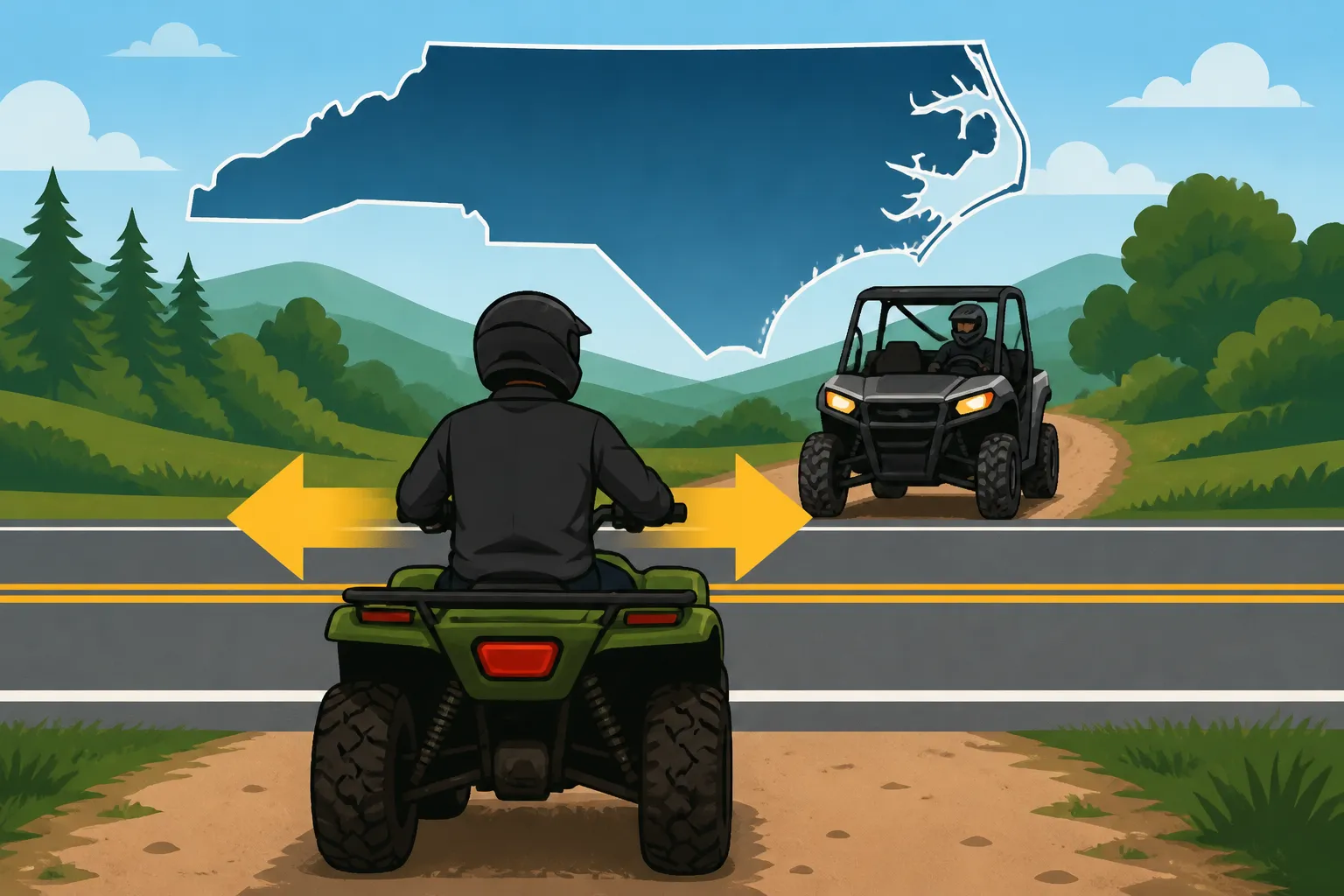
- Directly Across: You must travel perpendicular to the flow of traffic. No turning and riding down the road for any distance, even a short one. Imagine a straight line from one side of the road to the other – that's your path. You can't make a right turn, ride for 50 feet, and then make a left turn onto another property. It's a "straight shot" across the pavement.
- To Access Another Off-Road Area: The purpose of the crossing must be to reach another area where ATV use is legal, such as another section of private property, a public trail, or designated riding land. You're not crossing just "because." You have a destination on the other side that is not a public road. This is why [North Carolina Rules for Crossing a Road] are so specific about intent.
- Minimum Distance: While the law doesn't specify a precise number of feet, the spirit of the rule implies the shortest possible distance required to cross safely. This is typically a two-lane road. Crossing a multi-lane highway, especially one with a median, becomes significantly more complex and often falls outside the spirit, if not the letter, of this narrow exception.
Let's consider a practical example: You own a large tract of land, but a small state road splits it in two. You want to ride from the northern half to the southern half. You can legally cross the road at the most direct point, ensuring it's a two-lane road, and then continue your off-road activity on your property. This is a legitimate use of the crossing exception. You couldn't, however, ride your ATV from your property, cross the road, and then ride another quarter-mile down the shoulder to reach your friend's driveway, as that would constitute riding on a public street.
The Difference Between Crossing and Riding a Public Street
This distinction is perhaps the most critical point to grasp. Crossing is a momentary act of necessity; riding a public street is prolonged use, and it's almost always illegal for ATVs in North Carolina. The penalties for violating this can be significant, including fines and potential impoundment of your machine.
When you cross, your wheels are on the pavement for the absolute minimum time required to move from one side to the other. When you ride a public street, you are traveling along the public right-of-way, mixing with vehicular traffic for a duration. Even riding a few yards down the shoulder or in a ditch parallel to the road is generally not allowed, as this is still considered operation on the public right-of-way. The only general exception for street-legal use applies to [North Carolina's Modified Utility Vehicle Route], which requires extensive modifications and registration, clearly a different scenario than a standard ATV crossing.
Here's a quick comparison to highlight the difference:
| Feature | Legal Crossing | Illegal Street Riding |
|---|---|---|
| Purpose | Access off-road area on other side | Travel along the road, often for convenience |
| Direction | Perpendicular to traffic flow | Parallel to traffic flow, even for short distances |
| Duration | Brief, momentary contact with pavement | Prolonged operation on public right-of-way |
| Machine Type | Standard ATV/UTV (with some safety gear) | Standard ATV/UTV (unless heavily modified and registered as MUV) |
| Common Scenario | Connecting two private land parcels | Riding to a neighbor's house down the street |
It's tempting to think, "It's just a little bit of road, who will notice?" But law enforcement officers are trained to distinguish between a legitimate crossing and illegal street use. Ignorance of the law is not a defense, and a quick "hop" down the road could lead to a [North Carolina Fines for an ATV Violation].
Equipment Considerations for Road Crossings
While North Carolina doesn't generally require ATVs to have "street legal" equipment like turn signals or mirrors for a quick crossing, basic safety equipment is still paramount. Remember, you're sharing the road, however briefly, with cars.
Here's what you should always ensure for both your machine and yourself:
- Working Headlights and Taillights: If you're crossing anywhere near dawn, dusk, or in low visibility, functioning lights are crucial. Even during the day, they can improve your visibility to other motorists. Many aftermarket options from brands like SuperATV can provide robust lighting solutions that far exceed factory standards, which is always a good idea for any kind of riding.
- Functional Brakes: This might seem obvious, but well-maintained brakes are non-negotiable. You need to be able to stop quickly if unexpected traffic or hazards arise.
- Visibility: Consider wearing bright, high-visibility clothing. While not legally mandated for a crossing, anything that makes you more noticeable to drivers is a good idea. Some riders even attach a small orange flag to their machine for increased visibility, especially if they have to cross a small rise in the road.
- Helmet and Eye Protection: North Carolina law is clear on this for off-road riding, and it certainly applies when you're briefly on a road. Riders under 18 must wear a DOT-approved helmet and eye protection when operating an ATV. Even for adults, it's a non-negotiable safety practice. A stray rock kicked up by a passing car, or even just dust, can impair your vision. So, [North Carolina Helmet Law for ATV Riders] and [North Carolina Eye Protection Requirement] apply to all riders, at all times, including during a quick road crossing. This isn't just about avoiding a ticket; it's about protecting yourself from serious injury.
This is not to say you need to deck your trail machine out like a street bike, but these basic safety checks before any ride, especially one involving a road crossing, are just smart riding. You want to be seen, and you want to be able to react appropriately.
Safety and Best Practices for a Quick Crossing
Even a momentary crossing of a two-lane road carries inherent risks. You're bringing an off-road machine, often one without typical road safety features, into an environment dominated by faster, heavier vehicles. Therefore, approaching these crossings with extreme caution and a clear strategy is non-negotiable.
Preparing for Your Road Crossing
Before you even think about putting a tire on the asphalt, a little preparation can make all the difference between a smooth crossing and a potentially dangerous situation.
First, scout the crossing point. If you have the luxury, walk the area. Are there blind spots for approaching traffic, like a curve, a hill crest, or dense vegetation? Is there adequate shoulder space on both sides of the road where you can safely wait? The ideal crossing is one where you have clear lines of sight in both directions for a considerable distance, allowing you to see oncoming traffic and for drivers to see you well in advance. Avoid crossing immediately after a blind turn or over a crest if possible; seek out a flatter, straighter section of road.
Next, plan your approach and exit. You want to approach the road squarely, not at an acute angle, which might require you to briefly travel parallel to the road. The goal is to minimize the amount of time you are exposed to traffic. On the exit side, ensure the terrain allows for a smooth transition back to off-road conditions without losing momentum or stability. No sudden dips or obstacles that could cause you to get stuck or tip over right after crossing the pavement. For machines with larger tires or lift kits, a solution from SuperATV might make navigating these transitions easier and safer, but always assess the terrain first.
Finally, communicate if you're riding with a group. Establish a clear signal for when it's safe to cross. It might be one rider acting as a spotter, or a leader indicating when the path is clear. Everyone in the group should know the plan and be ready to execute the crossing swiftly and safely, one by one, rather than in a chaotic cluster. You might even consider having someone dismount and flag if visibility is truly poor, though this is rare and usually only for organized events with permits.
Executing the Crossing Safely
When it's time to actually cross, every second counts. Your focus should be entirely on traffic and the quick, efficient execution of the crossing.
- Stop, Look, and Listen: Just like you were taught as a child, come to a complete stop before entering the roadway. This means your tires are off the pavement, on the shoulder or private land. Look left, then right, then left again. Check for traffic in both directions. Don't assume anything. Listen for approaching vehicles, especially those that might be obscured from view. Take your time to be absolutely certain the road is clear.
- Wait for a Significant Gap: Don't try to "beat" an oncoming car. Wait until there's a large, unmistakable gap in traffic. Remember, cars are traveling much faster than you anticipate, and your ATV takes a moment to accelerate. A large gap means vehicles are far enough away that even if you're a bit slow, they won't have to slam on their brakes or swerve. Consider what it means to be a driver seeing an ATV unexpectedly enter the road – you want to give them ample time to react.
- Cross Decisively and Quickly: Once you've confirmed the road is clear, accelerate smoothly and cross directly. Don't dawdle. Maintain control of your machine, keeping your eyes on the path ahead and ready to react if an unforeseen hazard appears. Avoid any sudden swerving or braking unless absolutely necessary. The goal is to be off the paved surface as quickly and safely as possible.
- No Passengers Unless Designed For It: If your ATV is designed for a single rider, do not carry a passenger, especially during a road crossing. This can affect the machine's balance and your ability to react quickly. While [North Carolina Passenger Rules on an ATV] allow a passenger on a factory two-seater, common sense dictates minimizing any additional risks during a road crossing.
The Importance of Landowner Permission
While this guide focuses on the "crossing only" aspect of North Carolina law, it's absolutely vital to remember that the ability to cross a road almost always presumes you have legal access to the land on both sides of that road. This means you must have permission to ride on the private property from which you're departing and to which you're arriving.
Without explicit permission, even if you execute a perfect legal crossing, you could immediately find yourself in violation of [North Carolina Landowner Permission Rules] or trespassing laws. This is a common oversight. Riders often focus so much on the road rules that they forget the adjacent property. Always obtain written permission from landowners whenever possible, or at least have a clear verbal agreement, to avoid any issues. This applies whether you're riding on a family farm or a friend's hunting lease. Don't assume that just because a gate is open, you're welcome to ride. It's not worth the potential legal trouble or strained relationships with property owners. Always clarify your access rights before you ever start your engine.
Disclaimer
This article is for general informational purposes only and does not constitute professional advice. Laws, prices and regulations vary by location and change over time. Consult a qualified professional for guidance on your specific situation.