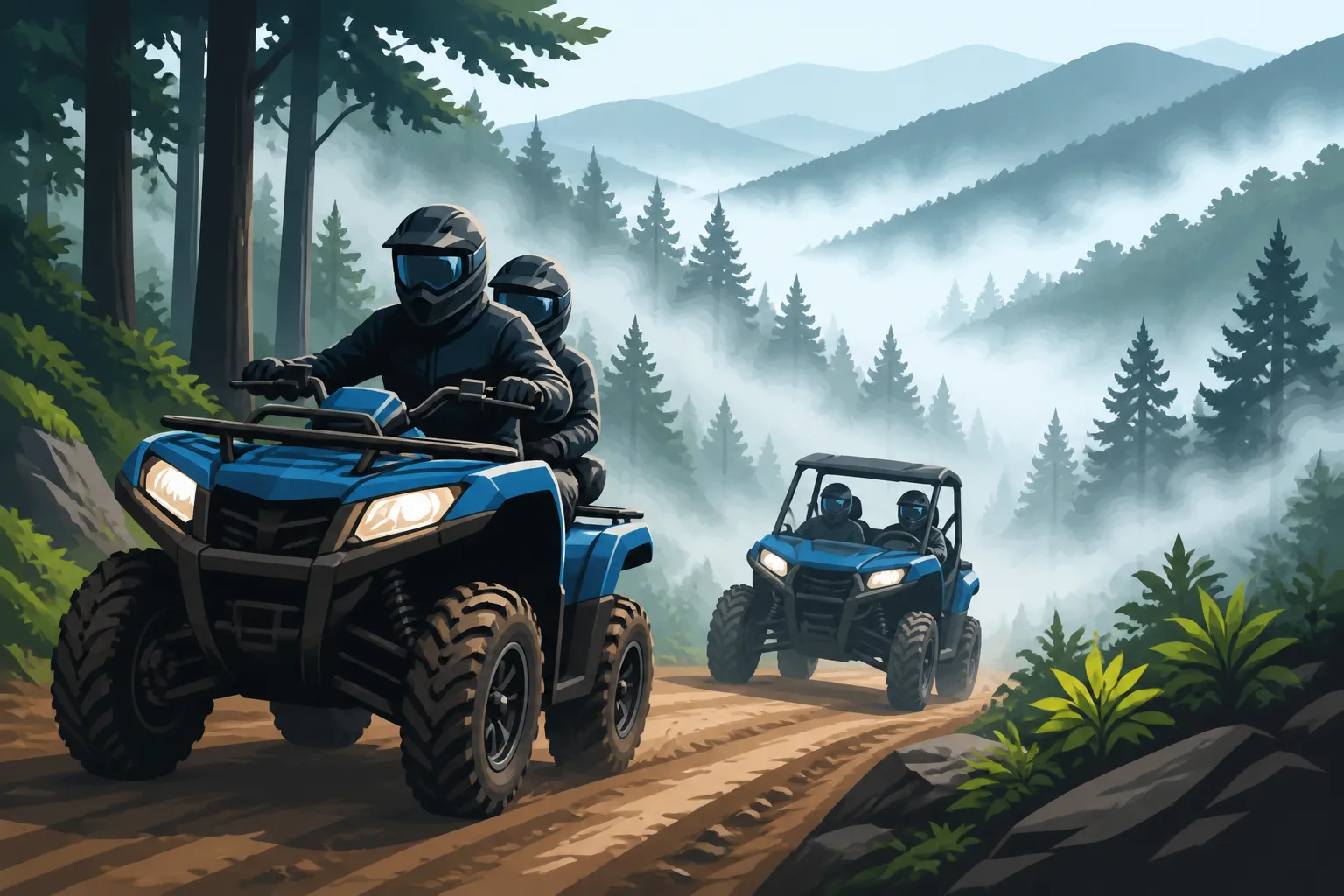
Riding a Blue Ridge Forest Road in Fog
A foggy Blue Ridge morning can turn a familiar forest road into a wall of gray, hiding bends, washouts, gates, and oncoming traffic until they are close. This guide explains how to decide whether to ride, prepare your ATV or UTV, manage visibility and road hazards, and turn around safely when conditions are beyond your comfort level.
Decide whether the road and conditions are suitable
Confirm that motorized travel is allowed
A road that appears on a map is not automatically open to ATVs or UTVs. In North Carolina’s national forests, motorized access depends on the road or trail’s current designation and any seasonal or temporary restrictions. Check the applicable forest motor vehicle use map and notices before you leave. A route that works for a highway vehicle, bicycle, or foot traveler may not be open to your machine.
This distinction matters around places such as Pisgah and Nantahala national forests, where public roads, forest roads, and designated off-highway routes can sit close together. Do not rely on a faded sign, an old screenshot, or tracks left by another rider as proof that you may continue. Review North Carolina Rules for Riding a Mountain Forest Road and North Carolina Forest Trail Maps as part of your planning.
Also separate forest access rules from street-use rules. An ATV or UTV that is allowed on a designated forest route is not automatically legal on the paved public road you use to reach it. Check North Carolina Rules for Riding a Public Street before planning any connection that involves pavement.
Check closures and weather before loading
Fog can settle into mountain valleys while nearby ridges look clear. Rain, a recent storm, or overnight temperature changes may also affect visibility and the road surface. Look for official forest or ranger-district notices before driving to the trailhead, then check again if conditions change during the trip. Checking a Forest Alert Before You Drive and North Carolina Trail Conditions Before You Ride can help organize that check.
Think about the whole route, not just the first mile. Ask whether you have a safe place to turn around, how you will get back if visibility worsens, and whether your group can stay together without riding bumper-to-bumper. A route that is manageable in light mist may become a poor choice when fog thickens around a blind curve or low-water crossing.
If you use onX Offroad to review a route, treat it as a planning aid rather than permission to ride. Confirm access against the relevant official map and notices. Mapping apps can help you keep track of where you are, but a displayed line does not establish that a road is open to your vehicle or that it remains passable.
Use a clear go-or-no-go test
Before setting off, ask whether you can see far enough to stop safely within the visible road ahead. If a bend, slope, or obstacle disappears into fog before you can judge it, slow down or postpone the ride. If you cannot tell where the road edge is, or you are unsure whether the track continues past a junction, do not press forward just to see what is around the corner.
A short delay can be frustrating, especially after trailering from Charlotte, Asheville, or another distant starting point. But arriving at a staging area does not make the route safe. If conditions are poor, choose a less exposed location, wait for visibility to improve, or call the ride off. A missed morning is easier to recover from than a collision or a machine stuck beyond a safe turnaround.
| What you notice | Safer response |
|---|---|
| Light mist with clear road edges | Ride cautiously only if the route is confirmed open |
| Fog hiding curves or junctions | Reduce speed and stop at a safe place to reassess |
| Road edge or surface no longer visible | Turn around if you can do so safely |
| A closure, gate, or uncertain access point | Do not go around it; check official guidance |
| Fog thickening while you ride | Stop outside the travel lane and consider returning |
Prepare the machine and group before riding
Check lights, brakes, tires, and controls
Fog makes it harder for other road users to see you, and it can make you misjudge distance. Check that the machine’s lights work, lenses are clean, tires are in good condition, and brakes respond predictably. Secure loose cargo and make sure mirrors, if fitted, are clean enough to use. A useful pre-ride check also includes steering, throttle return, horn or other warning device if equipped, and fuel level.
Use lighting suited to the machine and conditions. More light is not always better in fog: high beams can reflect off suspended moisture and make the view in front of you look even whiter. Keep lighting aimed so it helps you see the road without dazzling an approaching rider. For a narrow, twisting lane, Aiming a Headlight for a Narrow Mountain Lane offers a useful reminder to think about beam direction, not only brightness.
Carry basic recovery and repair items appropriate to your vehicle and route, such as a tire repair kit, tool kit, tow strap, and a charged phone or other communication device. On a remote forest road, a small problem can become a long wait if the group has no way to communicate or help a disabled machine. Do not assume you will have reliable cellular service in a mountain hollow.
Agree on spacing and communication
Fog changes how a group should ride. Leave enough room to stop without hitting the machine ahead, but do not spread out so far that the lead rider disappears. Agree on a pace that suits the least experienced rider and the machine with the shortest safe stopping distance. Establish simple signals for slowing, stopping, and turning around before helmets go on.
If the lead rider cannot see the next rider, the group is probably too spread out for the conditions. At the same time, tailgating is not a safe fix: a sudden brake or hidden pothole can cause a collision. Use designated pull-offs or other genuinely safe places to regroup rather than stopping in the active travel lane.
A quick briefing should also settle what happens if someone loses sight of the group. Agree that riders will stop in a safe location rather than continue alone, and make sure everyone knows the route back to the staging area. If the group is split across a junction, do not guess which branch the others took. Pause and communicate before moving.
Bring the right clothing and navigation
Mountain fog can feel colder and damper than the parking area, particularly when a moving machine adds wind chill. Wear layers that stay comfortable when damp, gloves that still let you operate the controls, eye protection that resists fogging, and a helmet suitable for the ride. Pack a dry layer in a sealed bag if the trip is long enough for clothing to become wet.
Keep navigation usable without depending on a live signal. Download or save the relevant route information ahead of time, and carry a paper map or another backup when practical. onX Offroad can be one way to keep track of a planned route, but compare what it shows with official access information before the ride. Make sure more than one person in the group knows the return route; the person carrying the phone should not be the only one who can navigate.
Ride slowly and handle fog hazards deliberately
Set a speed that matches what you can see
There is no single safe speed for every foggy forest road. The right pace depends on visibility, road width, surface condition, vehicle handling, and the presence of other users. The practical rule is to ride slowly enough that you can stop within the distance you can clearly see. If you cannot do that, slow down further or stop somewhere safe.
Avoid sudden acceleration and hard braking, especially on wet leaves, loose gravel, or slick clay. Keep both hands ready to control the machine and give yourself more room than you would on a clear day. Do not let a faster rider behind you pressure you into riding beyond your sight distance. Pull over only where the shoulder is stable and wide enough to keep the machine out of the path of traffic.
Fog can make familiar landmarks disappear. A turn that is obvious in sunshine may be difficult to recognize when the surrounding trees and ridgelines blend together. Check your location at deliberate pauses, not while staring down at a device as you ride. If the track becomes confusing, stop in a safe place and compare your location with your route plan before choosing a direction.
Expect people, vehicles, and changing surfaces
Forest roads may be shared with authorized passenger vehicles, trucks, maintenance crews, cyclists, hikers, and other riders. Visibility may give everyone less time to react. Stay to the appropriate side of the road, approach blind bends cautiously, and avoid cutting across the center of a narrow lane. Read Meeting a Log Truck on a Pisgah Forest Road before a trip where large vehicles may be present.
Fog can also hide surface changes. Water running across a road, loose rock, a washed-out edge, a fallen branch, or a deep rut may be difficult to see until you are close. Do not ride through standing water if you cannot judge its depth or what lies beneath it. Give steep slopes, narrow bridges, and drop-offs extra margin; turning around is preferable to testing an uncertain crossing.
At intersections, stop where you can see and be seen without blocking the route. Confirm the next direction using your map and the signs on the ground. If a sign is missing, blocked, or unclear, do not assume the route you planned is still open. A route decision made in the parking area is not more important than new information you encounter on the road.
Know when and how to turn around
Turn around when visibility keeps shrinking, the road surface becomes difficult to judge, you have lost confidence in the route, or a closure makes access uncertain. Do not wait until the machine is at the edge of a steep bank or wedged on a narrow bend. Look for a broad, stable area where you can maneuver without putting the vehicle or another road user at risk.
On a narrow road, avoid an abrupt multi-point turn in the travel lane. If no safe turning space is available, move only as far as needed to reach one, at a pace that keeps you in control. If another vehicle approaches, yield from a safe position rather than backing blindly around a bend. When you need to stop, choose a visible pull-off and keep the machine clear of the road whenever possible.
After turning around, do not treat the return trip as automatically safe. Fog may have thickened, traffic may have changed, and the downhill direction may affect braking. Continue to ride within your sight distance and regroup at a suitable spot. If anyone is shaken, cold, or struggling with visibility, end the ride rather than asking them to push through.
Make the trip safer from the trailhead to the return
Keep permits, maps, and trip details organized
Before leaving, confirm which permits or other access requirements apply to the specific riding area and machine. Requirements vary by location and can be different for public forest land, private off-road parks, and other properties. North Carolina Forest OHV Permits is a helpful starting point for understanding forest permit considerations, but check the relevant district’s current instructions for the place you plan to ride.
Share a simple trip plan with someone who is not riding: where you intend to park, which route you expect to take, and when you plan to return. Keep your phone charged and consider carrying a backup power source. If the plan changes, tell the person who has your itinerary when service is available. A route shared in advance is especially useful when a group’s return is delayed by poor visibility, a mechanical issue, or a closure.
When using onX Offroad or another navigation tool, save the map for offline use if that feature is available, and check the machine’s battery and mounting before setting out. Do not stop in a dangerous place to troubleshoot a device. Navigation should support good judgment, not replace looking at signs, checking the road, and recognizing when conditions have changed.
Give yourself time and an easy exit
Build extra time into the schedule so the group does not feel rushed to finish a loop before dark. Fog, slow travel, and a cautious turnaround can make a short route take longer than expected. Set a time by which you will head back, even if you have not reached the planned destination. A ride is not a failure because you choose to turn around early.
If fog is expected, consider a shorter route with more straightforward navigation and clear turnaround options. Tell the group that the route may be shortened without debate. This helps avoid the familiar pressure of having already driven a long distance or paid for access and feeling that you must complete every mile.
Before you leave the staging area, confirm that everyone has the route information, understands the group plan, and knows what conditions will end the ride. Then check the road again at the first safe opportunity. The Blue Ridge can be beautiful in fog, but no overlook or loop is worth continuing when you can no longer see enough to ride safely.
Disclaimer
This article is for general informational purposes only and does not constitute professional advice. Laws, prices and regulations vary by location and change over time. Consult a qualified professional for guidance on your specific situation.