North Carolina Fines for Riding Without a Permit
Riding an ATV or UTV on a North Carolina forest trail without the required permit can turn a planned outing into a citation and an avoidable expense. The hard part is that there is no single permit rule for every road or trail in the state. Here’s how to tell when a permit applies, what a citation may mean, and what to do if an officer stops you.
What riding without a permit means in North Carolina
A permit is not a general statewide ATV or UTV registration. It is an access requirement for particular riding areas and trails. A machine may need a permit to use a designated off-highway vehicle trail even though North Carolina does not require ATV registration in the way some states do.
This distinction matters because riders sometimes check only whether their machine is registered at home, or assume that a title, insurance policy, safety certificate, or trail pass from another state will cover local access. Those documents serve different purposes. A forest permit authorizes use of a specific managed riding area under its rules; it does not make a machine street legal or give permission to ride anywhere in a national forest.
The clearest practical rule is to check the permit requirements for the exact riding area before unloading. North Carolina’s national forest OHV systems can have their own permit arrangements, operating seasons, and trail rules. Brown Mountain, Badin Lake, and Wayehutta are examples of named OHV areas where riders should verify current access details before traveling. Start with North Carolina Forest OHV Permits and Do You Need a Permit for North Carolina Forest Trails?.
A rider may be considered to be riding without the required permit when they:
- Enter or operate a machine on a trail or area where a permit is required without obtaining the required permit.
- Use a permit that does not apply to that area or type of access.
- Ride a machine that is not covered by the permit, where the permit rules require one for each vehicle.
- Fail to display or carry the permit as directed by the current instructions.
- Continue riding after a permit or access authorization has expired or no longer applies.
The exact conduct that can lead to a citation depends on the forest order, permit conditions, and the facts on the ground. A permit bought for one riding area should not be assumed to cover another. Likewise, a permit that covers one machine should not be treated as a group pass unless the current permit terms explicitly say it covers multiple vehicles.
A permit violation is also different from riding on a closed trail, leaving a marked route, or riding in an area where motorized use is not allowed. Those can be separate violations, and more than one issue may be cited during the same stop. For related restrictions, see [North Carolina Fines for Riding a Closed Trail] and [North Carolina Rules for Riding Off the Trail].
What fines and other consequences may follow
There is no reliable single dollar amount to quote for every North Carolina “no permit” citation. The consequence depends on where the ride occurred, which authority issued the citation, the specific rule or forest order involved, and whether other violations are alleged. A roadside warning, a citation requiring a response, and a court case are not interchangeable outcomes.
On national forest land, federal rules and orders may apply. An enforcement officer may issue a citation or direct the rider to stop using the area. If the matter proceeds formally, the citation will identify the alleged offense and instructions for responding. The amount and process should be confirmed from the citation or the court or agency named on it, rather than guessed from a general online figure.
A rider should take the paperwork seriously even if the stop seemed brief or the officer described the issue as minor. Missing a response deadline, paying a citation without understanding what it resolves, or assuming that a permit bought afterward cancels the alleged violation can create additional problems. Follow the instructions printed on the citation and contact the issuing agency or court if anything is unclear.
| Situation | What may happen | What to check |
|---|---|---|
| No required permit on a permit-controlled trail | An officer may issue a citation or require the rider to leave the area | The specific permit rule and instructions on the citation |
| Permit is for a different area or machine | The rider may be treated as lacking the required authorization | Permit terms, area name, and vehicle coverage |
| No permit plus riding a closed trail | Separate allegations may apply | The closure order and the exact charges listed |
| Permit purchased but not displayed or carried as directed | The officer may need to verify whether the permit is valid and properly used | Current display rules and proof of purchase |
| Rider receives a warning | The warning may not settle a separate or later citation | Ask what the warning covers and keep any paperwork |
A permit bought after the stop may help the rider comply before returning, but it does not automatically erase a prior allegation. Similarly, a receipt may help establish that a purchase was made, but it is not a guarantee that an officer will treat the permit requirement as satisfied. The permit’s validity, the area it covers, the machine it applies to, and the required display method all matter.
Other practical consequences can be just as disruptive as a fine. The ride may end early, a group may have to turn back, and a rider may spend time dealing with an agency or court process. If a machine has also been operated on a closed trail or outside the marked route, the rider may face additional scrutiny. Do not assume that paying for a permit at the trailhead settles every issue raised during a stop.
For a citation that may affect more than one rider or machine, keep each person’s paperwork separate. Note who was operating which machine, what permit was purchased, where the group entered, and what the officer said. A clear record makes it easier to understand the alleged conduct and respond accurately.
Where a permit is required and why reciprocity is not enough
Permit rules attach to riding areas, not simply to the rider’s home state or license plate. A visiting rider should check the North Carolina area’s requirements in the same way a resident would. A registration, title, or sticker issued elsewhere does not automatically substitute for a permit required by a North Carolina forest riding area.
The same applies to a safety card. North Carolina has a separate safety-certificate rule based on the rider’s birth year for certain forest trail use. A certificate is not a riding permit, and having one does not excuse a missing area permit. Conversely, buying a permit does not necessarily satisfy an applicable safety-certificate requirement. Review North Carolina ATV Safety Certificate Requirements separately from the permit information.
Before a trip, verify these points for the specific destination:
- Whether the route is a permit-controlled OHV trail. A public road, a forest road, a developed recreation area, and a designated OHV trail may not follow the same access rules. Do not treat every unpaved route as an ATV trail.
- Which permit is accepted. A day permit and a season permit are different products, and the available choices may vary by area. See North Carolina’s Forest Day Permit and The Forest Season Permit in North Carolina.
- Whether a permit is required for each machine. Some forest permit systems require a separate permit for every vehicle. Check Why a Permit Is Per Vehicle in North Carolina instead of assuming the driver’s pass covers a convoy.
- How the permit must be displayed or carried. Follow the instructions provided at purchase and posted by the managing agency. A digital confirmation, paper receipt, or decal may not be interchangeable.
- Whether the area is open. A valid permit does not authorize riding during a closure or on a route that is not open to motorized use. Check North Carolina Trail Closures to Check First before loading the trailer.
- Where to buy the permit. Confirm that a sales location or online option is available for the area and time you plan to arrive. Where to Buy a North Carolina OHV Permit can help with the practical planning.
The phrase “North Carolina permit” can make the system sound more uniform than it is. In practice, permit details can vary between forest riding areas, and seasonal arrangements can change. A permit intended for one area should not be assumed valid at another just because both are in North Carolina or managed within national forests.
Do not rely only on a friend’s old pass, a post from a prior season, or a sign remembered from a previous trip. Access details can change. Confirm current requirements with the managing agency or the official information for the riding area shortly before departure, especially if the trip is planned around a holiday or a season opening.
What to do if an officer cites you
A stop can be stressful, especially when the group is far from the trailer or the trailhead. Keep the interaction calm and focus on understanding what the officer says the violation is. Do not argue on the trail or try to leave before the officer has finished giving instructions.
At the trail
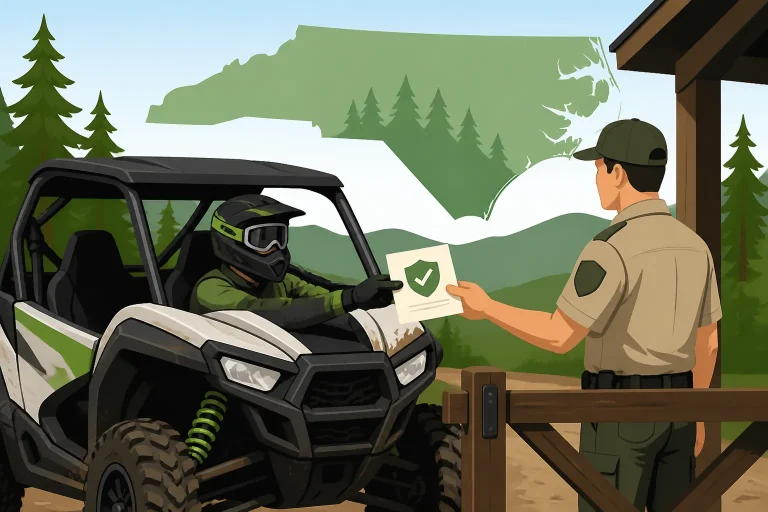
Ask respectfully which permit rule or trail order the officer believes applies. If you have a permit, show it and explain which machine and area it covers. If you have a receipt but cannot find the permit itself, say so plainly and ask whether the receipt is useful. Avoid claiming that a permit covers the ride unless you have checked the conditions.
Write down or photograph relevant details when it is safe and lawful to do so. Useful information may include:
- The citation or warning number and the issuing agency.
- The date, approximate time, and location of the stop.
- The trail or access point the group used.
- Which machine was being operated and by whom.
- The permit type, purchase record, and display method.
- Any instruction to leave, stop riding, or avoid a particular route.
If an officer directs the group to leave or stop using a trail, comply. Continuing after being told to stop can turn a permit dispute into a more serious situation. Make sure the group knows where it is allowed to go next; do not simply follow another machine onto an unmarked or closed route.
After receiving paperwork
Read the entire citation, including the response instructions. Identify the alleged offense, the issuing authority, any response date, and whether the document requires a court appearance or another action. If a document is difficult to interpret, contact the office or court listed on it rather than relying on an informal summary from someone who received a different citation.
Keep the citation with any documents that may help explain what happened. These could include the permit confirmation, photographs of the permit and machine, the route map, and messages showing when the group checked access information. Do not alter or discard records because they seem unimportant at the time.
If the citation involves a disputed interpretation of a forest order, multiple alleged violations, or a potential court case, consider getting legal advice from a qualified professional. The right response depends on the specific charge and facts; an online discussion about another trail or another rider may not match your situation.
Before riding again
Resolve the permit question before returning to the area. Confirm the correct permit, the required display method, and whether the route is open. If the group includes several machines, check the permit for each one. A rider who was warned or cited should not rely on the assumption that the same setup will be accepted on a later trip.
How to avoid a no-permit citation
The safest approach is to make the permit check part of trip planning rather than something handled after reaching the trail. This is particularly important for visitors, groups with several machines, and riders going to an area they have not used before.
Use a simple pre-ride check:
- Name the exact riding area. “A national forest near the lake” is not specific enough. Identify the OHV system or trailhead you plan to use.
- Confirm that the intended route is open to your machine. Trail access, width limits, temporary closures, and route designations can affect where you may ride.
- Check current permit requirements. Confirm the permit type, purchase method, validity, and any display instructions directly with the managing agency.
- Match permits to machines. If the system requires a permit per vehicle, make sure every ATV or UTV has its own.
- Keep proof accessible. Store the required permit where it can be shown without digging through luggage or leaving the machine unattended.
- Carry the required safety certificate if the rule applies to you. Treat it as a separate requirement, not a substitute for the permit.
- Brief the whole group. Tell each operator which trails are open, where permits are displayed, and what to do if the group encounters a closure.
- Recheck close to departure. A recent closure notice or changed access detail can make an older plan unreliable.
If you are buying a permit shortly before riding, read the instructions before leaving the sales point. Confirm the area name and dates, whether the permit is attached to a particular vehicle, and whether it must be placed somewhere visible. If you are unsure whether a receipt counts as proof or how a permit should be shown, ask the seller or managing agency before entering the trail.
A well-planned group ride also needs a clear lead and sweep rider. The lead can check trail signs and prevent the group from drifting onto a closed route; the sweep can make sure no one is left behind or misses a turn. Neither role replaces each operator’s responsibility to have the correct permit and follow posted restrictions.
Finally, keep permit requirements distinct from permission to ride on private land, public roads, or other forest roads. A forest permit only covers the access described by its terms. It does not grant permission from a private landowner, authorize road use, or override a closure. If you are uncertain whether a route is included, stop and verify before riding it.
Frequently Asked Questions
Is there one statewide fine for riding an ATV without a permit in North Carolina?
There is no single amount that safely applies to every situation. The outcome depends on the location, applicable rule, issuing authority, and any other alleged violations. Use the citation and the named court or agency to confirm the exact process and consequence.
Does an out-of-state registration replace a North Carolina forest permit?
No. Registration and trail access permits serve different purposes. A registration from another state does not automatically satisfy a permit requirement for a North Carolina riding area.
Does one permit cover every machine in a group?
Do not assume so. Some permit systems require a separate permit for each vehicle. Check the current terms for the specific riding area and match the permit to each machine as required.
If I buy a permit after being stopped, does that clear the citation?
Not automatically. A later purchase may help you comply before riding again, but it does not by itself cancel an earlier allegation. Follow the citation’s instructions and contact the listed authority if you need clarification.
Disclaimer
This article is for general informational purposes only and does not constitute professional advice. Laws, prices and regulations vary by location and change over time. Consult a qualified professional for guidance on your specific situation.