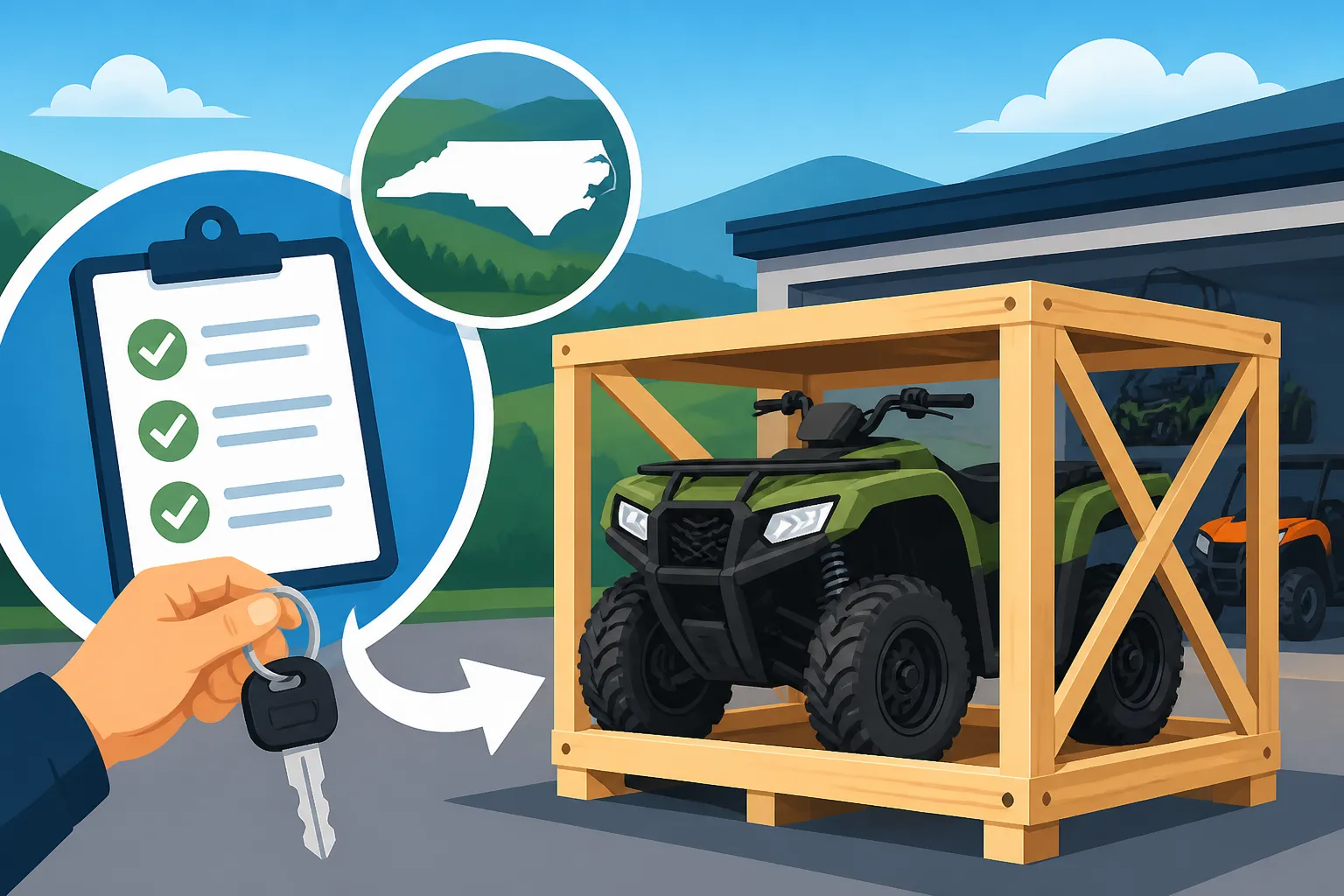
Titling a Quad Still Crated at a Piedmont Dealer
So, you've just made the exciting purchase of a brand-new quad from a dealer somewhere in North Carolina's beautiful Piedmont region, maybe near Statesville or out towards Rocky Mount. That machine is probably still sitting there in its crate, gleaming with potential, and you're already dreaming of tearing up some trails. But before you can uncrate it and truly make it yours, you've got to navigate the world of North Carolina's ATV titling process. It might seem a bit odd to title something that's still in a box, but this guide is here to demystify every step, ensuring your crated quad is legally recognized and ready for adventure.
Why a Crated Quad Needs a Title Even If It's Not Registered
This is one of those quirks of North Carolina law that often stumps new ATV owners, and honestly, it can be a source of real frustration! You’ve probably heard that North Carolina doesn’t require ATVs to be registered for off-road use, which is absolutely true for most machines you’ll take to a place like the Uwharrie National Forest. So, if there's no registration, why on earth do you need a title, especially for a machine that hasn't even seen the light of day outside its packaging? It’s a valid question, and understanding the distinction is key.
The Difference Between Titling and Registering in North Carolina
Let's clear this up right from the start: for your typical recreational ATV, North Carolina does not require registration for general off-road use. This often surprises folks moving from states with mandatory ATV registration. You won't be getting a license plate or a yearly sticker for your quad just to ride it on trails. We’ve covered this in more detail in posts like [Why North Carolina Has No ATV Registration] and [Do You Need to Register an ATV in North Carolina?]. The state recognizes that these machines are primarily for private land or designated off-highway vehicle (OHV) parks, not public roads.
However, titling is an entirely different beast. A title is essentially the official legal document that proves you are the rightful owner of a vehicle. Think of it like the deed to a house, but for your ATV. Even if your quad never sees a public road – and honestly, most won't, outside of very specific exceptions like farm use or Modified Utility Vehicles – having a title is incredibly important. It establishes clear ownership, which is absolutely critical for several reasons. For one, if you ever decide to sell your machine, a clean title makes the transaction smooth and legitimate. Buyers almost universally expect a title, even if it's not legally mandated for their off-road enjoyment. Secondly, if your prized possession is ever stolen, a title is your primary proof of ownership when reporting it to law enforcement and trying to get it back. Without it, proving that the ATV is yours can be a real headache. Lenders also insist on titles if you finance your purchase, as it gives them security in the loan. We delve into these benefits more deeply in [Why a North Carolina Title Is Worth Having]. So, while optional, it’s practically a necessity for protecting your investment.
The Dealer's Role and Your Responsibility
When you buy a brand-new, crated quad from a dealer, especially one here in North Carolina, they play a pretty significant role in the initial paperwork. Most reputable dealerships are well-versed in the process and will guide you through what they handle and what you’re responsible for. Typically, the dealer will take care of preparing the initial Manufacturer's Statement of Origin (MSO) – which we'll talk more about in a minute – and might even collect the highway use tax and title fees on behalf of the state, then submit everything for you. This is the ideal scenario, as it makes your life much easier!
However, it's absolutely crucial that you clarify exactly what your dealer is doing. Don't just assume. Ask direct questions: "Will you be submitting the title application for me?" "What paperwork will I walk out of here with today?" "What do I need to do next?" Some dealers, especially smaller ones or those focused purely on sales, might hand you all the necessary documents and tell you to take them to the DMV yourself. This isn't necessarily a problem, but it shifts the responsibility onto you, and you need to be prepared for that. If you're buying from a dealer who doesn't explicitly offer to handle the titling, you'll be the one making that trip to the DMV. Make sure you understand their process fully before you sign on the dotted line, so there are no surprises down the road.
Essential Paperwork for a Brand-New, Crated Quad
Navigating the DMV can feel like a labyrinth, but with the right paperwork in hand, it's much smoother. For a brand-new quad, especially one still in its crate, there are a few key documents you absolutely must have. Gathering these upfront will save you untold frustration and repeat trips to the NCDMV office. Think of it as your golden ticket to ATV ownership.
Manufacturer's Statement of Origin (MSO) – The Holy Grail
When you buy a brand-new ATV, it doesn't come with a title because it's never been owned by anyone before you. Instead, it comes with something called a Manufacturer's Statement of Origin, or MSO. This document is, effectively, the very first "title" for your machine. It's issued by the manufacturer to the dealer, and then assigned to you upon sale. The MSO confirms that the vehicle is new, hasn't been titled before, and identifies all the key details like the make, model, year, and crucially, the Vehicle Identification Number (VIN).
This MSO is the single most important piece of paper you will receive from your dealer. You cannot title a brand-new ATV in North Carolina without the original MSO. Do not accept a photocopy, and do not leave the dealership without ensuring they have given you the original, properly signed and dated MSO with the assignment section filled out in your name (or your financing company's name, if applicable). If your dealer is handling the titling for you, they will submit this original MSO directly to the DMV. If you're doing it yourself, this MSO is your prized possession that you'll hand over at the DMV counter. Losing it is a major headache, as you'd then have to go back to the dealer to request a duplicate, which can delay everything.
Application for Certificate of Title (Form MVR-1) and Highway Use Tax
Once you have that MSO in hand, the next critical step is to complete the North Carolina [North Carolina Title Application on Form MVR-1]. This form is straightforward but requires accurate information. You'll fill in your personal details, the ATV's information (which you can get directly from the MSO), and details about the purchase. Make sure every box is filled in clearly and legibly to avoid any delays. If there's a lienholder (like a bank or credit union that financed your purchase), their information will also need to be included on this form.
Now, let's talk about the [North Carolina's 3 Percent Highway Use Tax]. This is where many folks get a bit confused. Even though your ATV won't be registered for highway use, North Carolina assesses this tax on the sale of new and used vehicles that are titled in the state. It's not a sales tax in the traditional sense, but rather a tax on the privilege of using the highways (even if your machine primarily avoids them!). For your new, crated quad, this tax will be 3% of the purchase price. So, if you paid $10,000 for your new machine, expect to pay $300 in highway use tax. This tax is typically paid at the time of titling at the NCDMV. We explore this in more detail in [3 Percent of Retail Value in North Carolina]. Ensure you bring an acceptable form of payment for this, along with the title fee, when you head to the DMV.
Bill of Sale and Other Supporting Documents
While the MSO is paramount for a new machine, and the MVR-1 is the official application, a clear bill of sale from the dealer is still a very good idea to have. Even though a reputable dealer will provide their own sales contract, for your own peace of mind and to ensure all details are clearly recorded for your personal records, you might consider using a professional bill of sale template. Services like LawDepot offer customizable templates that can help you create a comprehensive record of the transaction, detailing the buyer, seller, purchase price, and the specific ATV being sold. This can be especially useful for confirming the exact purchase price that the highway use tax will be based on, leaving no room for ambiguity.
Additionally, remember to bring your valid driver's license or state-issued ID as proof of identity. The DMV needs to verify who you are when you're titling a vehicle. You'll also need proof of North Carolina residency, which your driver's license usually covers, but sometimes they might ask for a utility bill or other official mail if your address isn't current. For ATVs, you typically won't need an odometer disclosure statement (Form MVR-1A) since they're not designed for road mileage, but it's always good practice to ask your dealer if any other specific forms might be required in your unique situation. Having a solid paper trail is always wise; beyond the MSO and title application, a comprehensive bill of sale, perhaps drafted using a service like LawDepot, can strengthen your proof of ownership, especially if you ever need to sort out an issue.
Here's a quick checklist for your titling day:
| Document/Item | Purpose | Who Provides It |
|---|---|---|
| Original Manufacturer's Statement of Origin (MSO) | Proof of new vehicle from manufacturer | Dealer |
| Completed Form MVR-1 | Application for your NC title | You (or Dealer if they submit for you) |
| Bill of Sale | Proof of purchase price for tax calculation | Dealer (or template from LawDepot) |
| Valid Photo ID | Proof of identity and NC residency | You |
| Payment for Highway Use Tax | 3% of purchase price | You |
| Payment for Title Fee | Statutory fee for issuing the title | You |
The Titling Process at the North Carolina DMV
Alright, you’ve gathered all your documents, triple-checked them, and you’re ready to take the plunge. The actual act of titling your crated quad usually happens at your local North Carolina Division of Motor Vehicles (NCDMV) office. While it might sound daunting, especially if you’re not a fan of waiting in line, knowing what to expect can make the process much smoother.
Where to Go and What to Expect
Your journey to officially title your new ATV will take you to any full-service NCDMV office across the state. Whether you're in the mountains, at the coast, or in the heart of the Piedmont near Greensboro or Charlotte, you'll find a location. We’ve covered this ground before in [Where to Title an ATV in North Carolina]. Once you arrive, you’ll typically take a number and settle in for a wait. Peak times, like lunch hours or the end of the month, can be particularly busy, so if you have flexibility, try to go during off-peak times.
When your number is called, you'll approach a counter with a DMV technician. Present all your carefully prepared documents: the original MSO, your completed Form MVR-1, your bill of sale, and your identification. The technician will review everything to ensure it's complete and accurate. They'll also calculate the exact amount of highway use tax and the title fee you owe. Be prepared to pay these fees at the counter. Once everything is processed and payments are made, the technician will give you a receipt acknowledging your application and payment. It’s important to understand that you won't walk out with your physical title that day. Instead, the NCDMV will mail the official Certificate of Title to you, typically within a few weeks. This waiting period is standard, so don't fret if it doesn't arrive immediately. We discuss this process in more detail in [How Long the DMV Takes to Mail a Title].
Overcoming Common Hurdles with a Crated Machine
Even with all your ducks in a row, sometimes unexpected issues can pop up. One common hurdle, especially with a brand-new machine, might involve the MSO itself. What if there’s a typo on the MSO? Or perhaps the dealer accidentally filled out the assignment portion incorrectly? These small errors can cause delays. If you notice any discrepancies, it's best to address them with the dealer immediately, before heading to the DMV. The dealer is responsible for providing a correct MSO. Similarly, a dealer might sometimes delay providing the MSO if they haven't received it from the manufacturer yet, or if there's an internal processing lag. Stay on top of them if you experience delays – your titling process can't move forward without that document.
Another potential area of confusion can arise simply because an ATV isn't a typical "vehicle" the DMV deals with daily for titling purposes, especially one still in its crate. While most technicians are well-versed, occasionally you might encounter one who is unfamiliar with titling an off-road-only machine. If they express confusion about why an ATV needs a title without registration, politely explain that while registration isn't required for off-road use, titling is an option for establishing ownership, which is crucial for finance, resale, and theft protection. Refer back to the MVR-1 form's instructions if necessary, as it applies to all vehicles requiring a title. If for some reason the MSO is lost or irretrievable from the dealer, which is a rare but stressful situation, getting a duplicate from the manufacturer via the dealer is paramount. This can sometimes be a lengthy process. In such unique cases, legal document services such as LawDepot can sometimes provide frameworks or guidance for formal requests or affidavits of lost documents, though it's usually best handled directly through the dealership's chain of command.
What Happens After You Submit Your Paperwork
After you successfully submit all your paperwork and pay the necessary fees at the NCDMV, the hard part is over! You'll leave with your official receipt, which is your temporary proof that you've applied for the title. Keep this receipt in a safe place. This document serves as evidence that you've initiated the titling process, which is important if you plan on taking your new quad on a trail trip soon. While a title isn't typically required to ride at a place like Brown Mountain or Badin Lake, having proof that you're in the process of titling it can be helpful if any questions arise about ownership. [Titling Before a North Carolina Trail Trip] is a good read if you're eager to get out there.
The NCDMV will then process your application. This involves reviewing everything internally, ensuring no issues, and then printing and mailing your official Certificate of Title. The typical [North Carolina ATV Title Processing Time] can vary, but generally, you can expect to receive your title in the mail within 2-3 weeks. During peak times or if there's a backlog, it might take a bit longer, so patience is key. Once that title arrives in your mailbox, congratulations! Your brand-new, previously crated quad from that Piedmont dealer is now officially and legally yours in North Carolina. You've completed all the essential [North Carolina ATV Title Paperwork] and can now confidently enjoy your machine, knowing you have undeniable proof of ownership.
Disclaimer
This article is for general informational purposes only and does not constitute professional advice. Laws, prices and regulations vary by location and change over time. Consult a qualified professional for guidance on your specific situation.