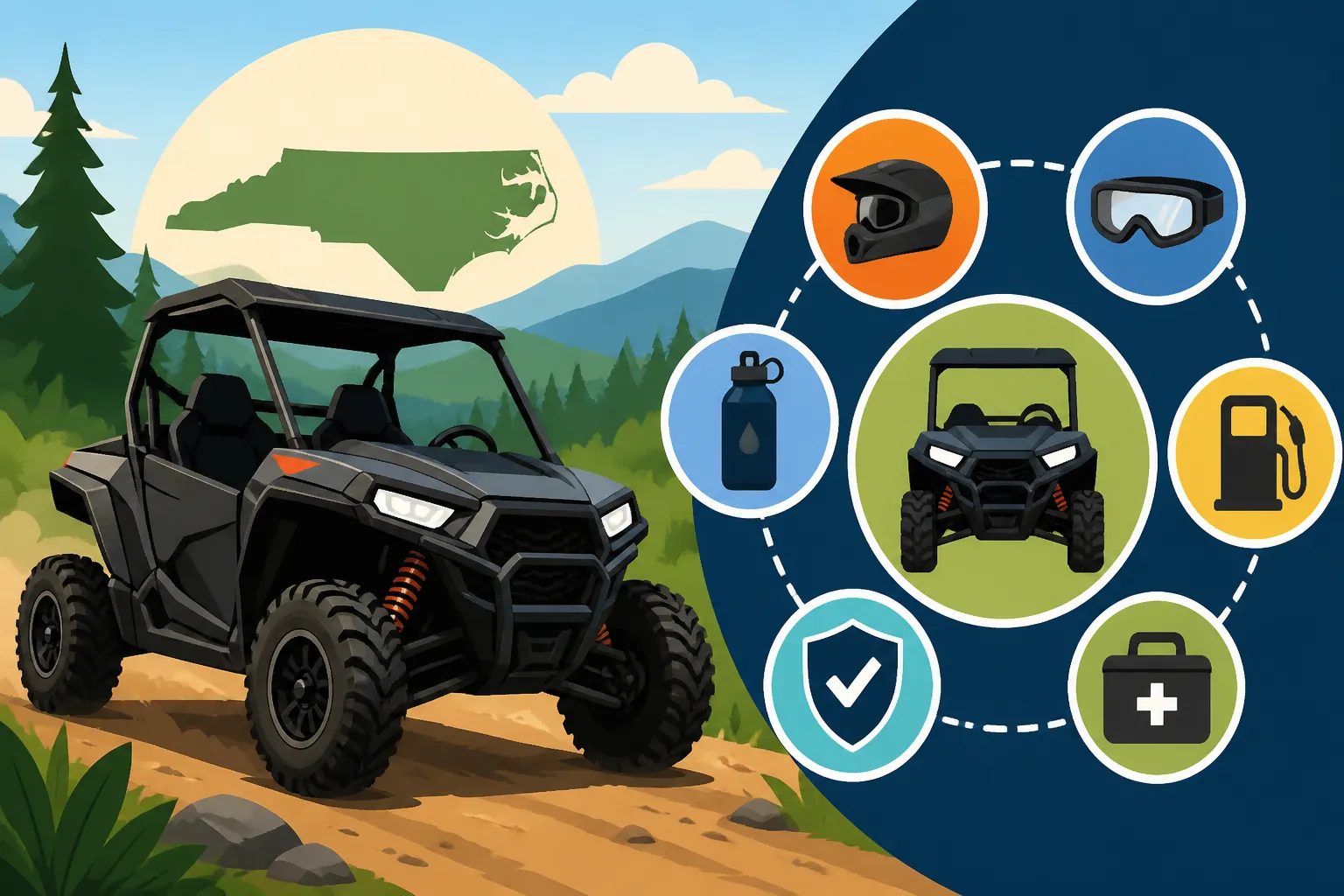
What a North Carolina UTV Rental Includes
A North Carolina UTV rental can mean anything from a machine and a helmet to a guided ride with route planning and support. The hard part is knowing what is actually included before you book. Use this checklist to compare rentals, spot likely extra costs, and confirm that the machine and ride fit your plans.
What a standard North Carolina UTV rental may include
Most rentals start with use of a UTV for a set period, but the details vary by operator. A booking might cover a machine for a half day, a full day, or a longer trip. Some rentals are self-guided, while others are guided tours with a leader and a planned route. Never assume that two bookings described as a “UTV rental” come with the same equipment, access, or support.
A rental package may include:
- The UTV for the booked period
- A basic orientation or safety briefing
- A helmet for each permitted rider
- Goggles or other eye protection
- A route map or directions, if the ride is self-guided
- A guide, if the booking is explicitly for a guided tour
- A forest permit, if the operator says it is included
- Fuel for the ride, or a starting fuel level explained at pickup
- Basic roadside assistance or a recovery process
Treat that list as a set of questions, not a promise. Some operators provide only the machine and required safety information. Others bundle protective gear, a route, and trail access into one booking. Equipment may also depend on the machine, rider size, group arrangement, and operator policies.
A clear booking page should tell you which vehicle you are reserving, how long you can use it, where you may take it, and whether the quoted amount covers any trail permit. If the page is vague, ask the operator to confirm the details in writing before paying. A useful starting point is What a North Carolina UTV Rental Includes—but because this is the title of this article, use the questions below to evaluate a specific operator instead.
Many listings leave out practical details that matter on ride day. For example, “helmet provided” does not tell you whether goggles are included, whether you can bring your own helmet, or whether the shop has sizes that fit everyone in your group. “Trail access” does not necessarily mean that a permit is covered, that every nearby trail is open, or that the route is suitable for the machine you booked.
| Item | What may be included | What to confirm |
|---|---|---|
| UTV | Use for a set rental period | Seating, model class, passenger limit, pickup and return times |
| Orientation | Basic controls and safety information | How long it takes and whether it includes route-specific guidance |
| Helmet | One per approved rider | Fit, sizing, condition, and whether goggles are separate |
| Fuel | A starting level or fuel for a stated route | Who pays to refill, what happens if you run low, and where to refuel |
| Trail access | A route recommendation or permit | Whether the permit is included and which trails it covers |
| Guide | A leader for an organized ride | Group size, route, pace, and what happens if the group is delayed |
| Support | Help if the machine has a problem | Who to call, where to stop, and whether recovery charges may apply |
The operator’s contract and pickup briefing should settle any uncertainty. If a service is important to your day, such as a helmet for each passenger or a permit for a particular forest trail, ask about it directly rather than relying on general advertising language.
The UTV, seats, gear, and passenger arrangements
The machine is the main part of the rental, but it is worth checking that it suits your group and your route. A side-by-side may have two, four, or more designated seats, depending on the model. The number of seats is not a suggestion: follow the manufacturer’s seating arrangement and the rental company’s passenger rules. Do not plan to carry an extra rider on a seat or in a cargo area.
Ask what class of UTV you are booking and whether the machine shown in the listing is guaranteed. Some operators reserve a machine category rather than a specific make or model. That can be reasonable, but a category is only useful if you know its seat count, approximate size, and intended use. A larger machine may fit more people but can feel different on narrow trails and require more space to maneuver.
Confirm who can drive and ride
Rental companies set their own rules for drivers and passengers. They may require a valid driver’s license, impose a minimum age for drivers, or ask a parent or guardian to participate when minors are in the group. The rules can differ between a self-guided rental and a guided tour, and a booking platform’s summary may not include every operator requirement.
Before you book, provide accurate ages and group details. Ask whether each adult passenger needs to sign a waiver, whether a minor can ride, and whether a minor must be accompanied by a particular adult. If your group includes younger riders, check the rental conditions as well as applicable state and land-manager rules. A rental company’s approval does not automatically make every riding arrangement legal. See North Carolina Rental Age and License Rules and [North Carolina Minimum Age to Ride Public Land] for related questions.
Do not assume that a person who is allowed to ride as a passenger can also drive. Confirm the requirements for each driver separately. If the rental involves a guided tour, ask whether only the guide may drive, whether customers may take turns, or whether the booking is for passengers in a guide-operated vehicle.
Ask what protective equipment is supplied
Helmets are commonly offered, but their inclusion, condition, and fit need to be confirmed. Find out whether the rental includes one helmet per rider or only per machine, whether sizes are available for children, and whether you can use your own properly fitting helmet. Ask whether goggles are included or whether you should bring them. Dust can make eye protection important even when the weather is clear.
Other equipment is less predictable. Gloves, rain gear, face coverings, and storage bags may be available, but do not count on them unless the operator confirms. Wear clothing that can handle dust, mud, brush, and changing weather. Closed-toe shoes that stay secure are a sensible choice for an off-road ride; ask the operator if it has additional footwear rules. Bring layers for a mountain outing, since conditions can differ from the forecast at your lodging or pickup point.
If you book for children, check that the operator has correctly sized equipment and that the machine’s seat belts or other restraints fit them. A helmet that is too loose or a belt that cannot be adjusted properly is not an acceptable substitute for the right fit. Bring up fit concerns before departure, when there is time to find another solution.
Fuel, permits, deposits, and other costs
The rental price is only one part of what a ride may cost. Fuel, trail access, damage protection, cleaning, delivery, and other charges are handled differently by different businesses. No single inclusion list applies to all North Carolina rentals. Ask for a written breakdown of what is included, what is optional, and what could be charged after the ride.
Fuel and range
Some operators supply the machine with a stated fuel level and expect it back at the same level. Others may include fuel for a specified tour, sell fuel as an add-on, or give you instructions for refilling before return. Read North Carolina Rental Fuel Policy before you book, then ask what happens if the machine runs low on a route.
A rough route estimate is not a guarantee of range. Terrain, speed, load, riding style, and stops can affect how quickly fuel is used. On a remote trail, running out can also mean a long wait or a recovery process. Ask whether the operator provides a fuel range estimate for the planned route, where the closest suitable fuel stop is, and whether you may carry a properly secured spare fuel container. Do not carry fuel unless the operator permits it and explains how to do so safely.
If fuel is not included, ask whether the machine must be refilled before return and what counts as an acceptable return level. Clarify whether the shop charges for refueling if you return below that level. “Full tank” and “fuel provided” are not always the same promise.
Forest permits and access charges
A rental booking does not automatically include permission to ride a public trail. On designated North Carolina national forest OHV trails, riders may need the appropriate permit for the machine. Permit requirements, sales locations, and operating conditions can vary by riding area. The key question is not simply whether the company operates near a forest; it is whether your specific route uses trails that require a permit and who is responsible for obtaining it.
Ask the operator:
- Does the route use a permit-controlled trail?
- Is the required permit included in my booking?
- If not, where do I obtain it, and when must I display or carry it?
- Does one permit cover the rented vehicle, or is another required for each machine?
- What should I do if a trail is closed on the day of the ride?
The operator may provide a permit, direct you to buy one, or choose a route that does not use a permit-controlled trail. Confirm the arrangement rather than assuming the rental price includes access. For general background, see North Carolina Forest OHV Permits and North Carolina Rentals That Include the Permit. Before driving to a riding area, check North Carolina Trail Conditions Before You Ride because closures or changing conditions can affect whether the planned route is usable.
A permit also does not make every nearby road or trail open to UTVs. Follow the route and land-use rules explained by the operator and land manager. Do not leave a marked route because another track looks inviting.
Deposit, damage protection, and possible charges
Many rental businesses require a deposit or place a temporary hold on a payment card. The amount, timing, release process, and accepted payment methods depend on the operator. Ask whether the deposit is separate from the rental charge, when it may be released, and what kinds of damage or contract violations can affect it. See North Carolina Rental Deposits and Card Holds for more on what to ask.
A damage waiver, if offered, is not necessarily the same as insurance and may not cover every loss. Exclusions can apply to rollovers, underbody damage, tires, misuse, unauthorized routes, or failure to follow the contract. The business should explain the terms before you decide. Read North Carolina Rental Insurance and Waivers and ask for the waiver wording rather than relying on a short description at checkout.
Other potential charges can include cleaning, late return, recovery, delivery, or a fee for missing equipment. These are not guaranteed parts of a rental, and they do not apply in the same way everywhere. Ask which situations may trigger them and how the shop determines responsibility. Practical coverage of questions such as cleaning and recovery is available in North Carolina Rental Damage Charges. Take photos of the UTV at pickup and return, including any visible damage, and report a concern to staff immediately.
Self-guided rentals, guided tours, and where you can ride
A self-guided rental and a guided tour are different services, even if both use a UTV. With a self-guided rental, you or your group generally follow an approved route without a staff member leading the ride. The operator may provide a map, directions, a limited riding area, or boundaries you must respect. With a guided tour, a leader typically controls the route and pace, explains the ride, and helps the group stay together. Confirm exactly what “guided” means for the booking.
A guide does not necessarily provide mechanical support, transportation, food, or a permit. Those are separate inclusions to verify. Likewise, a self-guided booking does not necessarily give you free choice of roads or trails. The rental agreement may limit where the machine can go, and some machines may not be allowed on particular public trails.
Ask about the route, not just the location
A business may advertise a rental near a forest, lake, or mountain area, but that does not prove the machine can be driven on every public road or trail nearby. Ask for the actual route or riding area. Find out whether it is private land, a managed OHV trail, a forest road, or a combination. Each type of land can have different access rules.
For a forest ride, ask whether the route stays on designated trails, whether there are width or machine restrictions, and whether the route is appropriate for a beginner. A side-by-side that is comfortable on a wide trail may be awkward on a narrow one. If you are new to off-road riding, ask about trail difficulty, steep sections, water crossings, rocks, and places where the group can stop safely.
A route can also change because of weather, maintenance, or land-manager closures. The operator should explain whether it can substitute another route, shorten the ride, or reschedule if conditions make the planned route unsuitable. A route description is more useful when it covers terrain and riding pace, not just scenery.
What a guide usually changes
A guided tour can reduce the planning burden, especially for visitors unfamiliar with local trails. A guide may lead the group, explain controls, set the pace, and choose a route that fits the group’s ability. Ask how many machines may be in the group, how often the group stops, and whether the guide rides in front or follows behind. Also ask how the guide handles a rider who needs to turn back or a machine that has a problem.
A guide is not a substitute for reading the waiver, wearing protective equipment, or following instructions. Ask whether the tour includes a briefing, whether riders can switch drivers, and what happens if someone is uncomfortable with the pace or terrain. If you are comparing an operator’s direct booking with a listing through Viator or Polaris Adventures, check the operator’s own terms as well as the listing. Confirm which business runs the ride and who handles changes, questions, and support.
Know the difference between road travel and off-road access
Do not plan to use a rented UTV as an ordinary road vehicle unless the operator has specifically confirmed that the machine and route are authorized for that use. A rental company may prohibit public-road travel even where a particular vehicle category has a legal path to road use. The machine’s appearance, license plate, or ability to reach a road does not establish that it can be driven there.
Ask whether the rental route requires any road crossing, who gives instructions for crossings, and whether the operator expects you to remain entirely on private or designated off-road property. For background, see North Carolina Rules for Riding a Public Street and North Carolina Rules for Crossing a Road. Follow the rental contract and posted controls; do not improvise a route between trails.
What is often not included, and how to read the terms
The easiest way to avoid a surprise is to separate the advertised package from the services you still need to arrange. A rental may include the vehicle but not its fuel. A tour may include a guide but not transportation to the starting point. A helmet may be supplied while goggles are not. A suggested route may be included without the permit needed to ride part of it.
Common exclusions to check include:
- Fuel or refueling at the end of the rental
- Trail permits or access fees
- Goggles, gloves, and weather gear
- Food, water, and transportation
- A second driver or additional passenger
- Delivery to a campground or lodging
- A damage waiver or other optional protection
- Recovery if the machine gets stuck or breaks down
- Cleaning after a muddy ride
- Extra riding time or late return
- A specific make or model rather than a vehicle category
An exclusion is not automatically a problem. It becomes a problem when you discover it after arriving or when you have planned around something the operator never promised. Match the booking page with the rental agreement, and ask about any difference between them. Keep the answer with your reservation details.
Read cancellation and weather terms before paying
Outdoor trips are vulnerable to rain, trail closures, mechanical trouble, and severe weather. Ask what happens if the operator cancels, a forest gate closes, or conditions make the route unsafe. The policy may distinguish between a customer cancellation and an operator-initiated cancellation. It may offer a reschedule, credit, refund, or another arrangement; the terms are set by the business or booking provider. Review North Carolina Rental Cancellation Policies before committing.
Do not assume that rain automatically means a ride is canceled. Some operators may ride in ordinary rain, while other conditions can make a route unsafe or unusable. Ask who makes the decision, when you will be notified, and whether the operator has a weather contact on the day of the ride. If you booked through a third-party platform, find out whether the platform or the local operator handles the change request.
Look for restrictions that affect the ride
Read the fine print for prohibited uses, maximum passenger count, driver qualifications, route limits, and required return time. Restrictions can include no riding after dark, no towing, no leaving the assigned route, or no use on certain trails. The exact terms depend on the machine and operator. If the rental is for a special purpose, such as hunting access or a trip with a child, ask the operator whether that use is permitted before booking.
The contract should explain how to report an incident or mechanical problem. Save the contact number in your phone before departure, and ask whether a staff member is available throughout the rental period. If the machine stops, stay in a safe location, follow the operator’s instructions, and avoid attempting repairs that the rental terms prohibit.
A practical booking and pickup checklist
A few direct questions can establish what you are paying for and whether the rental matches your group. Contact the operator before booking if the answers are not clear online. Use specific questions rather than “Is everything included?” That phrase can mean different things to the customer and the business.
Before you book
Confirm the following:
- Vehicle and seats: What type of UTV is included, how many approved seats does it have, and is a specific model guaranteed?
- Drivers and passengers: What are the age and license requirements? Can a passenger drive, and what rules apply to minors?
- Rental period: When does the clock start and end? Does the time include orientation, loading, or travel to the riding area?
- Route: Where may you ride? Is the route guided, mapped, or limited to a particular property or trail system?
- Permit: Does the booking include every permit needed for the planned route? If not, who obtains it?
- Gear: Are helmets and goggles provided for every rider? Are suitable sizes available?
- Fuel: What fuel level do you receive, and what level must the machine have at return?
- Support: Who do you contact for a breakdown, a stuck machine, or an injury?
- Protection and damage: What do the waiver and damage terms cover, and what exclusions or charges should you know about?
- Changes: What happens if you cancel, arrive late, or the operator changes the route?
Save the operator’s answers. If a booking is through a marketplace or tour platform, make sure you know the name of the local business responsible for the vehicle and pickup. Review Booking a North Carolina ATV Rental for more booking considerations, and use Renting a Side-by-Side in North Carolina when comparing the vehicle type itself.
At pickup
Arrive early enough to complete the paperwork, fit helmets, and listen to the briefing without rushing. Bring the required identification and payment method, and make sure the person who booked has the information the operator needs. If minors are riding, have the operator confirm any consent or supervision requirements before the group starts.
Before leaving, walk around the machine with staff. Point out existing damage and take clear photos of the exterior, tires, seats, belts, and any accessories. Check that the vehicle has the equipment you were told it would have. Ask how to operate the seat belts, lights, brakes, and any winch or storage feature that you will use. Do not attempt to use equipment without instruction.
Make sure every rider understands the route boundaries, meeting points, and emergency procedure. Confirm where to stop if the group gets separated and how to contact the operator if there is no cell service. In mountain and forest areas, cell coverage can be unreliable, so a phone number alone may not be enough; follow the operator’s plan for a lost or delayed group.
At return
Return the machine at the place and time in the agreement. Before handing it over, note the fuel level and take another set of photos. Tell staff about any warning light, mechanical issue, or contact with an obstacle, even if the machine still runs. Early reporting helps the operator assess the problem and is better than leaving an unexplained issue for the next renter.
Ask for confirmation that the machine and equipment have been checked in. If a cleaning or damage charge is proposed, request an explanation and documentation. Keep the contract and payment records until any deposit hold has been resolved. For general advice on documenting the vehicle and discussing damage, see Photographing a Rental at Pickup in North Carolina and Reporting Damage at a North Carolina Rental Counter.
Frequently Asked Questions
Does a North Carolina UTV rental automatically include a trail permit?
No. Permit coverage depends on the operator and the route. Ask whether your booking includes the permit required for every permit-controlled trail you plan to use. If it does not, confirm how and where to obtain one.
Are helmets and goggles included?
Helmets may be provided, but goggles and other gear are not guaranteed. Ask whether equipment is supplied for each rider and whether the operator has sizes that fit your group. You can also ask whether properly fitting personal gear is accepted.
Does the rental price include fuel?
It depends on the operator. Confirm the starting fuel level, whether fuel for the planned route is included, and what level is expected at return. Ask about refueling and possible charges if the machine comes back low.
Can a rented UTV be driven on public roads?
Do not assume so. The rental agreement may restrict road use, and a vehicle’s appearance does not establish that it can be driven on a public road. Follow the operator’s approved route and confirm any road crossing instructions before departure.
What should I ask before paying a deposit?
Ask how the deposit or card hold works, when it may be released, and what could lead to a deduction or charge. Read the damage and cancellation terms, and confirm the vehicle, route, permit, gear, fuel, and support included in the booking.
Disclaimer
This article is for general informational purposes only and does not constitute professional advice. Laws, prices and regulations vary by location and change over time. Consult a qualified professional for guidance on your specific situation.