What Is Illegal on an ATV in North Carolina
Riding an ATV in North Carolina can be an absolute blast, a fantastic way to explore the beautiful backroads, trails, and wild spaces our state offers. However, many riders, especially those new to the Tar Heel State or to off-roading in general, often find themselves scratching their heads over where they can and cannot legally ride their machines. It's a common frustration, the desire to connect one trail to another, or just run down the road to a gas station, only to be met with confusing rules and the very real risk of a ticket. This guide aims to clear up that confusion, diving deep into what exactly is illegal on an ATV in North Carolina, focusing specifically on public roads and associated operational practices, so you can ride confidently and within the bounds of the law.
The Core Problem: Why Most ATVs Are Illegal on North Carolina Roads
Let's get straight to the heart of the matter: your standard, factory-built ATV or UTV, as wonderful as it is for tearing up the dirt, is generally not street legal in North Carolina. This isn't just a random rule; it stems from a fundamental difference in how these machines are designed and regulated compared to traditional motor vehicles. Many riders express frustration, wondering why their powerful, four-wheeled machine can't handle a simple paved road, but the state sees a significant safety and regulatory gap.
The Fundamental Mismatch Between ATVs and Highways
Think about what makes a car or motorcycle safe for public roads. They have specific lighting, mirrors, turn signals, speedometers, horn, and often impact-absorbing structures, all designed to meet stringent federal and state highway safety standards. ATVs, by their very nature, are designed for off-road use. They typically have low-pressure tires optimized for traction on loose surfaces, not for stability and grip on pavement at higher speeds. Their suspension systems are built for absorbing bumps and jumps, not necessarily for smooth, controlled handling on asphalt.
Beyond the physical design, there's the issue of safety features. Many ATVs lack proper street-legal lighting configurations, turn signals, and even rear-view mirrors that are standard on road-going vehicles. The seating position, often straddling the machine, and the absence of a conventional steering wheel can make them less predictable in traffic. Because of these inherent design differences, the North Carolina Department of Motor Vehicles (DMV) classifies most ATVs as off-highway vehicles, making them unsuitable and therefore illegal for general public road use. It's not about horsepower or the number of wheels; it's about meeting a comprehensive set of safety and equipment standards that most ATVs simply don't possess straight from the factory.
The Frustration of Limited Road Access for Riders
We get it. It's incredibly frustrating to know there's a fantastic trail system just a few miles down a paved road, or that the nearest gas station is only a short hop away, but you can't legally ride your machine to get there. This often leads to needing a truck and trailer just to move your ATV a short distance, adding extra time, cost, and logistics to what should be a simple outing. This limitation can feel counterintuitive, especially if you're coming from a state with more lenient ATV road laws or if you see other types of vehicles, like golf carts, sometimes allowed on certain public roads.
The desire to connect trails, access small-town amenities, or simply reach private property without loading and unloading a trailer is a very real pain point for North Carolina riders. This frustration sometimes pushes riders to take chances, ignoring the law for convenience, which can lead to serious consequences. Understanding why these rules exist, even if you disagree with them, is the first step in avoiding illegal activities and staying safe and lawful on your rides.
Specific Places Where Riding an ATV is Illegal on North Carolina Roads
While the general rule is "no ATVs on public roads," it's worth drilling down into the specific types of roads where riding an ATV is absolutely forbidden. Ignorance of the law is never a valid defense, and understanding these distinctions is crucial for all riders.
Interstates and Controlled-Access Highways are Absolutely Forbidden
Let's make this crystal clear: you cannot, under any circumstances, ride an ATV on an interstate highway or any other controlled-access highway in North Carolina. This includes entrance and exit ramps. These roads are designed for high-speed traffic, and an ATV, even a powerful one, is not built for that environment. The speed differentials alone create an extremely dangerous situation, not to mention the lack of appropriate safety features, signaling, and visibility for highway use.
Attempting to ride on these highways isn't just a minor infraction; it's a serious safety hazard that puts you, your passengers, and every other motorist at extreme risk. Law enforcement takes these violations very seriously, and the penalties can be severe, including significant fines, potential impoundment of your machine, and even more serious charges depending on the circumstances. It's a firm, non-negotiable "no."
Public Streets and Paved Roads: The General Prohibition
For the vast majority of your typical paved roads, city streets, county roads, and state routes, ATVs are generally prohibited. This is the big one that catches most riders out. Whether it's a quiet residential street, a bustling main road through a town, or a scenic two-lane highway winding through the countryside, if it's a publicly maintained road, your standard ATV should not be on it. The rationale, as we discussed, comes back to the design limitations and safety standards.
This prohibition applies regardless of speed limits. Even if a road has a low speed limit, if it's a public street, your ATV is likely illegal there. There are, however, a few very specific and limited exceptions to this general rule, which we'll explore in the next section. But it's vital to operate from the default understanding that if it looks like a public road and is paved, it's off-limits for your ATV. This rule also extends to the shoulders of these roads. Staying on the shoulder does not make it legal. [North Carolina Rules for Riding a Public Street] delves deeper into these restrictions.
The Distinction Between Crossing a Road and Riding on It
This is a critical nuance that often causes confusion. While you generally cannot ride your ATV on a public road, North Carolina law does make provisions for crossing certain public roads under specific conditions. The key word here is "crossing," which implies moving directly across the roadway from one off-road area to another, taking the shortest and most direct path possible.
You cannot drive down the road for any distance, even a short one. The intent of the law is to allow connectivity between off-road trails or private properties when a public road temporarily obstructs the path, not to facilitate using the road as a thoroughfare. Typically, when crossing, you must yield to all vehicular traffic, only proceed when it is safe to do so, and often the law specifies certain types of roads where this is permissible (e.g., generally not interstates or multi-lane highways). [Crossing a Road on an ATV in North Carolina] provides more detail on the legal requirements for this specific maneuver, but always remember: crossing is not riding.
North Carolina's Limited Exceptions to the Road Rules
Despite the general prohibition, North Carolina does offer a few very specific and highly conditional exceptions that can allow certain off-road machines onto public roads. However, these are not blanket permissions and come with strict requirements.
The Modified Utility Vehicle MUV Route: A Street-Legal Transformation
For those truly dedicated to making their UTV or side-by-side street-legal, North Carolina offers the Modified Utility Vehicle (MUV) route. This is probably the closest you'll get to a truly "street legal" ATV or UTV in the state, but it's a complex and often costly process. An MUV isn't just any side-by-side; it's a specially equipped machine that has been modified to meet a specific set of criteria that essentially brings it up to par with traditional motor vehicle safety standards.
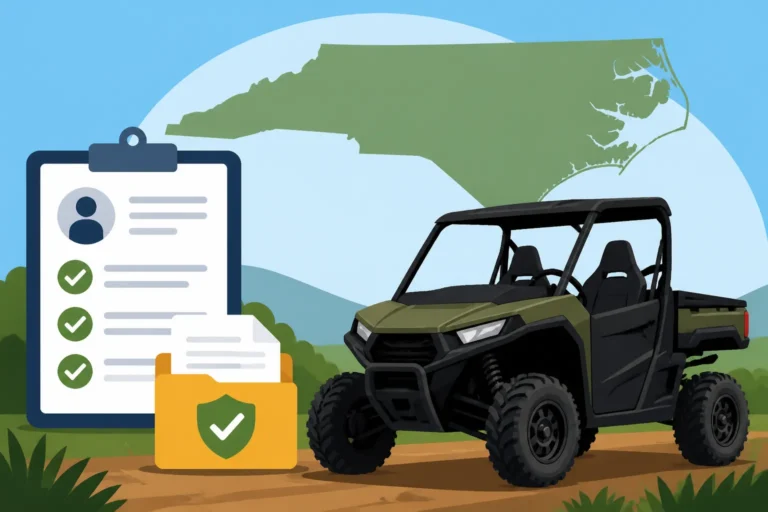
To qualify as an MUV, a machine must meet precise dimension requirements – a length of not more than 142 inches, a width of not more than 58 inches, and a height of not more than 70 inches. It also must have an engine displacement of more than 2,400 cubic centimeters and be capable of exceeding 40 mph. Crucially, it must be outfitted with a whole host of safety equipment, including headlights, taillights, turn signals, brake lights, a horn, a rearview mirror, a parking brake, a speedometer, and seat belts. Many riders find that a stock side-by-side, even a large one, won't meet all these criteria without significant modification. This is where companies like SuperATV come into play, offering a vast array of aftermarket parts and accessories that can help transform a UTV to meet these exacting specifications, from full lighting kits to mirrors and turn signals. Once modified, the MUV must be inspected by the DMV and issued a VIN if it doesn't already have one, then registered and titled, just like a car. This pathway is specific to UTVs and generally does not apply to traditional straddle-seat ATVs. [North Carolina's Modified Utility Vehicle Route] outlines all the precise requirements.
Farming Operations: A Conditional Exception
North Carolina law provides a limited exception for ATVs and UTVs used in bona fide farming operations. This exception allows these machines to be operated on public roads, but only for purposes directly related to farming. This is not a recreational pass to take your quad out on the highway because you own a few acres. The machine must be used to transport farm supplies, equipment, or products, or to perform other tasks directly associated with the ongoing operation of a farm.
This means you can potentially ride your ATV on a public road to move between fields, to a nearby barn, or to transport tools to a different part of your property, provided those activities are integral to the farm. However, if you're taking a joyride, heading to a friend's house, or simply using the road for non-farm-related errands, this exception does not apply. The operator must be a farmer or an employee of the farm. Moreover, there might still be rules regarding lighting if operating after dark, and general safety precautions should always be observed. This exception is very specific in its scope and intent, solely designed to support agricultural activities. [North Carolina's Farming Operations Exception] covers the specifics of this exception.
Ocean Beaches: Seasonal and Area-Specific Rules
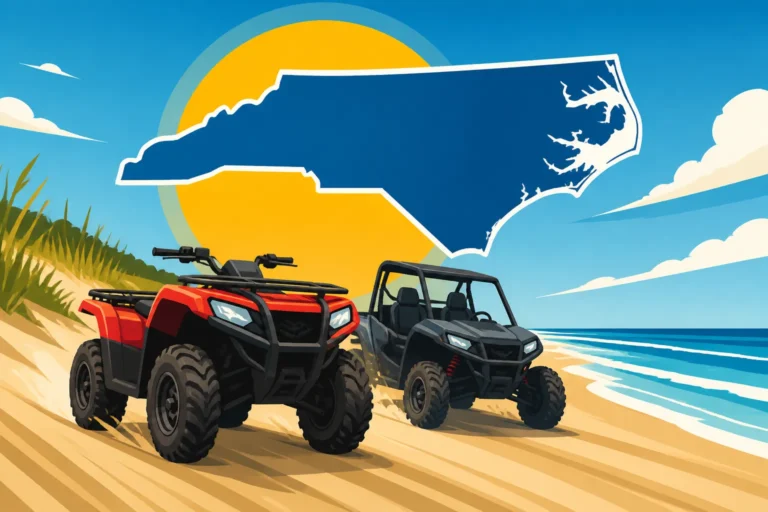
For some lucky North Carolina riders, there's a chance to operate an ATV or UTV on certain ocean beaches. However, this isn't a free-for-all across the entire coastline. Beach riding is highly regulated and typically managed by local municipalities or counties, often with seasonal restrictions and designated areas. For instance, some areas may allow beach riding only during the off-season, or only in specific stretches of sand, and often with permits required.
Furthermore, there are usually age restrictions in place for operating ATVs on beaches. For example, some jurisdictions might require riders to be 16 years of age or older. Always, always check with the specific local authorities (county, town, or park service) before you even think about riding on a North Carolina beach. A beautiful ride on the sand can quickly turn into a costly ticket if you haven't done your homework. These rules are put in place to protect both the environment (like dune systems and nesting wildlife) and public safety, especially in popular tourist areas. [North Carolina's Ocean Beach Rule] explains more about these regulations.
Illegal Operational Practices and Equipment for ATV Riders
Beyond where you ride, how you ride and the condition of your machine also fall under North Carolina's ATV laws. Violating these rules, even when riding legally on private land or designated trails, can lead to citations and serious consequences.
Violating Age and Supervision Requirements
North Carolina has specific, mandatory rules regarding who can operate an ATV and under what conditions, especially for younger riders. For starters, it is illegal for anyone under the age of eight to operate an ATV on any public or private property within North Carolina. This is a hard and fast rule, no exceptions. [North Carolina's Under-Eight Ban] is clear on this.
For riders between the ages of 8 and 16, stricter supervision rules apply. An ATV operator who is under 16 years of age must be under the continuous visual supervision of an adult. This means the supervising adult must be able to see the young rider at all times, ensuring their safety and adherence to proper riding techniques. Furthermore, riders born on or after January 1, 1990, must possess a safety certificate issued by the ATV Safety Institute or an equivalent course approved by the Commissioner of Insurance. This certificate must be carried with the rider while operating an ATV. [North Carolina Rules for Riders Under 16] details these requirements. It's important to note that while an old 70cc engine rule for young riders used to exist, it has since been repealed. However, the manufacturer's age recommendation label on the machine is legally binding under North Carolina law, meaning if your ATV states it's for riders 16+, a 14-year-old cannot legally operate it, even with supervision.
Mandatory Safety Gear and Passenger Restrictions
When it comes to personal safety, North Carolina takes a firm stance. It is illegal for any ATV operator or passenger under the age of 18 to operate or ride without wearing a safety helmet and eye protection. The helmet must be a Department of Transportation (DOT) approved motorcycle helmet, fitting snugly and fastened securely. Eye protection could be goggles or a face shield that meets ANSI Z87.1 standards. Even if you're an adult over 18, wearing appropriate safety gear is highly recommended for your own protection, but for minors, it's the law. [Helmet and Eye Protection Rules in North Carolina] covers this in depth.
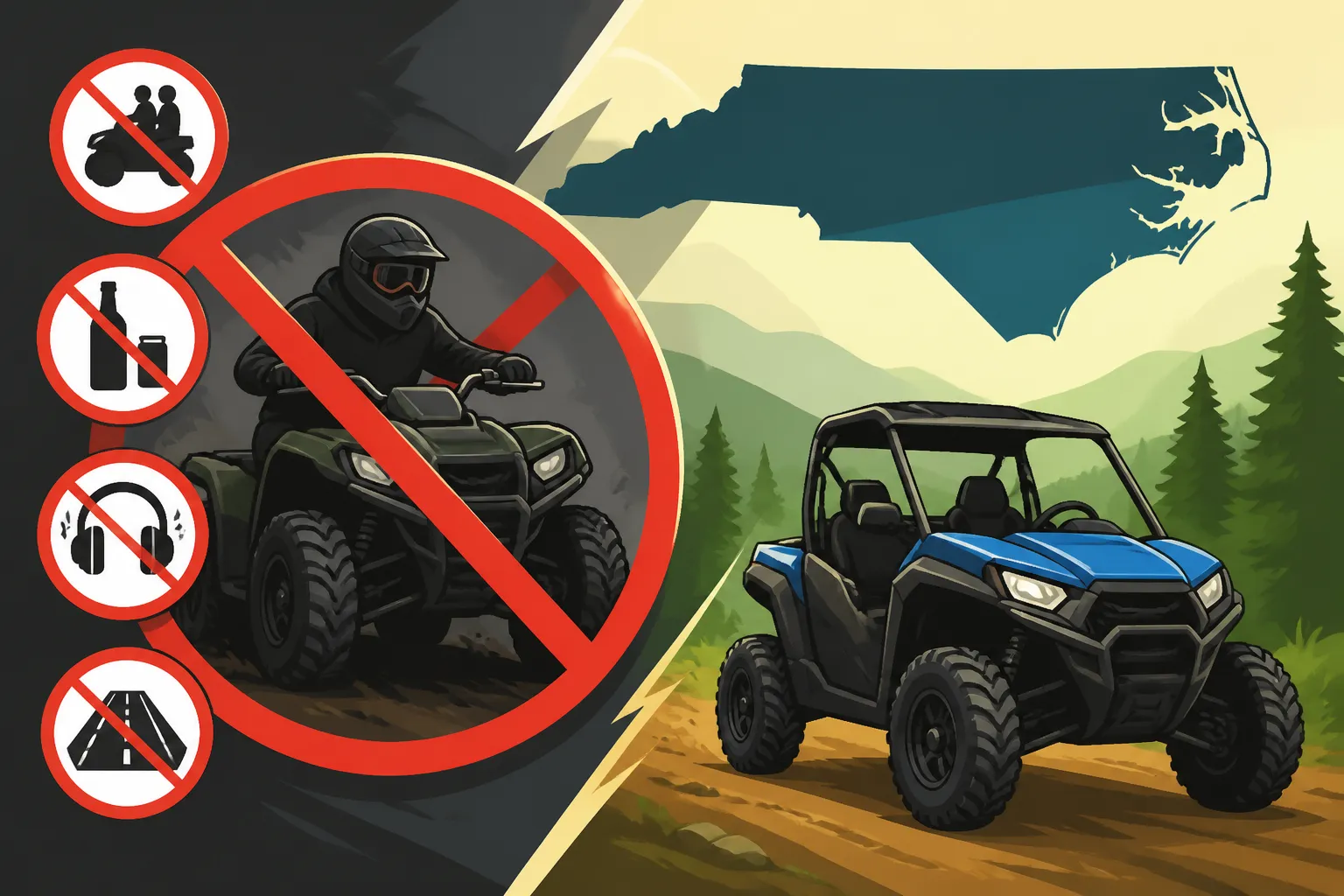
Regarding passengers, it is generally illegal to carry a passenger on an ATV that is not specifically designed for more than one rider. Most ATVs are designed as single-operator machines. Attempting to carry a passenger on a single-seat ATV not only violates the law but also significantly compromises the stability and handling of the machine, creating a very dangerous situation. If your machine is a factory-built two-up ATV or a side-by-side with designated passenger seating and seat belts, then carrying passengers is permissible, provided all other rules (like age and helmet requirements) are followed. Always check your ATV's manufacturer specifications for passenger capacity. [When North Carolina Lets You Carry a Passenger] is a good resource here.
Essential Machine Equipment for Legal Operation (Even Off-Road)
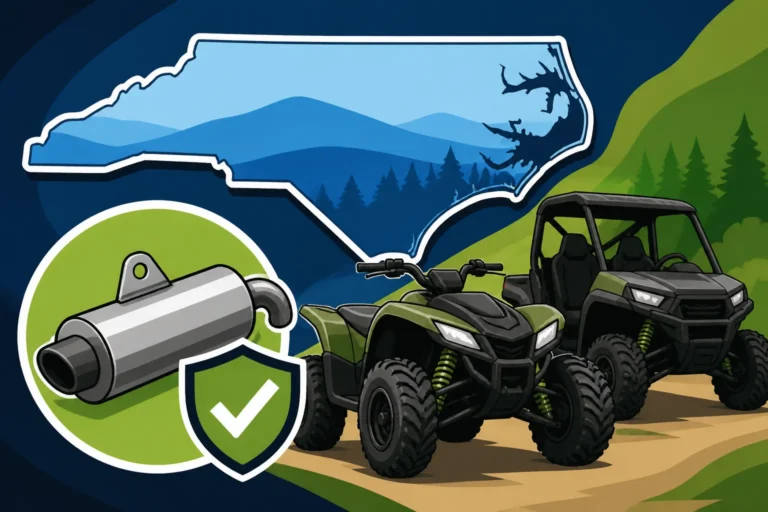
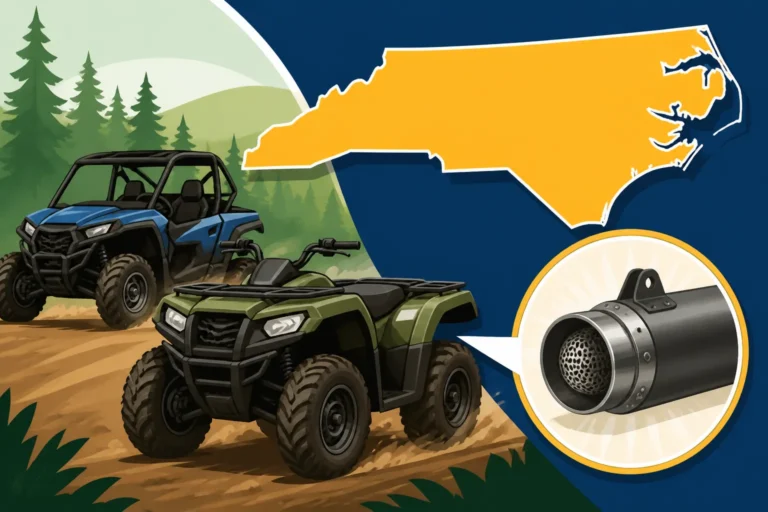
Even when riding on legal trails or private property, your ATV needs to meet certain basic equipment standards. One of the most common requirements is a properly functioning spark arrester. Most public lands, especially federal forests like the Uwharrie National Forest, require ATVs to be equipped with a U.S. Forest Service approved spark arrester to prevent wildfires. Riding without one is not only illegal but can have devastating environmental consequences.
Furthermore, if you plan to ride after dark, whether on private property or in areas where it's permitted (like specific campgrounds or crossing roads), your ATV must have functioning headlights and taillights. While not always strictly enforced on private land, operating without adequate lighting in low visibility conditions is incredibly risky. Some trails may also have specific noise limits, making heavily modified or "straight-piped" exhausts illegal. Always ensure your brakes are in good working order and your tires are suitable for the terrain. While these aren't "street legal" requirements, they are critical for safe and legal operation in most riding environments. [North Carolina Equipment Rules for ATVs] and [North Carolina Rules for Riding After Dark] provide more detail on these essential requirements.
The Steep Consequences of Breaking North Carolina's ATV Laws
Breaking the rules, whether intentionally or out of ignorance, carries real and often unpleasant consequences. North Carolina isn't lenient on ATV violations, especially those involving public roads or rider safety.
Financial Penalties and Citations
The most immediate consequence of an ATV violation is usually a financial penalty. Depending on the specific infraction, you could be facing a fine that ranges from moderate to substantial. For example, riding on a prohibited public road could result in a significant ticket, similar to other moving violations. Operating without required safety equipment, carrying an illegal passenger, or allowing an underage rider to operate without supervision can also lead to citations, each carrying its own monetary penalty.
These fines can quickly add up, turning what might have seemed like a harmless shortcut into an expensive mistake. It's not just the base fine; you'll often be responsible for court costs and other administrative fees, making the total cost of a violation much higher than anticipated. These citations go on your record, and while they might not directly impact your driving license points for a car, they are still official legal infractions. [Who Writes an ATV Ticket in North Carolina] explains which agencies are authorized to issue these citations.
Machine Impoundment and Legal Troubles
Beyond a simple fine, more serious or repeated violations can lead to your ATV being impounded by law enforcement. If your machine is impounded, you'll be responsible for towing fees and daily storage charges, which can quickly become exorbitant. Retrieving your ATV can be a lengthy and frustrating process, often requiring you to pay all outstanding fines and fees before it's released. In some cases, especially if there are multiple or severe violations, the machine could even be forfeited.
Furthermore, depending on the severity of the offense, you could face more serious legal troubles. Operating recklessly, endangering others, or causing property damage could lead to criminal charges beyond simple traffic infractions. If alcohol or drugs are involved, you could face charges similar to DWI (Driving While Impaired) in a car, with all the severe penalties that entails. The state takes these matters seriously, and what might start as a fun ride can quickly escalate into a legal nightmare.
Insurance, Liability, and Your Riding Future
Perhaps one of the most overlooked consequences of illegal ATV operation is the impact on your insurance and personal liability. Most ATV insurance policies are designed to cover off-road use. If you are operating your ATV illegally on a public road and are involved in an accident, your insurance company may deny coverage, leaving you personally responsible for all damages, injuries, and legal fees. Imagine being held liable for thousands, or even hundreds of thousands, of dollars in medical bills or property damage because you were riding where you shouldn't have been.
A history of violations can also make it difficult and more expensive to obtain ATV insurance in the future. Moreover, any incidents could become part of your public record, potentially impacting future employment or other aspects of your life. The risks far outweigh the momentary convenience of breaking the rules. Riding legally and safely isn't just about avoiding tickets; it's about protecting your financial well-being and your future.
| Illegal ATV Activity | Common Consequences | Key Restrictions |
|---|---|---|
| Riding on Public Roads | Fines, machine impoundment, accident liability | General prohibition on Interstates, state highways, county roads, and city streets. Limited exceptions for MUVs, farming, and specific beaches. |
| Underage Operation | Fines for rider and/or supervising adult | No riders under 8. Riders 8-15 require continuous adult supervision. Riders born 1990+ need safety certificate. Adhere to manufacturer's age label. |
| No Helmet/Eye Protection | Fines for rider (if 16+) or supervising adult | Mandatory for all operators and passengers under 18. Helmet must be DOT-approved. Eye protection must meet ANSI Z87.1. |
| Carrying Illegal Passenger | Fines, increased accident risk | Illegal on ATVs not specifically designed for more than one rider (e.g., single-seat ATVs). Permitted on factory "two-up" ATVs or multi-seat UTVs. |
| No Spark Arrester | Fines, potential fire risk | Required on most public lands (e.g., National Forests) to prevent wildfires. |
| Riding After Dark Without Lights | Fines, accident risk | Headlights and taillights are required for operation during periods of low visibility. |
| Reckless Operation/DWI | Severe fines, license suspension (for DWI), criminal charges, machine impoundment | Operating an ATV under the influence of alcohol or drugs carries similar penalties to DWI in a car. Reckless driving can lead to significant penalties and criminal charges. |
Disclaimer
This article is for general informational purposes only and does not constitute professional advice. Laws, prices and regulations vary by location and change over time. Consult a qualified professional for guidance on your specific situation.