Registering an MUV for the Road
It’s a common frustration among ATV and UTV enthusiasts across North Carolina: you love your machine, you use it for work and play, but getting it from point A to point B often involves the hassle of a trailer. Many riders dream of the freedom of simply driving their side-by-side or quad down a paved road to hit the next trail or even just to run to the corner store. While true "street-legal ATVs" are largely a myth in our state, there is a specific, regulated pathway for certain machines to legally operate on public roads: the Modified Utility Vehicle, or MUV. This guide will walk you through what an MUV is, what equipment it needs, and how to get one registered for the road, so you can understand if this path is right for your machine and your needs.
What Exactly is a Modified Utility Vehicle MUV in North Carolina?
When we talk about street-legal off-road machines in North Carolina, we're not just talking about strapping a license plate onto your average side-by-side. The state has a very particular category called a "Modified Utility Vehicle," or MUV, and it comes with a strict set of definitions and requirements. This isn't a workaround; it's a specific classification designed to allow certain utility vehicles that meet stringent safety and design standards to operate on public roads. It's the designated [North Carolina's Modified Utility Vehicle Route].
More Than Just a Souped-Up Side-by-Side
Many riders are surprised to learn that their beloved UTV, even a brand-new one packed with features, doesn't automatically qualify as an MUV. The term "modified" isn't just about adding a few lights; it refers to meeting specific criteria that differentiate it from recreational off-highway vehicles. Think of it less as an ATV that you can drive on the street, and more like a miniature car that happens to share some DNA with an off-road machine.
The key frustration for many is that a typical side-by-side, straight from the factory, simply won't cut it. They might be built tough for the trails or the farm, but they often lack the very specific dimensions, engine size, and safety equipment that the state mandates for road use. This means you can't just slap a tag on a Polaris RZR or a Can-Am Defender and expect to drive it to the gas station. The regulations are in place to ensure a basic level of safety when these machines share the road with passenger cars and trucks.
The Core Requirements: Size, Speed, and Engine
The North Carolina DMV has laid out clear, unambiguous physical criteria for what constitutes an MUV. These aren't suggestions; they are hard and fast rules your machine must meet or be modified to meet. If your machine doesn't align with these, it simply won't be considered an MUV for road registration purposes. It's crucial to understand [What Makes a Machine an MUV in North Carolina].
First off, the engine size is paramount: the machine must have an engine displacement of more than 2,400 cubic centimeters. This is a big hurdle for many popular side-by-sides, as most fall well below this mark. For example, a lot of the common utility and sport UTVs hover around 800cc to 1,000cc, sometimes a bit more, but rarely, if ever, hit the 2,400cc minimum without significant and expensive aftermarket engine swaps, which aren't practical for most owners. This specific requirement often rules out a vast majority of stock machines right from the start, so it’s important to understand [Why an MUV Needs More Than 2,400cc].
Then come the physical dimensions. The MUV cannot exceed 142 inches in length. Imagine trying to measure that from bumper to bumper; it’s a pretty generous length, but some custom builds or particularly long utility models might bump up against it. Equally important is the width: it must not exceed 58 inches. This is a common issue for many side-by-sides, which often exceed 60 inches in width for stability and passenger comfort, especially those with wider suspension setups. Many sport models, and even some utility models, are simply too wide. Lastly, the height cannot exceed 70 inches. These precise measurements are not just arbitrary numbers; they are part of a larger framework designed to classify these vehicles. You’ll need to grab a tape measure and double-check [The 142-Inch Length Requirement], [The 58-Inch Width Requirement], and [The 70-Inch Height Requirement].
Finally, the MUV must be capable of exceeding 40 miles per hour on a paved, level surface. While most side-by-sides can easily reach or surpass this speed, it's another box that needs to be checked. When you combine all these requirements—engine size, length, width, height, and speed—you begin to see why so few off-road machines actually qualify as MUVs. It's a very specific niche, often requiring a machine specifically designed with these regulations in mind, or a truly extensive modification process. Make sure your machine can hit [40 mph to Qualify as an MUV].
Essential Equipment for MUV Road-Legality
Once your machine technically meets the MUV definition based on its core specifications, the next hurdle is ensuring it's properly equipped for road use. This isn't just about having the basics; it’s about meeting a comprehensive list of safety and visibility requirements that are standard for most on-road vehicles. Skipping any of these could mean failing inspection and being denied registration.
Lights, Brakes, and Other Safety Gear
For your MUV to be road-legal, it needs to be visible and capable of communicating its intentions to other drivers, just like any car or truck. This means a full complement of lights. You'll need functioning headlamps for illumination, taillamps that are visible from the rear, and brake lights that activate when you slow down. Additionally, turn signals are absolutely mandatory, both front and rear, so you can clearly indicate turns and lane changes. Think about those aftermarket signal kits you see; for an MUV, they're not optional.
Beyond lights, your MUV must have a working parking brake. This might seem minor, but it's a critical safety feature, especially when parking on inclines or just securing the vehicle. A speedometer is also required, ensuring you can monitor your speed and adhere to posted limits. Imagine trying to drive legally without knowing how fast you're going! Don’t forget mirrors – specifically, a rearview mirror, and if the MUV has an enclosed cab, a left outside mirror. If it's an open-air design, you’ll at least need a left outside mirror. All of these components are subject to inspection and must be in good working order. These are all part of the [North Carolina MUV Inspection Requirements]. So check for [North Carolina MUV Speedometer Requirement], [North Carolina MUV Mirror Requirement], [North Carolina MUV Turn Signal Requirement], and [North Carolina MUV Parking Brake Requirement].
Seatbelts, Windshields, and the Little Things
The safety of the occupants is also a major concern for MUV road-legality. Your MUV must be equipped with seatbelts for every seating position. This is non-negotiable and will be thoroughly checked during inspection. If your machine is a two-seater, it needs two seatbelts. If it’s a four-seater, it needs four, and so on. These belts must be in good condition, securely mounted, and fully functional. It's a key part of the [North Carolina MUV Seat Belt Requirements].
Another crucial item is a windshield. If your MUV doesn't have a windshield, then the operator and passengers must wear eye protection (think goggles or safety glasses) while on public roads. Many factory UTVs come with half-windshields or no windshields, which would require the eye protection workaround. However, for maximum safety and convenience, a full windshield with working wipers is often the preferred choice. Companies like SuperATV offer a wide range of aftermarket windshields, wipers, and full cab enclosures that can help bring an off-road machine up to MUV standards, making the ride safer and more comfortable on the highway. Additionally, the MUV must have a horn, a muffler (no excessively loud exhausts!), and tires that are approved for highway use – typically DOT-rated tires, not just off-road treads. These "little things" are just as important as the big ones when it comes to passing inspection and staying legal.
The Registration Process: Getting Your MUV Legally Plated
So, you've confirmed your machine meets the MUV specifications and you've kitted it out with all the necessary safety equipment. Now comes the official part: getting it registered with the North Carolina Division of Motor Vehicles (NCDMV). This process is similar in many ways to registering a car, but with specific considerations for MUVs.
Gathering Your Paperwork and Inspections
Before you even think about heading to the DMV, you need to have all your ducks in a row. First, you'll need proof of ownership, which usually means a manufacturer’s certificate of origin (MCO) for a new machine or a valid title if you bought it used. If you’re coming from a state that doesn’t title ATVs, or if you bought one with no prior paperwork, this can become a significant hurdle, often requiring an affidavit process. You can find more detail on this in [North Carolina ATV Title Paperwork].
Next, you'll need proof of liability insurance. Just like a car, if you're driving it on public roads, it must be insured. Your off-road insurance policy likely won't cover road use, so you'll need to work with your insurance provider to get a policy that specifically covers the MUV for highway operation. This is a critical step, as the DMV will require proof of this coverage. For more, see [North Carolina MUV Insurance Requirements]. Finally, your MUV must pass a safety inspection at a licensed North Carolina inspection station. This is where all those lights, brakes, mirrors, seatbelts, and other safety components will be checked to ensure they meet state standards. An MUV will undergo the same type of safety inspection as a passenger car. You’ll need to get an inspection sticker, which is a key part of [North Carolina MUV Inspection Requirements].
Visiting the DMV and What to Expect
With all your documentation and the inspection passed, you can now make your pilgrimage to the NCDMV. You’ll need to fill out the North Carolina Title Application on Form MVR-1. This form is used for titling most vehicles in the state, and your MUV is no exception. Be prepared to provide detailed information about your machine, including its Vehicle Identification Number (VIN), make, model, and the date of purchase.
When you submit your title application, you'll also be responsible for paying the applicable fees. This includes a titling fee and, crucially, the North Carolina Highway Use Tax. This tax is typically 3% of the purchase price or the vehicle’s fair market value, and it’s a significant part of the total cost of getting your MUV street-legal. Don't confuse this with a standard sales tax; it's a specific tax levied when a vehicle is titled for use on public roads. Understanding [North Carolina ATV Highway Use Tax] and [What North Carolina Charges for an ATV Title] is essential for budgeting. The DMV clerk will process your application, and if all your paperwork is in order and your MUV meets all criteria, you'll eventually receive your official title and license plate, giving you the green light to hit the pavement legally.
What Roads Are Open to a Registered MUV?
Now that your Modified Utility Vehicle is officially registered and street-legal, you might be picturing wide-open roads. However, there are still specific rules about where an MUV can and cannot be operated in North Carolina. It’s important to understand these limitations to avoid citations and ensure safe operation.
The "Posted 55 mph or Less" Rule
The most significant restriction for a registered MUV is that it can only be operated on public roads or highways where the posted speed limit is 55 miles per hour or less. This immediately rules out interstates, major four-lane highways with higher speed limits, and many other principal arteries across the state. This regulation is in place because, while MUVs are safer than standard ATVs for road use, they are still not designed for the sustained high speeds and traffic volumes found on faster roads.
This means your MUV will be best suited for navigating local streets, rural roads, and secondary highways. It's perfect for a quick trip into town, commuting short distances, or connecting to nearby trails without the need for a trailer. However, if your journey requires traveling on a road where the speed limit exceeds 55 mph, you'll still need to revert to trailering your MUV. Always pay close attention to speed limit signs; if it says 60 or 70, that road is off-limits to your MUV. This specific rule defines [Which North Carolina Roads Are Open to an MUV] and clarifies [North Carolina MUV Street Legal Requirements].
Important Considerations and Responsibilities
Even once your MUV is registered, your responsibilities as a driver don't end. You must possess a valid driver's license to operate an MUV on public roads, just as you would for a car or truck. The MUV must maintain its required insurance coverage at all times. All occupants must properly use their seatbelts while the vehicle is in motion.
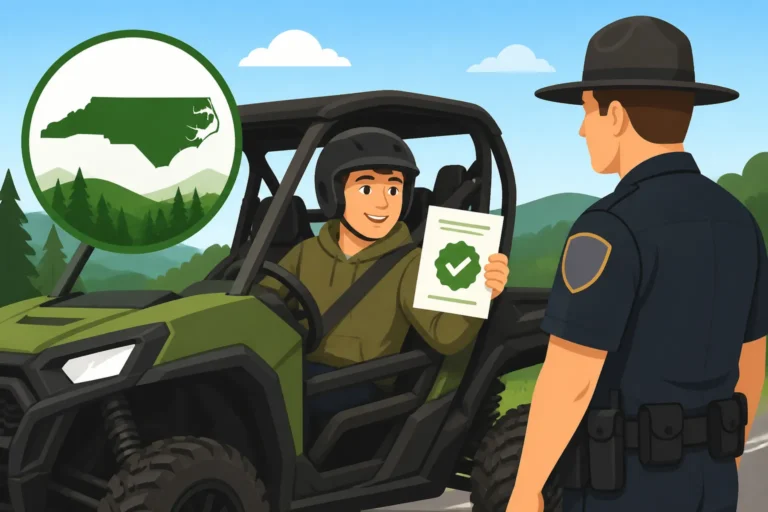
When a North Carolina State Trooper or local law enforcement officer stops you, they will check for all the standard requirements: your driver's license, the vehicle's registration, proof of insurance, and the current safety inspection sticker. They may also visually confirm that the MUV meets the physical and equipment requirements, so keeping it properly maintained is key. Remember, while you’re riding on the road, your MUV is considered a regular vehicle under these specific circumstances, and you're subject to all traffic laws.
Here's a quick summary of MUV requirements for easy reference:
| Category | Requirement | Description |
|---|---|---|
| Engine | Over 2,400cc | Minimum engine displacement for road qualification. |
| Length | Max 142 inches | Overall bumper-to-bumper length. |
| Width | Max 58 inches | Widest point, including tires but excluding mirrors. |
| Height | Max 70 inches | From ground to highest point. |
| Speed | Capable of 40+ mph | Must be able to exceed 40 mph on level pavement. |
| Lighting | Headlamps, Taillamps, Brake Lights, Turn Signals | Fully functional for visibility and signaling. |
| Brakes | Service Brake, Parking Brake | Essential for stopping and securing the vehicle. |
| Visibility | Rearview Mirror, Left Outside Mirror (if enclosed/open-air) | Crucial for driver awareness. |
| Occupant Safety | Seatbelts for all positions, Windshield (or eye protection for occupants) | Protects driver and passengers. |
| Other | Speedometer, Horn, Muffler, DOT-Approved Tires | Standard vehicle features for road legality. |
| Documentation | Title, Proof of Insurance, Safety Inspection Sticker (NC) | Required for NCDMV registration. |
| Road Use | Posted Speed Limit 55 mph or less | Restricted to specific public roads; no interstates or high-speed routes. |
By carefully reviewing these requirements and taking the necessary steps, you can confidently and legally enjoy the freedom of taking your MUV on the designated roads of North Carolina. It's a precise path, but for those who meet the criteria, it unlocks a new level of utility and enjoyment for their off-road machines.
Disclaimer
This article is for general informational purposes only and does not constitute professional advice. Laws, prices and regulations vary by location and change over time. Consult a qualified professional for guidance on your specific situation.