Riding a Forest Trail Without a Card
A missing card can mean two different things on a North Carolina forest ride: the rider’s ATV safety certificate or the machine’s forest permit. They are separate requirements, and one does not replace the other. Here’s how to tell which applies, what to do if you left a card behind, and how to avoid confusing proof of training with trail access.
First, identify which card is missing
When someone asks whether they can ride a forest trail “without a card,” the first question is what the card proves. North Carolina has a birth-year safety certificate requirement for certain ATV riders, while some public forest riding areas require a separate permit for each machine. A rider can have one and still be missing the other.
| What may be missing | What it relates to | Who or what it applies to |
|---|---|---|
| ATV safety certificate card | Completion of an approved safety course | The rider, when the birth-year rule applies |
| Forest OHV permit | Permission to use a designated trail system | The individual machine, when that system requires a permit |
| Driver’s license or other ID | Identity or rental requirements | Depends on the activity and provider |
The safety certificate is tied to the rider. North Carolina’s birth-year rule generally covers riders born on or after January 1, 1990 who operate an ATV on public land: they must complete an accepted safety course and carry the certificate as required. The details are explained in North Carolina’s Birth-Year Safety Certificate and North Carolina ATV Safety Certificate Requirements.
A forest permit, by contrast, is tied to the vehicle and the place where you ride. A pass or permit for one machine does not automatically cover every machine in your group. Requirements also depend on the trail system and its current rules. North Carolina Forest OHV Permits explains the distinction, while Do You Need a Permit for North Carolina Forest Trails? can help you check whether a permit applies to your planned ride.
Don’t treat a certificate card as a trail pass, or a trail permit as proof that the rider completed a course. They serve different purposes, and having one does not make up for missing the other.
If you forgot your safety certificate card
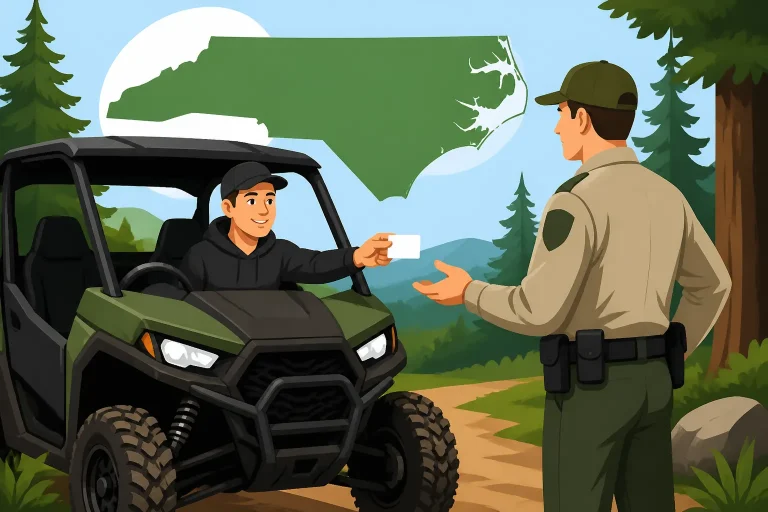
If the birth-year requirement applies to you and you completed a course but left your card at home, don’t assume that being able to describe the course or show a photograph of a card will be accepted. The practical question is whether you can produce the required proof in a form the relevant officials recognize.
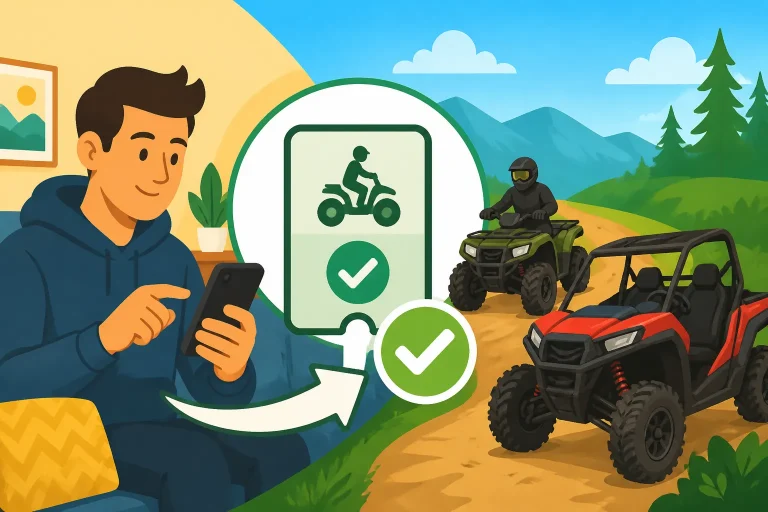
Before unloading, contact the course provider or the land manager responsible for the trail. Ask whether an official digital certificate, replacement document, or other verification is accepted. Requirements and checking practices can vary, so get a clear answer rather than relying on what another rider was allowed to do elsewhere. Carrying a Safety Card on a North Carolina Ride and When a Safety Certificate Is Checked at the Gate offer more detail on carrying and presenting proof.
If you cannot confirm that an alternative will be accepted, the lower-risk choice is to postpone the ride or have a qualified rider operate the machine while you stay off the ATV. Don’t ride first and hope that nobody asks. A missing card may not be checked at every trail entrance, but the absence of a check is not proof that the requirement does not apply.
If you have not completed an approved course, a card from another activity or a general riding lesson may not meet North Carolina’s requirement. Check that the course is accepted before counting it as proof. North Carolina does not automatically treat another state’s rules or documents as interchangeable; see Why North Carolina Has Nothing to Reciprocate for the reciprocity issue.
A useful preparation routine is simple:
- Check whether the birth-year rule applies to each rider.
- Confirm that the course and certificate meet North Carolina’s requirements.
- Put the official certificate card with your riding gear, not in a bag that may stay at home.
- Call the trail manager if your card is lost, damaged, or available only in digital form.
- Keep the forest permit separate from the rider’s certificate and confirm the permit instructions for each machine.
If the card is lost rather than merely forgotten, contact the course provider about replacement or verification. Don’t alter a screenshot or present an unofficial document as though it were an original certificate. If a replacement will take time, ask whether the provider can issue an accepted form of confirmation in the meantime.
If the missing card is the forest permit
A safety certificate does not authorize a machine to enter a trail system that requires a forest OHV permit. Before heading out, check the rules for the exact riding area and date. A permit process may differ by forest or trail system, and a machine’s title, registration, or ownership paperwork should not be mistaken for an OHV permit.
The permit may need to be purchased before riding and displayed or carried according to the instructions for that area. Do not assume that a receipt alone is enough, that a permit transfers from another vehicle, or that a permit from another state works in North Carolina. Confirm the current instructions through the responsible forest office or permit seller. Where North Carolina Forest Permits Are Sold can help with the purchasing question.
If you arrive without the required permit, stop before entering the trail. Find out whether the area offers a way to buy one before riding, and follow the posted instructions. If you cannot obtain the required permit, don’t ride that system that day. A permit for one machine may not cover a second machine in a group, even when the same person owns or operates both.
Also check the trail’s operating status. A valid permit does not authorize travel on a closed route or make an otherwise prohibited trail open. Conditions and access can change after storms, maintenance, or other closures. Check North Carolina Trail Closures to Check before loading the machine, and follow signs and gate notices when you arrive.
Private land, a public forest road, and a designated OHV trail are not interchangeable forms of access. Permission to ride on private property does not grant entry to a forest trail, and access to one trail does not mean machines may travel anywhere in that forest. If your destination is a specific OHV area, verify its permit, vehicle, and route rules rather than relying on a general assumption about forest access.
A quick check before you set out
A few minutes of preparation can prevent a wasted drive or an avoidable violation. Check the rider and the machine separately, then confirm the trail system’s current access conditions. This is especially important when a group includes visiting riders, younger riders, rented machines, or more than one vehicle.
Use this checklist before leaving:
- Rider: Does the birth-year rule apply? If it does, is the required course complete, and is the certificate available in an accepted form?
- Machine: Does the chosen trail system require a forest permit for this vehicle? Is it the right permit for this specific machine?
- Location: Are you going to a designated OHV trail, and is it open to your kind of machine?
- Documents: Are you carrying any required certificate or permit in the manner the trail manager specifies?
- Group: Has every rider checked their own certificate requirement, and does every machine have any required permit?
- Current conditions: Have you checked for closures or changes before you load?
For visitors, the safest approach is not to assume that a certificate or permit from home settles North Carolina requirements. Ask the relevant North Carolina provider or land manager what they accept. The same applies if you are renting: confirm whether the rental company supplies the forest permit, whether it is included in the arrangement, and what proof the rider must bring. A rental machine’s paperwork does not automatically satisfy the rider’s certificate requirement.
Keep the certificate and permit accessible, but don’t confuse accessibility with permission. A card in your pocket matters only if it is the right document for the requirement, and a valid document does not override a closure, posted restriction, or trail rule. When anything is unclear, resolve it before riding rather than at the trail entrance.
Disclaimer
This article is for general informational purposes only and does not constitute professional advice. Laws, prices and regulations vary by location and change over time. Consult a qualified professional for guidance on your specific situation.