Why City Crews Can Ride Where You Cannot
It's a scene that can really grind your gears, isn't it? You're driving down a perfectly normal road in North Carolina, maybe heading out to the trails or just running errands, and there it is: a city or county crew riding a side-by-side or an ATV right there on the pavement, often with lights flashing or a work crew following. You might even see them on roads posted at 35 mph, crossing intersections, or doing what looks like daily business, and you can't help but wonder, "Why can they do that, but I can't?" It's a common frustration for ATV and UTV owners across the state, and it often leads to confusion about what the law actually says. This guide is here to unravel that mystery, explaining the distinct legal frameworks that allow government and utility crews to operate off-road vehicles on public roads, while private citizens face a much more restrictive set of rules.
The Core Difference: Government vs. Private Use
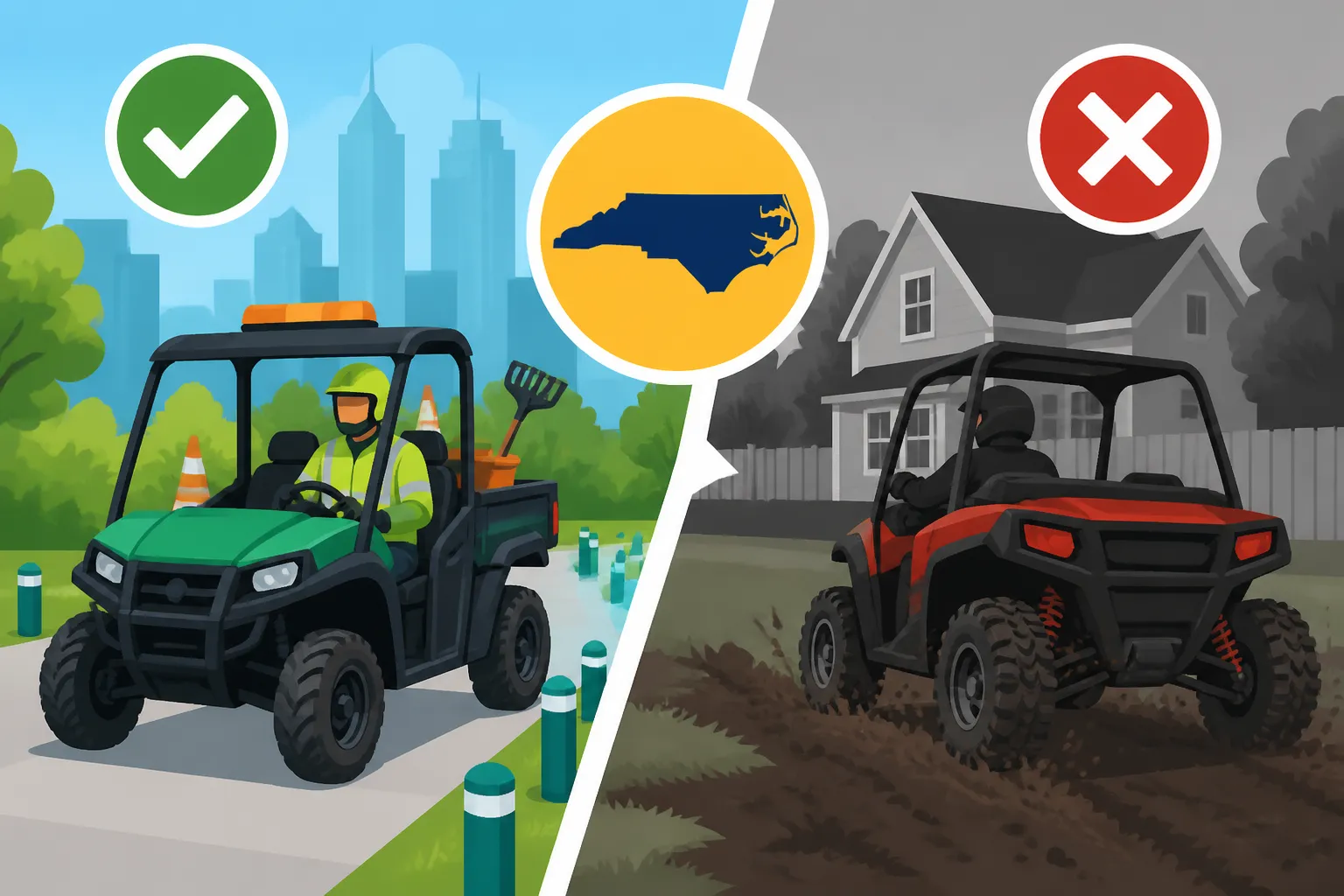
At its heart, the reason you see city crews riding ATVs and UTVs on public roads while you're relegated to private land or designated trails comes down to a fundamental distinction in North Carolina law: the purpose of the operation. Lawmakers created very specific, narrow exceptions for vehicles engaged in public service, emergency response, or certain commercial operations that benefit the public. Your weekend ride or trip to the general store, no matter how quick, simply doesn't fall into those categories. It’s not about who owns the machine, but rather the function it’s performing on the public right-of-way.
The "Closed System" Mindset: How NC Views Off-Road Machines
North Carolina, like many states, generally views ATVs and UTVs as machines designed for off-highway use. They are not built, licensed, or typically insured for regular street travel. This "closed system" mindset means that unless there's a very clear, statutory exception, these vehicles are presumed to be illegal on public roads. When you see a city crew, they aren't just flouting the law; they are operating under one of those specific, carefully crafted exceptions. These aren't loopholes; they're deliberate legislative decisions made to allow essential services to be carried out efficiently. For instance, a parks and recreation crew might use a UTV to maintain a public greenway that crosses a city street, or a public works team might need an ATV to access a utility easement that runs alongside a paved road. Without these exceptions, these essential functions would be severely hampered, requiring more expensive or less efficient alternatives.
Public Service vs. Recreation: A Legal Distinction
The law differentiates between vehicles used for public service and those used for recreation. A city crew's side-by-side isn't out for a joyride; it's likely hauling tools, surveying property lines, or transporting personnel for official duties. These activities are directly linked to municipal responsibilities and public welfare. Consider a parks department employee using a UTV to collect litter along a roadside park, or a water utility worker needing to access a remote pump station via a short stretch of paved road. Their use is incidental to their work, not the primary purpose of their outing. This distinction is crucial, because while your personal enjoyment is a valid reason to own an ATV, it doesn't grant you the same privileges as someone performing a necessary public function. This isn't about favoritism; it's about the inherent nature of public service and the tools required to perform it. It’s also important to remember that even these public service vehicles are often outfitted with additional safety equipment, like flashing lights, beacons, and sometimes even specialized tires or protective gear, to enhance visibility and safety when operating on public roads.
Who Enforces These Rules? Local vs. State
When it comes to ATVs and UTVs, enforcement can sometimes feel a bit like a patchwork. State Highway Patrol officers, county sheriffs, and local police departments all have jurisdiction over public roads. This means that if you're caught riding your ATV on a prohibited public road, any of these agencies could issue a citation. However, when it comes to city crews, the lines can blur a bit, especially within city limits. Local ordinances often complement state laws, and city departments are typically well-versed in the specific allowances granted to them. While a state trooper might question a private citizen on a public road, they're less likely to stop a clearly marked city vehicle performing official duties, as long as it adheres to the specific exemptions. The challenge for private riders is that local rules can sometimes add layers of complexity. For example, some municipalities might have specific rules for crossing certain streets, or designated routes that are temporarily opened for special events, which can add to the confusion for those not "in the know." Understanding [North Carolina Rules for Riding a Public Street] requires a deep dive into both state statutes and local ordinances.
North Carolina's Specific Legal Framework for ATVs on Roads
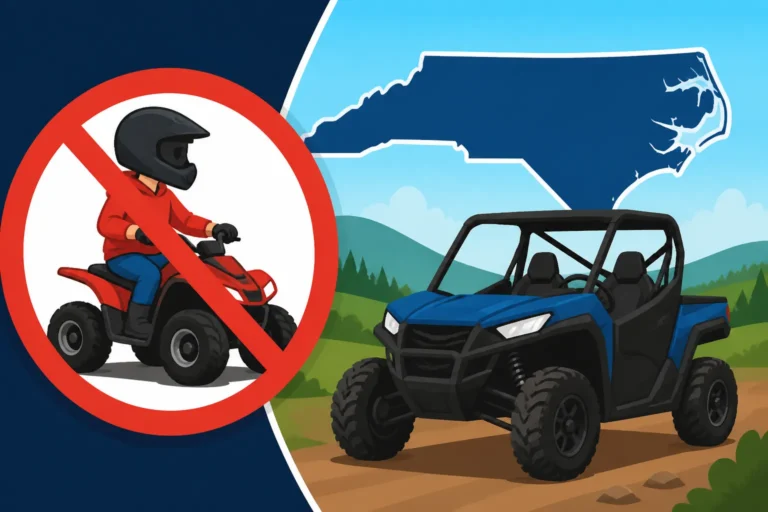
North Carolina General Statutes explicitly prohibit the operation of ATVs on public streets, roads, and highways. This is the baseline rule, and it's a critical one for every off-road enthusiast in the state to understand. However, the law carves out specific, limited exceptions to this general prohibition, which is where the city crew scenario comes into play. These exceptions are not broad invitations but rather narrow permissions granted under precise conditions.
General Prohibition on Public Roads
Let's be clear: in North Carolina, your standard, factory-issue ATV or UTV is NOT street legal. This means you cannot legally operate it on paved roads, gravel roads, or any other public right-of-way that is maintained by the state, county, or municipality. The law is designed to prevent these machines, which lack many of the safety features of on-road vehicles (like turn signals, proper lighting, mirrors, and crash-testing for road speeds), from mixing with regular traffic. Imagine the chaos if every ATV owner decided to commute to work on their quad! The risks of accidents, property damage, and severe injury would skyrocket. This foundational prohibition is the primary reason why your personal machine is usually relegated to private land or dedicated off-road trails. It’s about public safety and maintaining order on the roads.
The Farm Operations Exception
One of the most widely known exceptions to the general prohibition is for bona fide farm operations. North Carolina allows ATVs and UTVs to be operated on public roads when directly related to farming activities. This isn't a license for farmers to ride their quads into town for groceries, but rather to move between fields, transport equipment short distances, or check livestock on parcels of land separated by a public road. The machine must be used for a legitimate farm purpose, and the operation should be as brief and safe as possible.
For example, a farmer might need to cross a secondary road to access an adjacent pasture, or drive their UTV a mile down a rural road to get to another section of their property to repair a fence. This exception is vital for agricultural communities, allowing them to manage their operations efficiently without having to load and unload their machines onto trailers for every short move. However, even under this exception, common sense and safety precautions are paramount. The operation must be undertaken with due regard for the safety of others, and it must be clearly discernable as part of a farm operation. If you're using your ATV for farming, you should also be familiar with [North Carolina's Farming Operations Exception] to ensure you're fully compliant.
Emergency and Law Enforcement Use
This is where many of the city crew sightings stem from. Law enforcement, fire, and emergency medical services are expressly permitted to use ATVs and UTVs on public roads when responding to emergencies, conducting search and rescue operations, or performing official duties. Think about a sheriff's deputy patrolling a large park or responding to an incident in a remote, off-road area; their UTV might need to use a short stretch of paved road to get there. Or consider a fire department using an ATV to reach a brush fire in a difficult-to-access wooded area that abuts a residential street. These vehicles are equipped with emergency lights and sirens, and their operators are highly trained professionals. Their use is directly tied to protecting life and property, which supersedes the general prohibition. It’s a matter of necessity and public safety, allowing first responders to do their jobs effectively in situations where traditional patrol cars or larger trucks simply cannot go. These are specialized vehicles, often from brands like SuperATV or others, which might be outfitted with heavy-duty suspension, specialized tires, and winches to handle extreme conditions while performing critical tasks.
Understanding the "Modified Utility Vehicle" (MUV) Exception
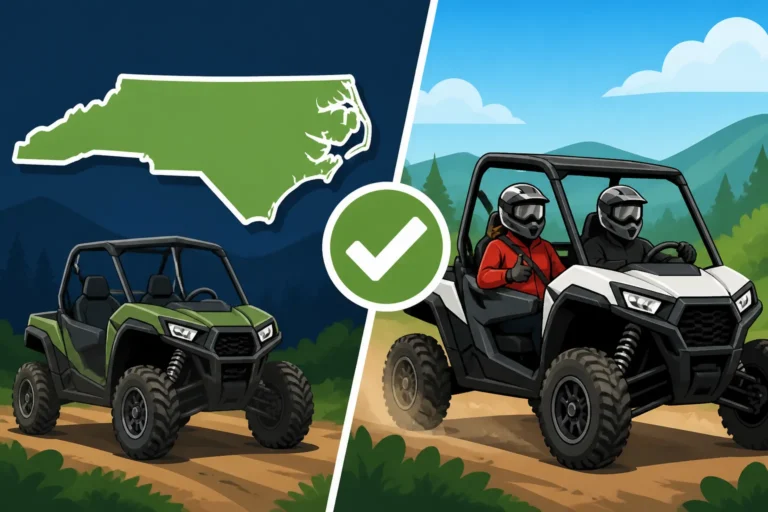
While the farm and emergency exceptions are specific to certain professions or activities, North Carolina does offer a path for private citizens to make a UTV street-legal, albeit under extremely strict conditions. This pathway is for what the state calls a "Modified Utility Vehicle," or MUV. It's not for your typical sport ATV or even a standard UTV; it's a very particular classification designed to bridge the gap between off-road vehicles and low-speed vehicles for certain practical uses. This is the closest a private individual can get to legally riding a UTV on most public roads in North Carolina, but it's far from simple.
What Qualifies as an MUV in North Carolina?
The definition of an MUV is highly specific and often misunderstood. It's not just any UTV you decide to put a few extra lights on. To qualify as an MUV, a vehicle must meet several stringent criteria:
- Engine Size: It must have an engine size greater than 2,400 cubic centimeters (cc). This immediately rules out the vast majority of consumer UTVs, which typically have engines in the 500cc to 1000cc range. This requirement effectively targets larger, more robust utility-grade machines, often diesel-powered, commonly found in industrial or heavy agricultural settings. [North Carolina MUV Engine Size Requirement] is a major hurdle for most.
- Dimensions: It must be at least 142 inches long (almost 12 feet), at least 58 inches wide (nearly 5 feet), and at least 70 inches high (almost 6 feet). These dimensions ensure the vehicle is substantial enough to be seen in traffic and somewhat comparable to larger utility vehicles. A standard side-by-side will almost certainly fall short of these length and height requirements, let alone the engine size.
- Speed Capability: It must be capable of exceeding 40 miles per hour on a paved, level surface. This indicates it’s not a slow-moving utility cart but rather something that can keep pace with lower-speed traffic.
These combined requirements mean that very few commercially available UTVs, as sold off the showroom floor, will ever qualify as an MUV. It's a niche classification aimed at a specific type of heavy-duty vehicle, not recreational side-by-sides. If you're curious about the specifics, you'll want to review [North Carolina's Modified Utility Vehicle Route].
The Rigorous Registration Process for an MUV
If by some chance your UTV does meet the physical and performance requirements of an MUV, the journey to street legality doesn't end there. The vehicle must undergo a formal registration process with the North Carolina Division of Motor Vehicles (DMV). This isn't like simply titling an ATV; it's a much more involved process akin to registering a traditional car or truck.
Here's what that typically entails:
- VIN Assignment: If the vehicle doesn't already have a proper Vehicle Identification Number (VIN) that meets DMV standards, one will need to be assigned through a special inspection process. This ensures the vehicle can be tracked and identified like any other road-legal machine.
- Inspection: The MUV will likely need to pass a safety inspection to confirm it meets all necessary equipment requirements for road use.
- Titling and Registration: The owner must apply for a title and registration, paying all applicable fees and taxes, including the Highway Use Tax.
- Insurance: Just like any other registered motor vehicle, the MUV must carry liability insurance as required by North Carolina law.
The process is designed to ensure that any MUV operating on public roads is as safe and accountable as a conventional vehicle. It's a significant undertaking and highlights just how serious the state is about regulating vehicles on its highways. You'll find more details on [North Carolina MUV Registration Requirements].
Equipment Requirements for Street-Legal MUVs
Once a UTV somehow qualifies as an MUV and goes through registration, it must be outfitted with specific equipment to be truly street-legal. This is where you might see some overlap with aftermarket parts from companies like SuperATV, though the base vehicle itself needs to be compliant first. These requirements ensure the MUV is visible, controllable, and predictable in traffic:
| MUV Equipment Requirement | Standard ATV Comparison |
|---|---|
| Headlamps (high/low beam) | Standard for off-road use, usually single beam |
| Taillamps | Standard for off-road use |
| Brake Lights | Standard for off-road use |
| Turn Signals (front/rear) | Not required on standard ATVs |
| Horn | Not required on standard ATVs |
| Rearview Mirror(s) | Optional or limited on standard ATVs |
| Windshield (safety glass) | Optional on UTVs, not typically safety glass rated for road |
| Seat Belts | Standard on UTVs |
| Speedometer | Not required on standard ATVs |
| Parking Brake | Standard on UTVs |
| DOT-Approved Tires | Off-road specific tires on standard ATVs |
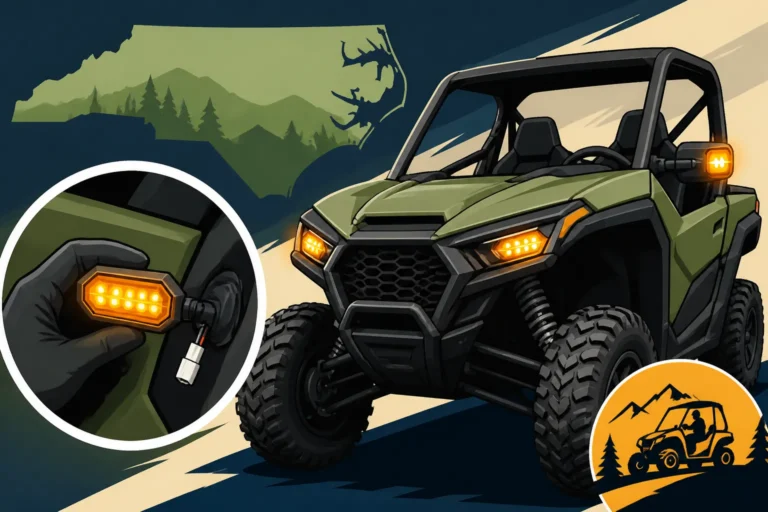
This comprehensive list of equipment goes far beyond what a typical ATV or UTV comes with from the factory. Many recreational UTVs might have some of these, like seat belts and basic headlights, but they often lack DOT-approved tires, proper turn signals, or safety glass windshields. Adding these components can be costly and complex, further emphasizing that the MUV path is not for the faint of heart or the casual rider. These [North Carolina MUV Equipment Requirements] are critical for road safety.
Special Exemptions for Specific Purposes
Beyond the farm and emergency uses, North Carolina law provides other targeted exemptions that explain why certain entities, often governmental or utility-related, can operate ATVs and UTVs on public roads. These are not general permissions but rather highly specific allowances tied to essential public services or infrastructure maintenance.
Municipal and County Operations: The "Official Business" Clause
This is arguably the most common reason you see city and county crews on public roads. Local government entities often use ATVs and UTVs for a wide array of official business. This "official business" clause allows them to operate these vehicles for tasks like:
- Parks and Recreation: Maintaining public parks, greenways, athletic fields, and open spaces that may require crossing or traveling short distances on public roads.
- Public Works: Inspecting drainage systems, maintaining public landscaping, accessing easements for utility repairs, or responding to minor infrastructure issues within city limits.
- Code Enforcement: Surveying properties, inspecting rights-of-way, or accessing difficult terrain for code compliance checks.
- Animal Control: Responding to calls in areas that are not easily accessible by traditional vehicles.
In these scenarios, the ATVs and UTVs are tools, much like a backhoe or a dump truck, that are essential for municipal employees to perform their jobs. They are not being used for personal transportation or recreation. The vehicles are typically clearly marked with government decals and often equipped with amber warning lights to signal their work status to other motorists. Their presence on the road is always incidental to the primary work being performed, not the goal itself. These city crews often utilize robust machines, perhaps enhanced with aftermarket gear from a company like SuperATV, designed for heavy-duty work and durability.
Utility Companies and Construction Sites
Beyond direct government employees, utility companies (electric, water, gas, telecommunications) and crews working on permitted construction sites also benefit from specific exemptions. These operations often require access to easements, rights-of-way, or remote equipment that can only be reached efficiently with an off-road vehicle.
For utility workers:
- They might need to patrol power lines that run parallel to a road, occasionally crossing it to access equipment.
- They may need to inspect pipelines or communication cables that are located in roadside ditches or heavily wooded areas adjacent to public roads.
- In the event of an outage or emergency repair, a UTV can quickly navigate difficult terrain to reach the problem area, often having to cross short stretches of pavement to do so.
For construction sites:
- Workers on large highway construction projects might use UTVs to move personnel and small tools across sections of the project that temporarily intersect with active roads.
- These vehicles are often operating within a designated construction zone, under the supervision of flaggers or with proper signage, further distinguishing their use from recreational riding.
In both cases, these uses are tied to specific permits, contracts, or the provision of essential services. They are not about personal convenience but about maintaining critical infrastructure and ensuring public services continue uninterrupted.
Controlled Access and Designated Areas (like Beaches, very limited)
While less common for day-to-day city crew operations, there are very limited scenarios where certain public lands or areas might have specific rules for ATVs, sometimes including government or authorized personnel. One example sometimes cited is beach riding. In North Carolina, beach driving for ATVs/UTVs is highly restricted and typically only permitted in specific, designated areas (often state or national parks, or certain towns with specific ordinances), and usually only for vehicles with proper permits. Even in these rare instances, most regulations prioritize conventional vehicles and strictly limit ATVs. However, you might see park rangers or authorized personnel using ATVs or UTVs on these same beaches for patrolling, maintenance, or emergency response, again under a special exemption that does not apply to the general public. These are [North Carolina Beach Riding Age Requirement] and other rules you would need to know.
What Private Riders Can Do (and Can't)
So, you've seen the rules that allow city crews to use ATVs on public roads. Now, let's bring it back to you, the private rider. It's important to be realistic about what is and isn't allowed to avoid fines, legal trouble, and potential accidents. The bottom line is that while there are very specific exemptions for certain types of private use, your recreational ATV or UTV is generally prohibited from public roads.
Sticking to Private Land and Designated Trails
For most ATV and UTV enthusiasts in North Carolina, the primary legal avenues for riding are private property (with the landowner's permission, of course) and designated off-road vehicle (OHV) trail systems. North Carolina boasts some fantastic trail complexes, like Brown Mountain, Badin Lake, and Wayehutta, which offer miles of diverse terrain specifically designed for off-road recreation. These areas are managed, often require permits, and have their own set of rules, but they are the safest and most legal places to enjoy your machine.
- Private Land: If you own land or have explicit, written permission from a landowner, you can ride your ATV on that private property. This is a common and enjoyable way for many families to use their machines. Always get permission, even from friends or family, and always respect property boundaries. Checking [North Carolina Landowner Permission Rules] is a good idea.
- Designated OHV Trails: These are public lands specifically set aside for off-road vehicle use. They are maintained, often mapped, and provide a legal, structured environment for riding. Remember to check seasonal closures and permit requirements before you head out. These trail systems often have strict rules on everything from sound levels to spark arresters, so do your homework.
These are your safe havens. Trying to stretch the rules about public roads, even for a short distance, can lead to unpleasant encounters with law enforcement.
The "Crossing a Road" Loophole (and its limitations)
This is a frequently misunderstood aspect of ATV use. North Carolina law does allow an ATV or UTV to cross a public road, but this is a very narrow allowance, not a general permission to travel on it. The intent is to allow riders to move from one section of private property to another when a public road separates them, or to access a trail system that requires a brief road crossing.
Here are the critical limitations of the "crossing a road" rule:
- Direct Crossing: The crossing must be as direct as possible, at approximately a 90-degree angle to the road. You cannot travel down the road, even for a short distance, to find a more convenient crossing point.
- Maximum Safety: You must yield to all on-road traffic and cross only when it is safe to do so. This means stopping, looking both ways, and making sure no vehicles are approaching.
- Road Types: This typically applies to secondary roads, not multi-lane highways or interstates, which are strictly off-limits.
- No Parallel Travel: You cannot ride along the shoulder, in the ditch, or alongside the road. The moment you begin to travel parallel to the road, even for a few feet, you are likely violating the law.
Many riders mistakenly believe this "crossing" rule allows them to connect trails or access gas stations by riding short distances on the road. It does not. The intent is purely to facilitate movement across a road, not along it. Be very clear on [North Carolina Rules for Crossing a Road] before attempting it.
The Importance of Knowing Your Local Ordinances
While state law provides the overarching framework, local county and municipal ordinances can add another layer of regulation. What might be allowed in a very rural county for farm use could be strictly prohibited in a more densely populated city. Some local governments may have specific rules regarding noise, time of day for operation, or even stricter definitions of what constitutes a "farm operation" within their jurisdiction.
- Before You Ride: If you plan to use your ATV anywhere near public property or roads (even private roads within a community), it's always wise to check with the local sheriff's office or city police department for any specific ordinances.
- Community Rules: If you're riding in a planned community or near a residential area, be aware of homeowners' association (HOA) rules, which can impose additional restrictions on off-road vehicle use, even on private property.
It's tempting to think that "no one will notice" for a quick trip, but law enforcement officers are keenly aware of the general prohibition against ATVs on public roads. Seeing a city crew might make you feel like you're being unfairly targeted, but their legal permissions are clearly defined and distinct from yours. Understanding and respecting these differences is key to staying safe and legal on your North Carolina ATV adventures.
Disclaimer
This article is for general informational purposes only and does not constitute professional advice. Laws, prices and regulations vary by location and change over time. Consult a qualified professional for guidance on your specific situation.