North Carolina Rules for Riding Game Lands
Game lands can look like open public land, but they are managed for wildlife, not general ATV and UTV recreation. The hard part is knowing whether a particular road or trail is actually open to your machine—and which rules apply when game land overlaps a forest riding area. This guide explains how to check access, permits, seasonal restrictions and out-of-state documents before you unload.
The short answer: game land is not automatically riding land
North Carolina game lands are managed for wildlife and public recreation, but that does not mean every part is open to motorized riding. The practical rule is to use only routes that are specifically open to your machine and activity. A visible track, an old logging road or a route shown on an unofficial map is not proof that ATV or UTV use is allowed.
In general, motorized travel on game lands is restricted to roads open to public vehicular traffic unless a specific rule or authorization allows otherwise. This is a starting point, not blanket permission to ride every public road. State vehicle laws, local restrictions, landowner or managing-agency rules, gates, and posted closures can still prohibit your machine or your planned use.
The distinction matters because a game land may border, overlap or sit near a national forest, a designated OHV trail system, private property or another managed area. Each may have different access rules. A forest permit, for example, is not a general permit to ride anywhere within the forest boundary or on adjoining game land. Likewise, having a hunting or fishing license does not, by itself, give you permission to operate an ATV wherever you want on game land.
| What you have or see | What it means | What it does not prove |
|---|---|---|
| A road is visible on the ground | People or vehicles have used it at some point | That it is open to your ATV or UTV today |
| A route appears on a general map | The route may be useful for orientation | That motorized recreation is permitted there |
| A forest OHV permit | You have met a permit requirement for the named riding area, if applicable | That you may leave the designated trail system |
| A hunting or fishing license | You may be licensed for the activity covered by that license | That you have motorized access to game-land routes |
| An out-of-state registration or permit | Your machine or trip may meet a requirement where it was issued | That North Carolina recognizes it as permission to ride game land |
| A gate is open | The route is physically accessible at that moment | That it is legally open to your machine or purpose |
Treat the map, current rules and signs together. If they do not clearly support the route you plan to ride, stop and check with the agency responsible for that area before you go. For broader context on access, see Game Land Access for North Carolina Riders and [North Carolina Rules on Game Lands].
How to confirm whether a route is open
Before a ride, identify the exact tract and route—not just the general forest, county or recreation area. Game lands can have complicated boundaries, and a short ride may pass through areas controlled by different agencies. A line that looks continuous on a phone map can change status at a boundary, gate or trail junction.
Use these steps to check access:
- Find the land manager. Confirm whether the place is a state game land, national forest, state park, private property or a combination of areas. Do not assume one agency controls every parcel around a trailhead.
- Get the current official map or access notice. Look for the map and rules for the specific game land, not just a broad regional map. Check the current forest or OHV map too if the route enters a designated riding area.
- Look for machine-specific rules. A route may be open to passenger vehicles, bicycles, horses or pedestrians but not to ATVs or UTVs. Confirm the permitted vehicle type and whether the route is intended for travel or only for a limited purpose.
- Check dates, closures and conditions. Seasonal restrictions, hunting activity, storms, repairs or resource protection can change access. A route that was open on your last trip may not be open now.
- Read the signs at the entrance and along the route. Posted restrictions can clarify a general map—or close an area temporarily. If a sign conflicts with what you expected, follow the restriction and verify it with the manager.
- Ask when the map is unclear. Contact the responsible district or office and describe the specific entrance, route and machine. Keep the answer with your trip information, but still follow any later closure or instruction.
Official maps are more useful than a screenshot of a route someone posted online. Online tracks can be outdated, can cross private property and may have been recorded when access conditions were different. Even a route used by other riders is not necessarily legal. If you need help interpreting maps before planning a route, North Carolina Forest Trail Maps covers map-reading considerations for forest rides.
Pay particular attention to boundary crossings. A trail may begin on a designated OHV route and then reach a game-land road that is not open to recreational riding. The fact that you can physically continue does not mean you can legally do so. Stay on the route you have confirmed, and turn back when its status becomes unclear.
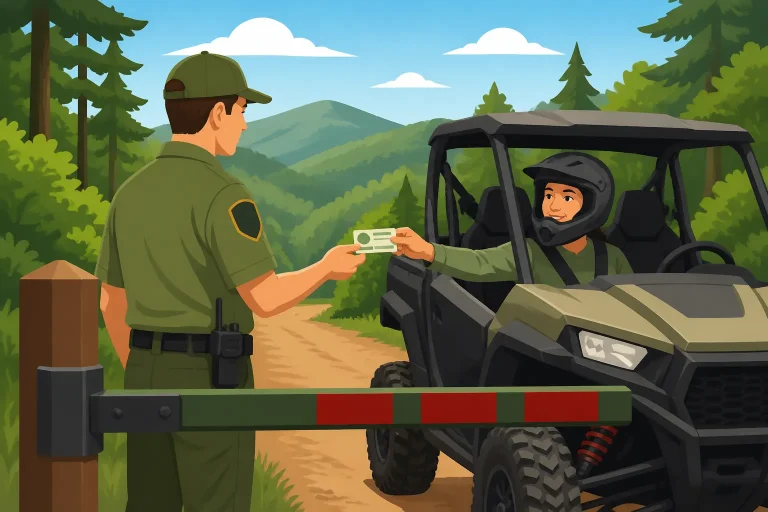
This is especially important around gates and unsigned roads. A gate may be open for wildlife staff, maintenance crews, hunters or another authorized user. An open gate is not a reliable signal that recreational ATV access is allowed. Similarly, a locked gate is not an invitation to find a way around it. Do not ride around, move or bypass a closure device.
Permits, licenses and what each one covers
There is no single permit that grants general ATV or UTV access to all North Carolina game lands. The requirement depends on the land, route and activity. Separate the documents you may need into three categories: permission to enter or ride a particular area, authorization for a regulated activity such as hunting, and documentation or equipment required for the machine and rider.
Game-land access is separate from a hunting license
A hunting license is for hunting under applicable rules. It does not automatically authorize recreational ATV riding on a game land. If you are hunting, your license and hunting rules matter, but motorized access still depends on the route and game-land restrictions.
The same distinction applies to fishing or other outdoor activities. A license for an activity does not turn a closed road into an open riding route. When a game land has a specific access requirement, meet that requirement separately. If it does not clearly allow your machine, do not infer permission from the fact that the area is public.
Forest OHV permits are specific to their riding areas
Some designated off-highway vehicle areas have their own permit or pass rules. Those rules are tied to the relevant riding area and its designated trails. A permit for a forest OHV system should not be treated as permission to ride onto any adjoining game land, forest road or unmarked route.
Check which areas accept the permit, which machine must display or carry it, and whether any additional rider requirements apply. Permit terms can differ by area, and access can change with closures. For details about the separate permit system, see North Carolina Forest OHV Permits and Do You Need a Permit for North Carolina Forest Trails?.
Do not rely on a pass from another state or a permit from another North Carolina riding area unless the responsible manager specifically confirms it applies. When you are making a trip that covers more than one managed area, check each area separately.
Safety certificates and rider requirements are another issue
North Carolina has a safety-certificate requirement tied to the rider’s birth year for certain off-highway riding. That requirement is distinct from a trail permit and from game-land access permission. If it applies to you, carrying the certificate does not make a closed route open; it only addresses that separate rider requirement. Review North Carolina Safety Certificate Birth Year Rule and confirm current instructions for accepted courses and proof.
Do not assume a certificate from another state will automatically satisfy North Carolina’s requirement. Acceptance can depend on whether the course or certificate is recognized under North Carolina’s rules. Check Does North Carolina Accept an Out-of-State Certificate? before travelling if you plan to rely on an out-of-state document.
A useful way to plan is to make a short checklist for each rider and machine:
- Is the route open to this kind of machine?
- Is a permit required for this particular riding area?
- Does each rider need a safety certificate?
- Are there age, supervision, passenger or protective-equipment rules?
- Does the route cross into another jurisdiction with different requirements?
Keeping those questions separate prevents a common mistake: treating one valid document as an all-purpose riding pass.
What changes during hunting seasons and closures
Game lands are actively managed, and access can change with wildlife work, road conditions, hunting seasons or other management needs. A route that is normally available for a particular use may be temporarily restricted. A route that is open to some users may have additional limits during certain activities.
Before setting out, check notices for the exact tract and date. Do not rely on what a friend remembers from a previous season or on an old map still saved in your phone. Check again shortly before leaving, particularly after a storm or during a busy hunting period.
Hunting activity calls for extra planning
When hunters are using an area, give them room and avoid adding confusion. Do not ride into a hunting setup, block access roads or continue along a route that has been closed or restricted for the activity. If you encounter a hunter or wildlife staff member, slow down, keep a safe distance and follow any reasonable direction given for the area.
Blaze orange can be a sensible visibility choice during hunting seasons, but do not assume that wearing orange makes an otherwise closed route legal. Nor should you assume the same clothing rule applies to every visitor in every situation. Hunting regulations and ATV access rules are separate; check the current rule that applies to your activity and the specific game land.
Quiet, considerate riding matters too. Avoid unnecessary revving near people, wildlife or hunting activity. Keep noise within applicable equipment and land-management rules, and do not use an ATV to pursue, harass or approach wildlife.
Weather and maintenance closures count
Heavy rain, flooding, washouts, fallen trees and repair work can make a trail unsafe or prompt a closure. A route can be physically passable while still being closed. Riding around a damaged section can widen erosion, damage habitat or put you into an area that is not authorized for motorized use.
If an official notice says a route is closed, follow it even if the closure point looks minor. Do not use a parallel track to get around the restriction. For an overview of closure checks before a forest ride, see North Carolina Trail Closures to Check First.
A closed route is not necessarily a permanent change, but that is no reason to test it. Ask the responsible manager when it is expected to reopen and whether there is an approved alternative. If no approved route is available, change the trip plan.
Riding near a forest, trail system or private boundary
The word “public” can create false confidence. A game land is public land in a broad sense, but it is managed land with rules. A nearby national forest may have a designated OHV system, but that does not make every road or adjoining parcel part of the system. Private parcels can be interspersed with public property, too.
Use a map that shows boundaries and the designated riding area. If you cannot tell which side of a boundary you are on, do not keep riding and hope the route is allowed. Turn back to a location you can identify, or contact the land manager for clarification. Do not cross a fence, gate or posted boundary to connect two routes.
Stay on designated routes
Leaving a marked trail can cause damage and may violate land-management rules, even if the ground looks durable. Avoid cutting switchbacks, making a new bypass around mud or fallen debris, riding through vegetation, or using a footpath as a shortcut.
If a section is difficult, use an approved route around it only when the manager has designated one. Otherwise, turn around safely. [North Carolina Rules for Riding Off the Trail] explains why going beyond the marked route can create both access and environmental problems.
A rider should also avoid widening a trail by driving around puddles or obstacles. Repeated detours can turn a narrow route into a larger damaged area. If conditions are beyond your machine or skill level, backing out is a better choice than creating a new line.
Public roads still have vehicle rules
A road that is open to public vehicular traffic on game land is not automatically legal for every ATV or UTV. Whether your machine may use it also depends on North Carolina vehicle laws and any local restrictions. Do not assume that an ATV becomes street legal simply because a road is shown as public or because the road passes through public land.
Where a road crossing is permitted, follow the applicable rules and cross only where allowed. Do not ride along a public road unless the machine and route qualify under the law. If your trip plan depends on a road connection, confirm that exact connection before you leave.
Private property needs permission
Game lands may meet private property without an obvious physical barrier. A map boundary, fence line or road junction may be the only clear clue. Do not treat an unmarked path as a public continuation just because it leads somewhere useful.
Get permission before riding private ground, and respect posted restrictions. If you are unsure whether a parcel is public or private, treat it as unavailable until you confirm. Written Landowner Permission in North Carolina offers more guidance on permission and access boundaries.
Nonresident riders and out-of-state documents
Visitors should plan by North Carolina’s rules, not by the rules of the state where they bought or registered their machine. A plate, registration, trail sticker or safety card from home does not automatically authorize riding on a North Carolina game land. It also does not replace a permit required by a specific North Carolina OHV area.
North Carolina does not have a general ATV registration system that acts as a universal access pass. That means visitors should not expect an out-of-state registration to substitute for route permission, a local permit or a rider requirement. See [North Carolina Rules for a Visiting Rider] for the broader visitor issue and Does North Carolina Honor Out-of-State Registration? for the registration distinction.
For each trip, check these items separately:
- Land access: Is this exact game-land route open to your machine?
- Area permit: Does the designated OHV area require a permit, and does your permit apply there?
- Rider documentation: Does North Carolina require a safety certificate based on your birth year, and is your certificate accepted?
- Machine rules: Is your ATV or UTV permitted on that route, and does it meet applicable equipment requirements?
- Temporary restrictions: Is there a closure, seasonal limit or management notice for the date of your ride?
A rental does not automatically solve these questions. The rental company may explain where its machine can be used, but you are still responsible for following route restrictions and closures. Ask whether the rental includes any area-specific permit, which exact trails it covers and whether game-land routes are excluded. If the answer is vague, get clarification before paying or loading the machine.
A practical pre-ride checklist
A few minutes of planning can prevent a long detour, a citation or damage to a sensitive area. Use this checklist for any ride that touches game land:
- Name the exact tract and entrance. “The forest near town” is not precise enough. Identify the game land, OHV area, road or trailhead.
- Confirm the route on current official information. Check the game-land map and, if applicable, the forest OHV map and current alerts.
- Verify machine access. Make sure the route allows your ATV or UTV, rather than only other forms of travel.
- Check permits and certificates. Confirm which permit is needed for the designated riding area and whether each rider must carry a safety certificate.
- Look for hunting or seasonal restrictions. Check for posted notices, dates, temporary closures and special-use limits.
- Inspect boundary crossings. Mark where the route approaches private land or changes management areas. Do not assume permission continues across the line.
- Prepare for a turn-back. Carry enough fuel and time to return by the route you confirmed. Do not depend on an unverified shortcut.
- Follow signs on the ground. If a gate, sign or ranger instruction conflicts with your plan, obey the restriction and ask for clarification later.
A paper map or an offline copy of the official map can help when cell service drops. If you buy a map case or other navigation accessories on Amazon, make sure the map itself is current and comes from a reliable source; a convenient mount cannot make an outdated route authoritative. A small first-aid kit and basic trail-repair supplies can also be useful, but they do not replace route planning or recovery equipment suited to your machine.
For a group ride, give every driver the same route and closure information. Do not let riders spread out onto side tracks or assume the lead machine has checked each junction. Agree on a turnaround point and a way to regroup if someone misses a turn. If one rider is unsure whether a road is open, stop the group and resolve the question before continuing.
The simplest rule to remember is this: permission is specific. A game-land boundary, public road, forest pass, hunting license, out-of-state registration or open gate does not by itself establish that your ATV or UTV may ride a particular route. Confirm the land manager, route, machine type and current conditions before unloading.
Disclaimer
This article is for general informational purposes only and does not constitute professional advice. Laws, prices and regulations vary by location and change over time. Consult a qualified professional for guidance on your specific situation.