North Carolina Forest OHV Season Pass Cost
A North Carolina Forest OHV season pass can be cheaper than buying a day permit for every ride, but there is no single pass for every trail system. The cost and coverage depend on where you ride, how often you go, and which machines need permits. Here’s how to compare the options and confirm the current price before you head out.
What a North Carolina Forest OHV season pass covers
A forest OHV season pass is a recreation permit for a particular riding area or permit program. It is not a North Carolina registration, a title, or a statewide trail sticker. A pass that works at one forest OHV area should not be assumed to cover another.
That distinction matters if you ride more than one place. For example, Brown Mountain OHV Trail System and Badin Lake OHV Trail Complex have separate riding areas and permit information. Wayehutta OHV in Western North Carolina also has its own access details. Check the terms for the exact place you plan to ride rather than relying on a pass you bought for a different forest.
Season passes can cover a defined riding season, but the season does not necessarily follow the calendar year. Trail areas can have different operating periods, and access can be affected by closures, weather, maintenance, or other forest notices. A pass does not guarantee that a trail will be open on a particular day. Before traveling, check both the permit terms and the current status of the riding area.
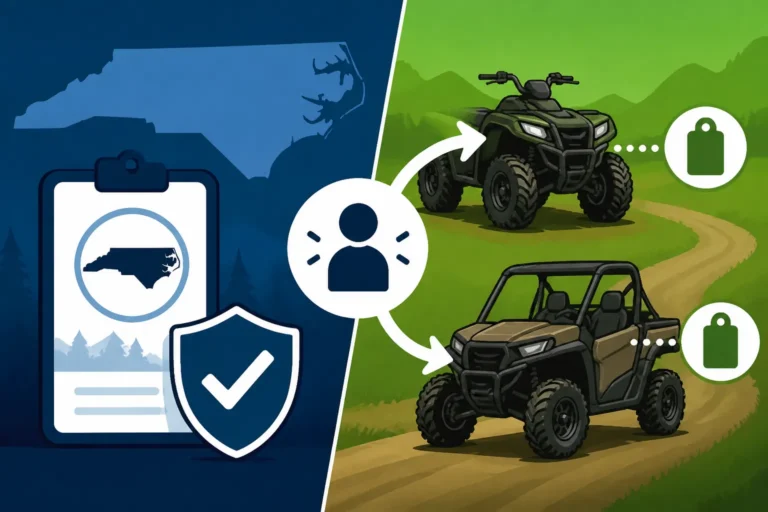
A pass is generally associated with the machine, not a rider’s personal right to ride any vehicle. If you take more than one ATV or UTV, check whether each machine needs its own permit. This is especially important for families and groups: one pass should not be treated as covering a whole convoy unless the published permit terms explicitly say so. The background is explained in Why a Permit Is Per Vehicle in North Carolina.
A season pass is also different from the safety certificate that may apply to some riders based on birth year. The two requirements serve different purposes, so a forest permit does not replace a required certificate. See North Carolina ATV Safety Certificate Requirements if you need to check the certificate rule.
How to work out whether the season pass saves money
The useful comparison is not just “season pass or day pass?” It is the total cost of the permits you expect to need for the season, for the specific machines you plan to ride. Because permit prices and terms may change, check the current figures with the official forest source or an authorized seller before doing the arithmetic.
| Riding plan | What to compare | What may make a season pass worthwhile |
|---|---|---|
| One visit | The current day permit cost against the season pass cost | A day permit may be the lower-cost choice if you expect only one outing |
| Several visits to one area | The expected number of day permits against one season pass | Repeated rides at the same covered area can make a season option more economical |
| Visits to multiple forest areas | Separate permit costs and each pass’s coverage | A season pass may still require additional permits elsewhere |
| Several machines on one trip | The permit requirement for each vehicle | A pass may need to be purchased for every machine rather than every rider |
| A trip during a short operating season | The pass’s valid dates and the area’s open dates | A shorter usable window can reduce the value of a season option |
A simple way to compare is to list the trips you realistically expect to make, not the number you hope to make. Then check the day-permit and season-permit terms for the area you’ll use most. If the season pass costs less than the day permits you would otherwise buy for those trips, and its validity dates fit your plans, it may be the better option.
Account for practical limits, too. A season pass for one area may not help if most of your planned rides are somewhere else. Likewise, a pass that is valid only during a particular operating period might not cover a trip outside that window. If your plans are uncertain, compare the cost of a few day permits with the season price rather than assuming frequent riding will happen.
For multi-area trips, build a separate line into your budget for each place. A weekend that includes two different OHV systems may involve two different permit requirements. North Carolina Forest OHV Permits provides broader context, while Which North Carolina Forests Take a Day Permit can help you identify which permit arrangements to check for your itinerary.
The cost of the pass is only one part of the trip budget. You may also need to plan for fuel, transport, lodging, and any required gear. Those expenses do not change which permit you need, but they can affect whether several separate day rides or a longer visit makes sense financially.
How to confirm the current cost and buy the right permit
Permit prices, sales locations, accepted payment methods, and validity periods can change. Use the official information for the specific riding area as your final check. A local shop or other seller can be convenient, but confirm that it is authorized to sell the permit you need and that it has the type you are seeking.
Use this process before paying:
- Choose the exact riding area. Identify the trail system or forest area you plan to use. Do not search only for a general “North Carolina OHV pass,” because that can lead to a permit for the wrong location.
- Check the current permit options. Look for day and season choices, the current price of each, and the period each one covers. If the details are unclear, contact the relevant forest office or authorized seller.
- Confirm the machine requirement. Check whether the permit is required for each ATV or UTV and whether any limits apply to the vehicle or type of use. A permit intended for one vehicle may not cover another.
- Verify where and how to buy. Find out whether permits are sold online, at a district office, through local vendors, or at another approved location. Do not assume a trailhead will have staff or a working payment option when you arrive.
- Read the display and proof requirements. Find out whether the permit must be displayed on the machine, carried with you, or both. Keep any receipt or confirmation until you know the permit has been properly issued.
- Check the trail notice before leaving. A valid pass does not override a closure. Review current notices for the area and confirm that the trails you intend to use are open.
For area-specific purchasing details, see Where to Buy a North Carolina OHV Permit and Buying a North Carolina Permit at a Ranger Station. If you plan to ride at Badin Lake, Badin Lake’s Season Permit is a useful place to check the system’s season-pass details. For Brown Mountain, consult Brown Mountain’s Season Permit and confirm the current terms before buying.
Do not rely on an old receipt, a friend’s recollection, or an outdated online post for today’s cost. Even when the general permit structure stays familiar, amounts, sellers, and operating dates can be revised. A quick confirmation before purchase is easier than arriving with a pass that does not cover the area or date you planned to ride.
Common cost mistakes to avoid
Assuming one pass covers the whole state. North Carolina does not have one general forest OHV season pass that automatically applies everywhere. Check each riding area separately, particularly when an itinerary includes more than one forest. Why There Is No North Carolina OHV Decal explains why a forest permit should not be confused with a statewide decal.
Counting riders instead of machines. Permit requirements may be tied to each vehicle. If several machines are going, check the cost and paperwork for every one rather than budgeting for a single pass for the group.
Buying a season pass for a place you rarely use. A pass can look like good value when compared with many day permits, but the calculation only works if you actually ride there enough during its valid period. For occasional visits or trips spread across different systems, day permits may be the more practical choice.
Forgetting that a season has boundaries. A pass can have start and end dates, and the trail area may close for reasons unrelated to the permit. Check the season’s dates and current notices before building a trip around the assumption that the pass allows access all year.
Treating the pass as permission to ride anywhere in the forest. A permit does not necessarily authorize travel on every road, trail, or piece of public land. Stay within the routes open to OHVs and follow posted restrictions. North Carolina Forest Trail Maps and North Carolina Trail Closures to Check can help with trip planning, but the local forest’s current notices remain important.
Leaving the permit purchase until the trailhead. A trailhead may have a self-service payment option, but availability and instructions can vary. Check in advance whether you can buy there, what payment methods are accepted, and how to handle proof of purchase. This is particularly useful if you expect to arrive early or ride in an area with limited cell service.
Confusing a forest permit with a title or registration document. A forest pass is for access under the applicable recreation rules. It does not establish ownership of an ATV or UTV, and it does not replace title paperwork where that paperwork is relevant. The distinctions are covered in Do You Need a Title for an ATV in North Carolina? and Why North Carolina Has No ATV Registration.
The most reliable way to estimate your season-pass cost is to identify the exact riding area, check its current day and season options, and count the machines that will need permits. If you ride the same covered area often, a season pass may offer better value. If you ride occasionally or visit several different areas, compare each permit separately before buying.
Disclaimer
This article is for general informational purposes only and does not constitute professional advice. Laws, prices and regulations vary by location and change over time. Consult a qualified professional for guidance on your specific situation.