Born in December 1989 and Not
Born in December 1989? North Carolina’s ATV safety-certificate rule has a birth-date cutoff, so your birthday puts you on the older side of it. That answers only the certificate question, though. It does not automatically waive trail permits, supervision rules, protective-gear requirements, or other restrictions that apply where you ride.
What the December 1989 birth date means
According to the North Carolina General Assembly, ATV operators born on or after January 1, 1990, must possess a safety certificate. A rider born in December 1989 was born before that cutoff, so the certificate requirement based on this birth-date rule does not apply.
The distinction is about the certificate, not a general exemption from ATV rules. Your age does not cancel requirements for a particular riding area, make a closed trail open, or allow an ATV on a road where it is prohibited. It also does not replace a site-specific permit or pass. The North Carolina General Assembly states that the training and certificate requirement took effect October 1, 2006; that date did not move the birth-date cutoff.
If you want to check the cutoff in more detail, Why the Certificate Binds by Birth Year and January 1990 and the North Carolina Line focus on how the date separates riders who must hold a certificate from those who do not. Why a Rider Born in 1989 Needs Nothing addresses the practical answer for a rider born before the cutoff.
| Your birth date | What the birth-year rule means | What it does not decide |
|---|---|---|
| December 1989 | The North Carolina General Assembly’s certificate requirement for operators born on or after January 1, 1990, does not apply to you. | Whether a riding area requires a pass, or which safety and site rules apply. |
| January 1, 1990, or later | The North Carolina General Assembly requires you to possess an ATV safety certificate. | Whether you also need an area-specific permit or must follow additional trail rules. |
The North Carolina General Assembly says ATV safety courses must be sponsored or approved by the All-Terrain Vehicle Safety Institute, or approved by the Commissioner of Insurance. If you are not required to hold a certificate because of your birth date, you can still choose to take an approved course. Training may help you prepare for riding unfamiliar terrain, but it does not change which legal requirements apply to you.
Keep the question narrow when you ask an agency, riding area, or event organizer about the certificate. Give your birth date and ask whether the North Carolina birth-year rule requires a certificate for you. Then ask separately about the permit, pass, or other rules for the place you plan to ride. That makes it less likely that an answer about one requirement will be mistaken for an answer about all of them.
Certificate, permit, registration, and proof are different things
A safety certificate and a trail permit serve different purposes. The certificate relates to the rider and the state’s training rule. A permit or pass relates to access to a particular riding area. Being exempt from the birth-year certificate requirement does not by itself give you permission to ride a managed trail.
For national forest OHV areas in North Carolina, the Forest Service says visitors need a valid permit or pass for the specific area where they are riding. Passes are sold through Recreation.gov, and riders must carry the valid pass on the trail. The Forest Service also says a state driver’s license must be available during a law-enforcement compliance check. Check the current requirements for your intended area before leaving; a pass for one place should not be assumed to cover another.
These distinctions are easy to mix up:
- Safety certificate: A rider-related requirement that depends on the birth-date cutoff set out by the North Carolina General Assembly.
- Area permit or pass: Access authorization for a specified riding area, under that area’s rules.
- Registration: A separate vehicle issue. The Forest Service says ATVs cannot be registered and therefore are not allowed on Forest Service roads.
- Proof to carry: The Forest Service requires trail riders to carry their valid pass and have a state driver’s license available for a compliance check.
For details on permits in forest riding areas, see North Carolina Forest OHV Permits and Do You Need a Permit for North Carolina Forest Trails?. Those questions are separate from whether a person born in 1989 needs an ATV safety certificate.
The Forest Service also says passes remain valid until midnight on the date written on them. Check the date and area printed on your pass, and keep it with you while riding. If you are unsure whether you have the correct pass, confirm with the provider or the relevant Forest Service office before you travel rather than relying on a certificate, an old pass, or another rider’s paperwork.
Registration is another point worth keeping separate. According to the Forest Service, vehicles on public roadways, including Forest Service roads, must be registered in accordance with state law, but ATVs cannot be registered and are not allowed on those roads. The Forest Service says OHVs must be trailered to the trailhead. In other words, having the right permit for an OHV trail does not make the ATV street-legal or authorize you to ride it along the road to reach that trail.
Rules that can still apply to a rider born in 1989
The certificate cutoff does not remove operating and safety rules. Requirements can depend on the trail, the vehicle, and the rider’s circumstances, so read the rules for your specific destination rather than relying only on the answer to the certificate question.
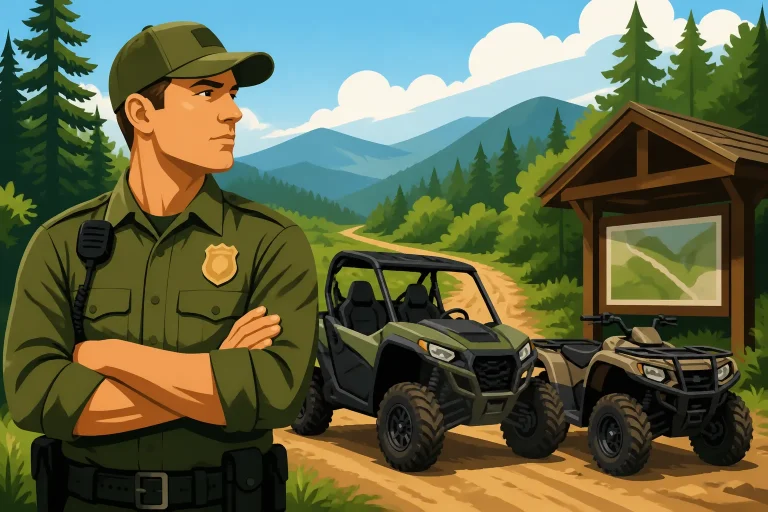
For national forest OHV areas, the Forest Service requires children under 16 to be under continuous visual supervision by an adult over 18. It also says ATV and motorcycle operators and passengers must wear helmets and eye protection that meet U.S. Department of Transportation motorcycle safety standards. A person born in December 1989 is not a child under 16, but the helmet and eye-protection requirements still matter.
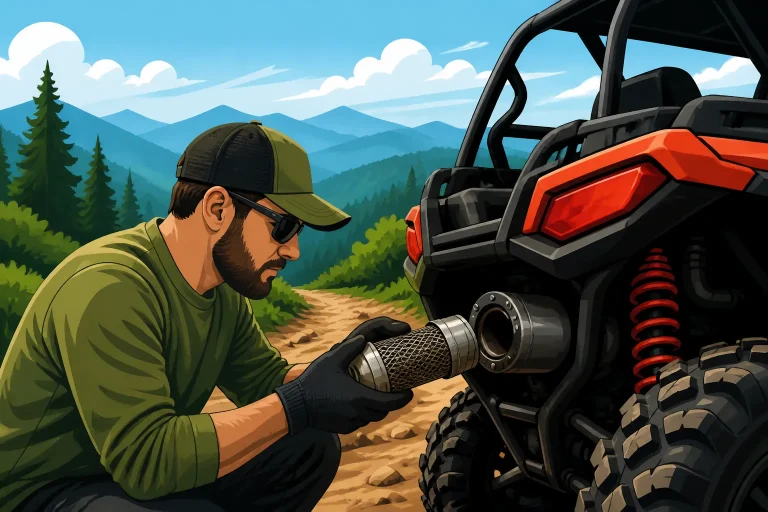
The Forest Service says an OHV operator may not carry passengers unless the manufacturer specifically designed the vehicle for that purpose. The vehicle must also have a working spark-arresting device. Riders must stay on designated trails; driving off-trail is prohibited. Alcoholic beverages are prohibited in OHV areas. These rules are not substitutes for a certificate requirement: they apply as separate operating conditions at the relevant locations.
North Carolina law also sets rules for ATV operation. According to the North Carolina General Assembly, riding an ATV on a public street, road, or highway is prohibited except to cross it, and riding on an interstate or limited-access highway is prohibited. The General Assembly also says that when an ATV is operated during darkness or reduced visibility, it must display a lighted headlamp and taillamp. These are road-use and equipment rules, not part of the birth-year certificate test.
The General Assembly further prohibits operating an ATV while impaired, or operating it carelessly or recklessly in a way that endangers or injures someone or damages property. Owners may not authorize operation contrary to the law. You should not treat being outside the certificate cutoff as permission to ignore these requirements.
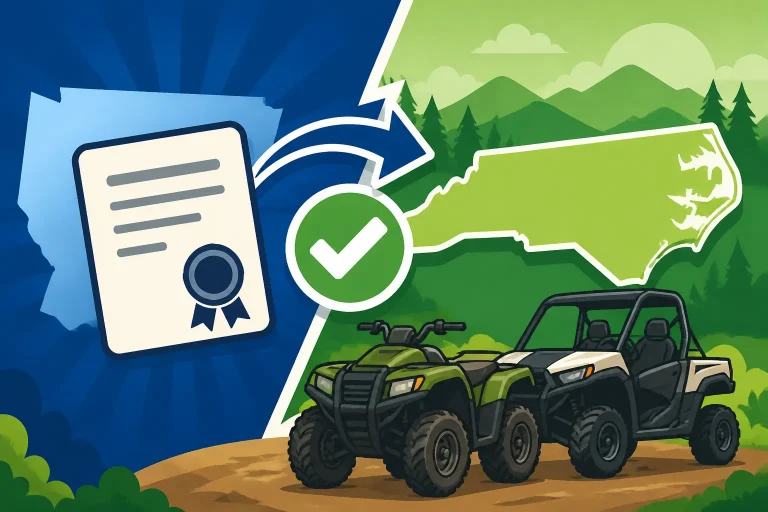
For a visit to a national forest trail, confirm the area’s rules for youth riders, passengers, equipment, passes, and trail access. The Forest Service identifies only four designated OHV areas within the National Forests of North Carolina, so it is especially important to identify the actual riding area rather than assume every forest road or trail is open to ATVs. North Carolina Rules for a Visiting Rider can help with the separate questions a nonresident may have, while Does North Carolina Accept an Out-of-State Certificate? concerns a different issue from the birth-date cutoff.
A practical check before you ride
Before loading your ATV, work through the requirements in separate steps. This helps prevent a correct answer about your birth date from being mistaken for complete permission to ride.
- Check the certificate rule. If you were born in December 1989, the North Carolina General Assembly’s requirement for operators born on or after January 1, 1990, does not apply to you. If you were born on or after the cutoff, confirm that you have an accepted certificate.
- Identify the riding area. Look up the specific trail or OHV area, not just the nearest national forest or town.
- Confirm the required pass. The Forest Service says a valid pass is needed for the specific area and must be carried on the trail. Check its validity date and where it is accepted.
- Review vehicle access. The Forest Service says ATVs cannot be registered and are not allowed on Forest Service roads, so arrange to trailer the ATV to the trailhead.
- Check rider and equipment rules. Review the rules for supervision, passengers, helmet and eye protection, spark arresters, and staying on designated trails.
- Carry the required proof. Bring the pass and have your state driver’s license available for a compliance check, as the Forest Service requires.
If you already have a safety card, carry it if doing so is convenient, but do not confuse it with an area pass. The Forest Service requires the pass for the specific riding area; a training certificate does not take its place. For more on what to have with you, see [Carrying a Safety Card on a North Carolina Ride] and North Carolina ATV Safety Certificate Requirements.
When an official page or sign is unclear, verify the rule with the agency responsible for that land or program before setting out. Ask specifically whether the question concerns the state certificate, a trail pass, vehicle access, or an operating rule. Those are separate checks, and getting the answer to each one is the practical way to avoid an unpleasant surprise at the trailhead.
Sources
- Forest Service — National Forests in North Carolina | Off-Highway Vehicles (OHV) | Forest Service (checked November 3, 2026)
- OSFM — ATV Safety | OSFM (checked November 3, 2026)
- Forest Service — National Forests in North Carolina | Black Swamp OHV Trailhead | Forest Service (checked November 3, 2026)
- Forest Service — National Forests in North Carolina | Brown Mountain OHV Trail System | Forest Service (checked November 3, 2026)
- Forest Service — National Forests in North Carolina | Off-Highway Vehicles (OHV) | Forest Service (checked November 3, 2026)
- USDA Forest Service — National Forests in North Carolina | Off-Highway Vehicles (OHV) | Forest Service (checked November 3, 2026)
Disclaimer
This article is for general informational purposes only and does not constitute professional advice. Laws, prices and regulations vary by location and change over time. Consult a qualified professional for guidance on your specific situation.