Which Safety Courses North Carolina Accepts
North Carolina’s ATV safety-certificate rule can be easy to misread: taking a course is not enough if the course does not meet the state’s approval criteria. Here’s who needs a certificate, which course approvals count, and what to check before enrolling so you can keep the right proof with you.
Who needs a North Carolina ATV safety certificate
The certificate requirement applies to certain ATV operators, not automatically to every rider. According to the North Carolina General Assembly, an ATV operator born on or after January 1, 1990, must possess a safety certificate. If you were born before that date, this particular birth-year rule does not require you to hold one. You can check the details in Who Needs a North Carolina Safety Certificate and North Carolina Safety Certificate Birth Year Rule.
The rule is about ATVs. The North Carolina General Assembly’s requirement does not, by itself, establish that every UTV operator must hold the same certificate. If you ride a UTV, check the rules that apply to the machine and the place where you plan to ride rather than assuming an ATV certificate rule covers every vehicle.
A safety certificate is also separate from a trail pass or permit. A course certificate shows that an operator met a training requirement. A trail pass authorizes use of a particular riding area under that area’s rules. For example, the Forest Service says riders in National Forest OHV areas must have a valid pass for the specific area and carry it while on the trails. Completing a course does not replace that pass.
Likewise, a driver’s license, vehicle paperwork, and a safety certificate serve different purposes. Having one does not automatically satisfy the others. For more on the certificate’s birth-year cutoff, see Why the Safety Certificate Depends on Your Birth Year and North Carolina Rules for Riders Born On or After 1990.
Which ATV safety courses North Carolina accepts
The key question is not simply whether a course is called an “ATV safety course.” According to the North Carolina General Assembly, an ATV safety course must be sponsored or approved by the All-Terrain Vehicle Safety Institute (ASI), or approved by the Commissioner of Insurance.
That approval standard is what to verify before you pay, enroll, or rely on a completion card. A course might cover sensible riding practices but still not meet the state’s stated criteria. Conversely, a course that satisfies the required sponsorship or approval condition may be relevant even if its name does not match the wording you expected. If you are considering an ASI course, What an ATV Safety Institute Course Covers can help you understand the training side of the decision.
| Course or training option | What to verify | How to treat it |
|---|---|---|
| A course sponsored or approved by ASI | Confirm the course itself is sponsored or approved, not just that it mentions ATV safety | It meets one of the approval routes stated by the North Carolina General Assembly |
| A course approved by the Commissioner of Insurance | Confirm that the specific course has that approval | It meets the other approval route stated by the North Carolina General Assembly |
| A community college course for a young person | Ask whether the specific training is an approved course under the state criteria | The North Carolina General Assembly authorizes the North Carolina Community College System to provide approved ATV safety training to people under 18 |
| A general online course or informal safety session | Ask who sponsors or approves it and whether the course meets the state criteria | Do not assume the course qualifies just because it covers safety topics |
| A course completed in another state | Ask whether the specific course meets North Carolina’s approval standard | Do not assume an out-of-state card is accepted automatically |
The table is a screening tool, not a list of every provider or course the state accepts. The facts that matter are the course’s actual sponsorship or approval and whether you can document completion. If an enrollment page is vague, ask the provider who approves the course and whether it is intended to satisfy North Carolina’s ATV safety-certificate requirement.
The North Carolina Community College System has a specific role for younger students. According to the North Carolina General Assembly, the system is authorized to provide approved ATV safety training to people under 18. That does not mean every class offered at every college automatically qualifies. Confirm that the particular course is approved and that the student will receive documentation of successful completion.
For details on finding a class, see Where to Take a North Carolina ATV Safety Course. If a provider describes its course as approved but does not say by whom, ask for clarification before registering.
How to check a course before you enroll
A little verification up front can prevent a frustrating problem later: finishing a course and then discovering you cannot show that it meets the state’s standard. Use these checks before committing.
- Ask which approval route applies. Is the course sponsored or approved by ASI, or approved by the Commissioner of Insurance? The provider should be able to identify the route clearly.
- Confirm the approval applies to that course. A provider’s general statement about safety training does not necessarily establish that every class it offers is approved. Ask about the exact course you plan to take.
- Check what proof you receive. Find out whether you receive a certificate or other completion record, what information it contains, and how you can access it after completing the training.
- Keep your own copy. Save the completion record somewhere you can retrieve it, and keep a physical copy if the provider supplies one. Do not rely only on a login or a course listing that could later change.
- Check the provider’s answer if your situation is unusual. If you are taking a course through a school, an out-of-state provider, or an online program, confirm that the course meets the North Carolina approval criteria rather than assuming its format settles the question.
North Carolina’s stated criteria are about sponsorship or approval; the facts do not establish that a course is acceptable solely because it is online, in person, offered by a particular kind of organization, or completed outside the state. For an out-of-state course, the careful approach is to ask whether that specific training has the required ASI sponsorship or approval or Commissioner of Insurance approval. The question is also covered in Does North Carolina Accept an Out-of-State Certificate?.
If a provider cannot explain the approval basis, pause before treating its card as the certificate required under North Carolina law. You can also ask the relevant state office or the course provider what documentation to keep. Be specific: identify the course, the organization offering it, and the approval claim you want confirmed.
What the certificate does not replace
A safety certificate addresses the training requirement for operators covered by the birth-year rule. It does not make an otherwise prohibited ride legal, replace protective equipment, or act as a permit for a riding area.
For example, North Carolina has separate rules about where ATVs may be operated. According to the North Carolina General Assembly, operating an ATV on a public street, road, or highway is prohibited except to cross it, and operation on an interstate or limited-access highway is prohibited. The General Assembly also requires a lighted headlamp and taillamp when an ATV is operated during specified darkness or reduced-visibility conditions. A training card does not waive those rules.
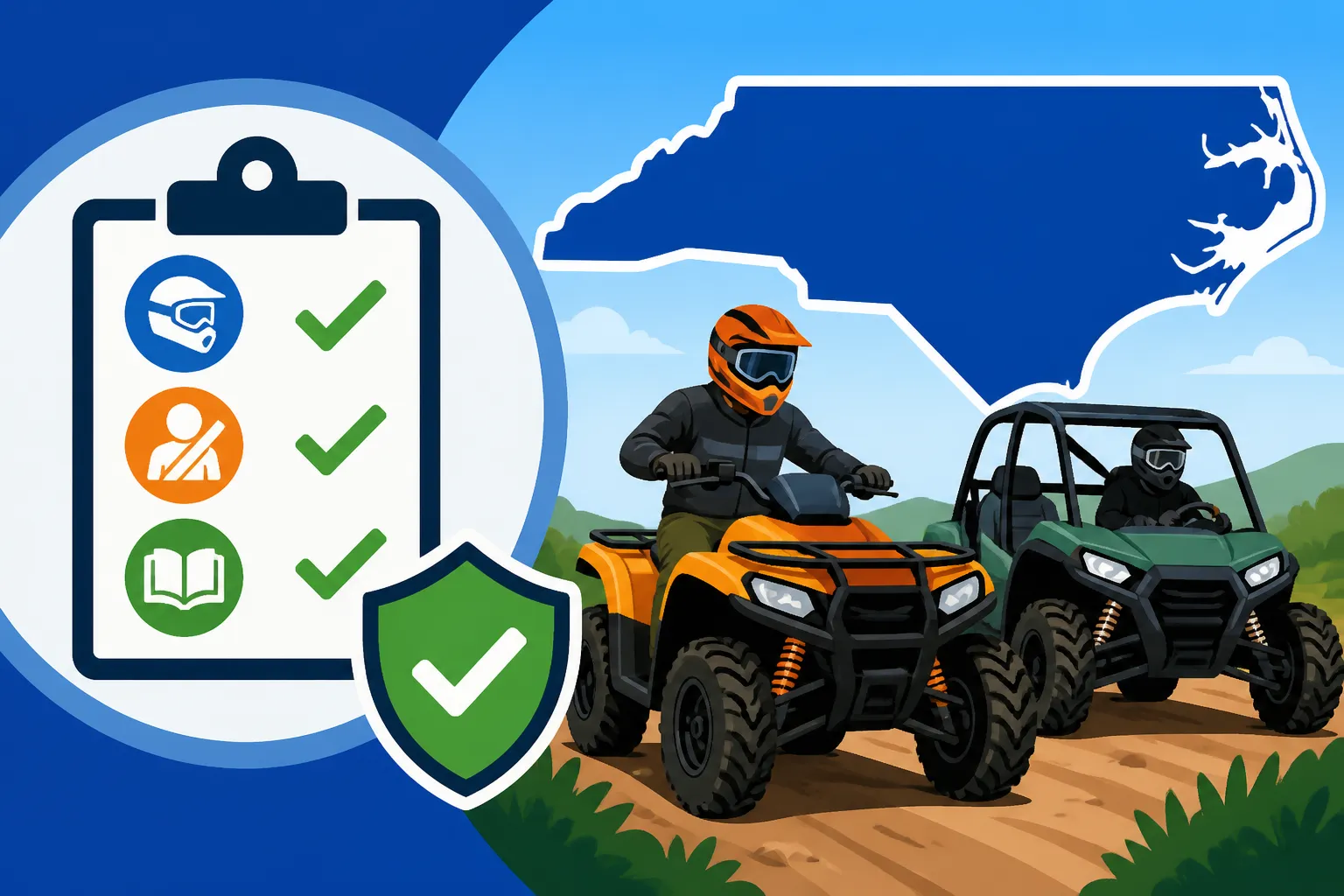
Protective gear is another separate responsibility. According to the North Carolina General Assembly, ATV operators on public streets, highways, or public vehicular areas must wear eye protection and a motorcycle safety helmet meeting United States Department of Transportation standards. The General Assembly also requires riders under 18 to wear that kind of eye protection and helmet when operating an ATV off a public street, highway, or public vehicular area. For more detail, see [Carrying a Safety Card on a North Carolina Ride] and North Carolina Helmet Law for ATV Riders.
Forest riding comes with its own area-specific requirements. The Forest Service says ATV and motorcycle operators and passengers must wear compliant helmets and eye protection in the relevant OHV areas, and riders must carry a valid pass while on the trails. The Forest Service also says OHVs must have a working spark-arresting device and stay on designated trails. These requirements are separate from the state safety certificate.
Before riding, make a practical check of what applies to your trip:
- Certificate: Does the operator fall under North Carolina’s birth-year requirement, and does the course meet an approved route?
- Proof: Can the operator produce the course completion record if needed?
- Location: Does the riding area require a pass, and is the machine permitted there?
- Equipment: Are the required helmet, eye protection, and vehicle equipment in place?
- Route: Are you staying on a permitted trail or using a road only where the rules allow it?
If you need help distinguishing a course certificate from a forest pass, Does a North Carolina Safety Certificate Ever Expire? and Do You Need a Permit for North Carolina Forest Trails? address related questions. Keep the documents separate and check the rule for the place you plan to ride; one form of proof should not be treated as a substitute for another.
If you are shopping for protective gear, focus on the safety standard and fit rather than the product listing’s general claims. For example, when comparing helmets on Amazon, check that the helmet is identified as meeting the required DOT motorcycle standard and fits the rider securely. A safety certificate does not certify equipment, and buying protective gear does not satisfy the course requirement.
The straightforward answer is that North Carolina accepts ATV safety courses sponsored or approved by the All-Terrain Vehicle Safety Institute, or courses approved by the Commissioner of Insurance. Confirm that the specific course meets one of those routes, keep its completion proof, and check the separate riding and equipment rules for your trip.
Sources
- USDA Forest Service — National Forests in North Carolina | Off-Highway Vehicles (OHV) | Forest Service (checked November 3, 2026)
Disclaimer
This article is for general informational purposes only and does not constitute professional advice. Laws, prices and regulations vary by location and change over time. Consult a qualified professional for guidance on your specific situation.