Gated Roads in a North Carolina Forest
A gate on a forest road can look like a simple invitation or a clear stop sign, but neither assumption is safe. In North Carolina, whether an ATV or UTV may use a gated road depends on the route’s official designation, current closures, machine type, and any applicable permit rules. Here’s how to check before you ride—and what to do when the map and the gate seem to disagree.
A gate does not tell you whether a road is open to riding
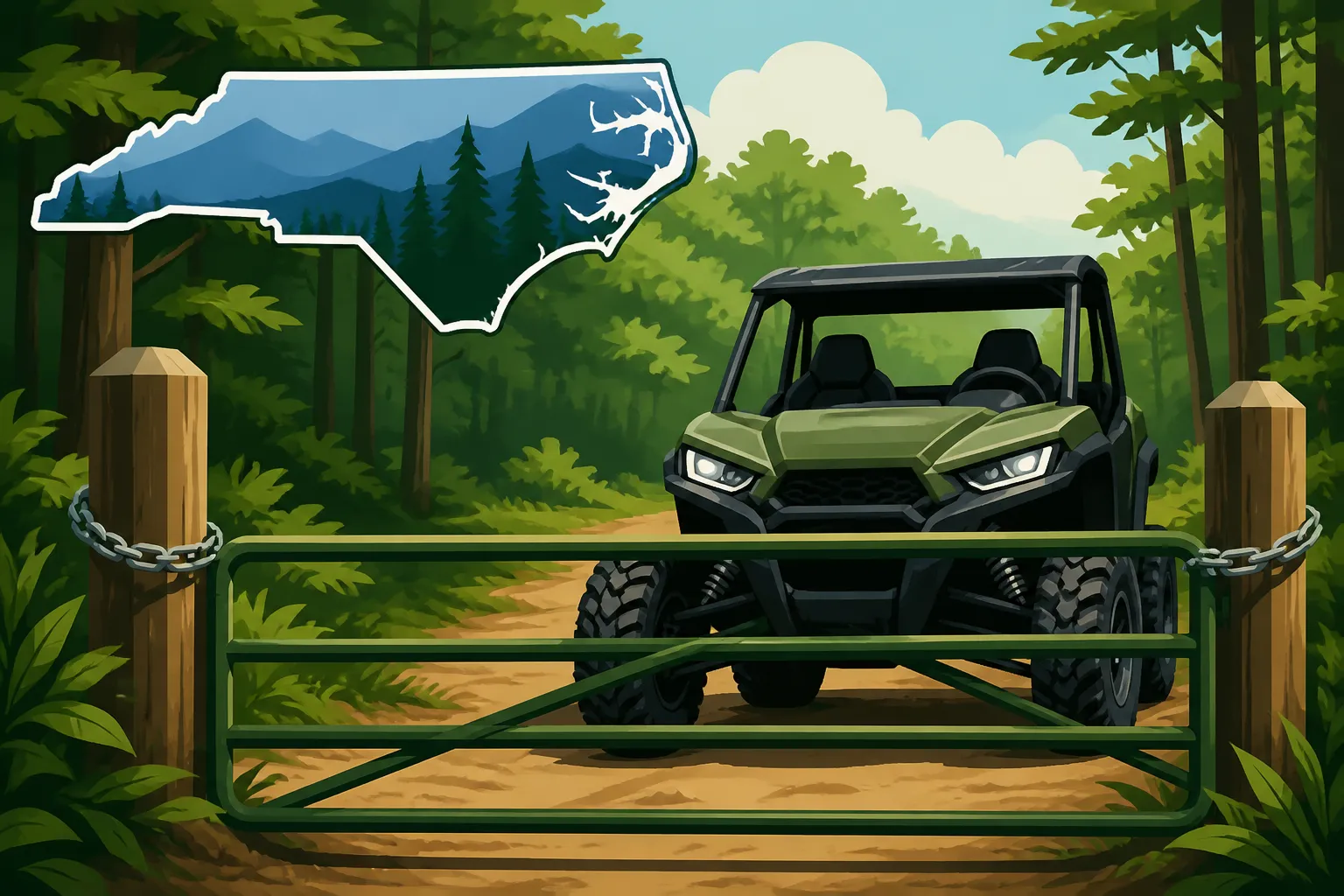
A gate is a physical control, not a complete description of who may use the road. Forest roads may be gated to limit public motorized access, manage seasonal use, protect natural or cultural resources, or control entry during maintenance or hazardous conditions. Some gates may be open at certain times, while others stay closed. A gate may also be open for agency work or another authorized use without opening the route to recreational ATV or UTV riding.
The key question is not simply, “Can I get through?” It is, “Is this route designated for my vehicle, and is it open today?” A route’s status comes from the applicable forest motor-vehicle map, posted signs, and current closure information—not from tire tracks, a missing lock, or another rider’s decision to pass through.
The same caution applies when a gate is closed. Do not go around it on a shoulder, through a gap, or along an informal track. That can take you onto land or a route where motorized use is not allowed. A closed gate is a strong reason to stop and verify the status rather than look for another way around.
Why the gate and the map may seem to conflict
A map describes the route’s designated use, but conditions can change after a map is published. A road shown as open may be temporarily closed for repairs, storm damage, fire risk, logging, or another management need. In the other direction, a gate may be open even though a road is not designated for the public ATV or UTV use you have in mind.
A gate can also control access for vehicles that are allowed on a road but not necessarily for every kind of off-highway machine. A road suitable for highway-legal vehicles is not automatically suitable for an ATV. Likewise, the fact that a UTV can physically fit through a gate does not establish that the vehicle is allowed on the route.
Treat each source as a different piece of information:
| What you see | What it can tell you | What it does not prove |
|---|---|---|
| An open gate | The barrier is not currently blocking entry | That public ATV or UTV riding is allowed |
| A closed gate | Access is physically restricted at that point | Why it is closed or when it may reopen |
| Tire tracks beyond a gate | Someone has traveled the route | That the travel was authorized or recent |
| A route on a map | The route has a designated status shown in that map’s legend | That there is no temporary closure |
| A permit for a riding area | You may meet a permit condition for that area | That every nearby gated road is open to you |
For the route-specific rules that maps describe, see Forest Roads Open to North Carolina Machines and North Carolina Forest Trail Maps. If you are planning around a particular forest or trail system, check the route information and current notices for that place rather than relying on a general impression of how forest roads work.
Check the route designation, the gate, and current notices
Before unloading your machine, identify the exact road or trail you intend to ride. Forest maps can show different kinds of routes and restrictions, and the legend matters: a line on the map is not, by itself, permission for every vehicle class. Confirm that the route is open to the kind of machine you have, and read any seasonal or other qualifications attached to it.
A practical pre-ride check looks like this:
- Find the official map for the forest and route. Use the applicable motor-vehicle or OHV map, and read its legend and notes. Do not rely only on a general recreation map, an old screenshot, or a route someone shared online.
- Match the route to your vehicle. Look for the designation that applies to your ATV or UTV, including any vehicle-size or seasonal limits. If the map does not make the answer clear, do not assume.
- Check for current closure notices. Look for updates from the responsible land manager, especially after storms, road work, or other disruptions. A route’s regular designation may not reflect a temporary closure.
- Read the signs at the entrance. Signs may explain restrictions, dates, vehicle limits, or a local closure. Follow the posted instructions even if another source appears to show the route as open.
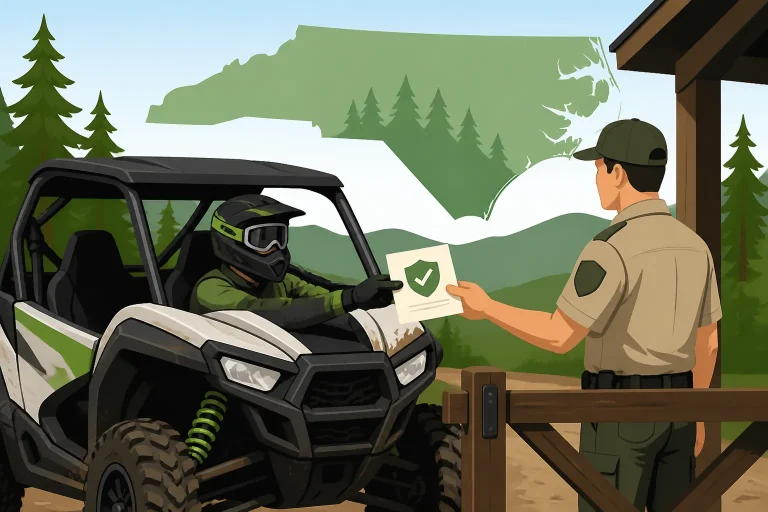
- Stop at a closed gate. Do not pass, bypass, move, or climb around it. Recheck the route status or choose a route that is clearly open to your machine.
- Keep your plan flexible. If a route is closed or uncertain, turn around and use a confirmed alternative. Do not continue onto an unmarked road hoping it reconnects with an open trail.
If storm or maintenance closures could affect your trip, North Carolina Trail Closures to Check and North Carolina Trail Status After a Storm can help you think through what to verify before setting out. A closure notice can affect one route without closing an entire forest, so check the specific road or trail rather than assuming every nearby route has the same status.
What if the gate is open but the route is not on your map?
An open gate does not make an unlisted road a legal riding route. It might be a service road, a private road, or a route reserved for authorized users. If you cannot confirm that the public may ride it on your vehicle, turn back. A visible road, bridge, or turnaround beyond the gate does not change that.
The reverse situation needs the same care. If your map shows a route as open but you arrive at a closed gate or a sign restricting use, do not treat the map as permission to enter. The map may not reflect a new closure, or the sign may apply to a particular section or date. Follow the restriction and check for an updated notice before trying again.
When two sources seem to disagree, do not settle the question by choosing the one that lets you ride. Check the current information from the land manager responsible for that forest or district. If the answer remains unclear, ask the responsible office before entering. That is especially useful where a road branches, crosses a boundary, or joins a trail system with separate rules.
Do not assume that a gate marks the edge of a forest boundary. Land ownership and management boundaries can change along a route, and a road that begins on public land may lead onto private property or an area with different restrictions. North Carolina Landowner Permission Rules explains why access permission matters when a ride reaches private ground.
Forest-road access is different from an OHV trail permit
A permit for a designated OHV riding area does not automatically authorize travel on every forest road. North Carolina forest OHV permits apply where the relevant permit system requires them; a permit is not a general pass to bypass a gate or ride an undesignated road.
Some established riding areas have their own permit rules. Those rules are separate from the route designation and any temporary closure. A rider may need to meet all of them: the route must be open to the machine, the rider must comply with applicable operating rules, and any required area permit must be valid. For an overview, see North Carolina Forest OHV Permits and Do You Need a Permit for North Carolina Forest Trails?.
That distinction can be easy to miss if a trailhead, forest road, and riding area share the same general location. A permit bought for one system should not be treated as proof that nearby gates are open. Check the area covered by the permit and the routes it allows.
| Situation | What to verify |
|---|---|
| Riding a marked OHV trail system | Whether the trail is open to your machine, the current trail status, and whether that system requires a permit |
| Using a forest road to reach a trailhead | Whether that road is designated for your vehicle and open at the time of travel |
| Arriving at a gated road | The posted restriction and current route status; do not enter just because the gate is open |
| Riding near a forest boundary | Whether the road remains on land where your planned use is allowed |
| Visiting from another state | North Carolina’s local route and permit requirements; do not assume another state’s credentials replace them |
A permit also does not cancel a closure. If a road or trail is closed, having the correct permit for the surrounding riding area does not give you permission to continue. North Carolina Rules for Riding a Closed Trail covers the separate issue of using routes that are closed.
Out-of-state registration does not open a gated road
Visitors sometimes assume that registration, a decal, or a permit from their home state settles the question in North Carolina. It does not. The forest route still has to be open to the vehicle being ridden, and local permit rules still apply where required. A credential from another state should not be treated as a substitute for checking North Carolina’s route-specific rules.
This matters because “reciprocity” can refer to different things. A state credential might relate to vehicle identification or registration, while a forest permit relates to access to a particular riding area. Neither one changes a closed gate or turns an undesignated road into an authorized ATV route. For more on visitor credentials, see Does North Carolina Honor Out-of-State Registration? and North Carolina Rules for a Visiting Rider.
What to do at the gate on ride day
Use the gate as a point to pause and confirm—not as an obstacle to overcome. Before the trip, save or carry the relevant map and closure information so you can check a route when cell service is limited. At the entrance, compare the road name or number, signs, and map location. If you cannot confidently match the route to an open designation for your vehicle, choose another route.
A few common situations call for a clear response:
- The gate is closed and there is a sign: Stop and follow the restriction. Do not move the barrier or take a path around it.
- The gate is closed but there is no sign: Treat the road as unavailable until you can confirm otherwise. A missing sign is not evidence that entry is permitted.
- The gate is open but the map shows no public route for your machine: Do not enter on that basis. Check with the responsible land manager.
- The map shows an open route but a new sign says it is closed: Follow the sign and verify whether the closure is temporary or applies to the whole route.
- A route is open, but a permit is required for the riding area: Get the required permit before riding there. Do not assume a road designation replaces the permit.
- You reach a boundary or an uncertain junction: Stop and confirm the next segment before continuing. Permission for one stretch does not necessarily apply beyond it.
Keep the ride on the designated route. A detour around a gate can cause more than a navigation problem: it may put you on a closed road, private land, or another area with different rules. Restrictions can also protect road surfaces, streams, and other resources. [North Carolina Rules for Riding a Watershed] and North Carolina Rules for Riding a Wilderness Boundary address two examples of areas where boundaries and land-use rules can matter.
If you encounter an unexpected closure, turn around where it is safe and return by an allowed route. Avoid blocking the gate or access road while checking your phone or map. If you see damage, a hazard, or a sign that appears unclear or out of date, report the issue to the appropriate land manager rather than trying to resolve it by entering the route.
The simplest rule is also the most dependable: ride only where you can confirm that your machine is allowed, the route is currently open, and any required permit is covered. A gate’s position is only one clue. The route designation, posted instructions, current closure notices, and area-specific permit rules together determine whether you should proceed.
Disclaimer
This article is for general informational purposes only and does not constitute professional advice. Laws, prices and regulations vary by location and change over time. Consult a qualified professional for guidance on your specific situation.