Courses the Commissioner of Insurance Has Approved
Courses the Commissioner of Insurance Has Approved
If you ride an ATV on covered public land in North Carolina, your birth year may determine whether you need a safety certificate. The confusing part is knowing which training counts: not every online quiz, dealer orientation or general riding class is necessarily approved. Here’s how the approval requirement works, how to check a course, and what proof to carry.
What “Commissioner-approved” means
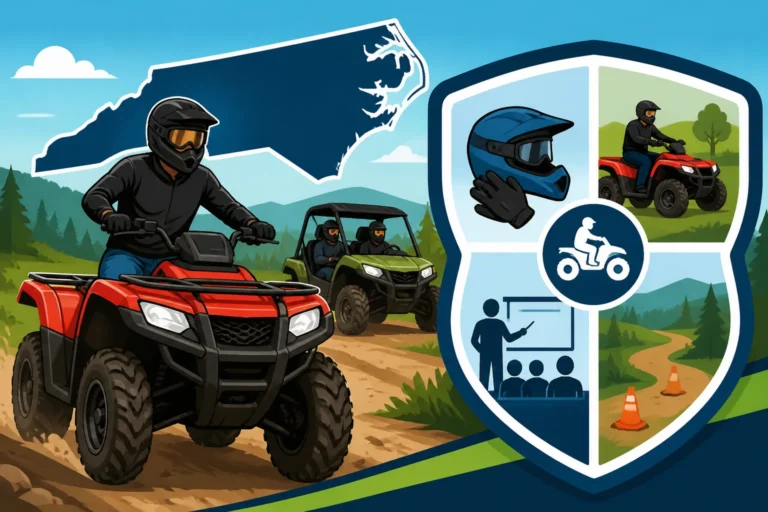
North Carolina requires certain ATV riders to complete a safety course approved by the Commissioner of Insurance. The key word is approved: a course can teach useful safety skills without necessarily meeting the state’s certificate requirement.
Approval is about whether a specific course satisfies the state rule, not whether the course looks reputable or is offered by a familiar organization. A manufacturer’s video, a rental-company briefing or a parent’s instruction may help a rider prepare, but do not assume any of those count as the required course. Confirm the course itself before enrolling.
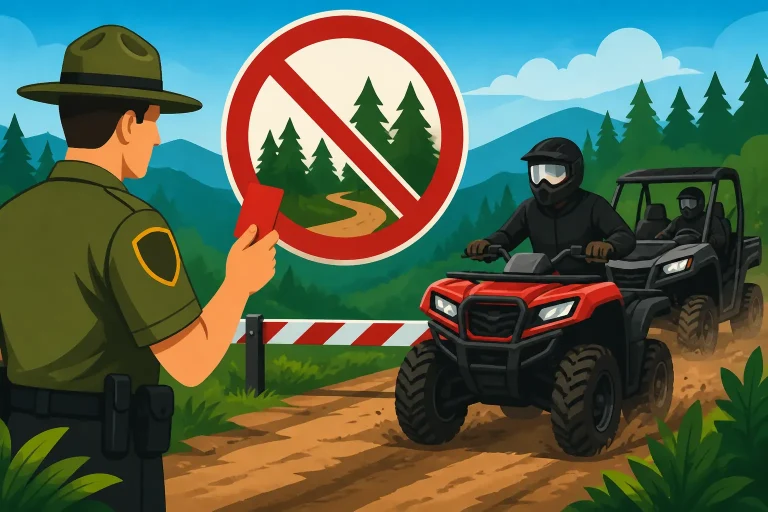
The rule is easy to mix up with other requirements for riding public land. An ATV safety certificate is not a trail permit, registration, title or permission to ride wherever you choose. For example, a certificate does not replace a required forest permit or allow a rider onto a closed trail. Read Do You Need a Permit for North Carolina Forest Trails? for the separate permit question, and [North Carolina Rules for Riding a Closed Trail] for what a certificate cannot authorize.
Approval also does not mean that a course waives other safety rules. Riders still need to follow the rules that apply to age, supervision, helmets, passengers and equipment. The certificate addresses the training requirement; it is not a general exemption from ATV laws.
The approval belongs to the course
When checking whether training qualifies, look for a clear match between the course you plan to take and the course recognized by the state. The provider, course name, format and completion document can all matter. A company may offer several programs, and approval of one program should not be treated as automatic approval of every program it sells.
That distinction is especially important for online courses. A brief online module may introduce basic safety ideas, while a longer course may include skills practice or a separate assessment. The fact that a course is online—or that it issues a certificate—does not by itself establish that it is approved for North Carolina’s requirement.
If the course provider says “state approved,” ask which state and which specific course that statement refers to. If the wording is vague, get the exact course name and confirm it with the state before paying or setting aside time to complete it.
Training is not the same as a forest permit
Public-land riding can involve several independent requirements. Depending on where and how you ride, you may need a permit for the riding area, proof of course completion based on your birth year, and compliance with local land rules. These are separate checks, even if a rider encounters them at the same trailhead.
North Carolina does not use one statewide ATV registration sticker as a substitute for those requirements. A safety card does not function as a registration decal, and carrying a title does not prove that you have completed an approved safety course. For the certificate’s age rule, see North Carolina Safety Certificate Birth Year Rule. For questions about whether an out-of-state card is accepted, see Does North Carolina Accept an Out-of-State Certificate?.
Who needs the certificate and when
The birth-year line commonly used for North Carolina’s ATV safety-certificate requirement is January 1, 1990. Riders born on or after that date should plan to complete an approved course and carry proof of completion when operating an ATV in the settings covered by the rule. Riders born before the line generally do not have the same certificate requirement.
Because a birth-year rule can be easy to misread, use the rider’s full date of birth rather than relying on age alone. Two people who are the same age during a particular season might fall on different sides of the line because their birth dates are in different years. If the question concerns a specific trail, rental or organized event, confirm its requirements as well; an operator may have conditions in addition to state law.
The certificate requirement is connected to where the ATV is operated. It should not be treated as a rule that automatically applies in exactly the same way to every private driveway, private property or public road situation. Public-land rules and site-specific conditions matter. Before a trip, check the land manager’s current instructions and any applicable state requirements.
The age line is not a minimum riding age
A safety certificate does not automatically make a young rider eligible to operate an ATV. Separate age and supervision rules may apply, and the machine’s manufacturer age warning is also important. A young rider can have completed training and still be restricted by a different rule or by the conditions of a particular riding area.
Likewise, a rider who is old enough to operate a machine does not necessarily have the required certificate. Age eligibility, safety training and land access are different questions. Review North Carolina Rules for Riders Under 16 and [North Carolina Supervision Rules for Young Riders] if a minor will be riding.
A parent or guardian should not treat the course as a substitute for supervision. Training can help a rider recognize hazards and make better decisions, but it does not eliminate the need to choose a suitable machine, inspect protective gear and supervise according to the applicable rules.
The rule is about ATVs, not every machine in the same way
People often use “ATV” loosely to refer to quads, side-by-sides and other off-road machines. Legal definitions can be more specific. Do not assume that every requirement for an ATV applies identically to a UTV, side-by-side, dirt bike or other off-road vehicle.
If you are unsure how the state classifies your machine, start with What North Carolina Counts as an ATV. If you are renting, ask the rental company what machine category it is and what training or documentation the operator requires. A rental company may set its own requirements, but those do not replace any state requirement that applies to the rider.
How to check whether a course qualifies
The safest approach is to verify the course with an official source before enrolling. Do not rely only on a search result, an old social media post, a retailer’s description or a course provider’s general claim that its training is “recognized.”
Use this process:
- Identify the exact course. Write down the provider’s name, the full course title and whether it is online, classroom-based, hands-on or a combination.
- Check the current state information. Look for the current approved-course information from the North Carolina Department of Insurance or the relevant state office responsible for the requirement.
- Match the course details. Confirm that the exact program and format are accepted, rather than assuming approval applies to every course from the same organization.
- Ask what proof you will receive. Find out whether the provider issues a completion certificate or card, and whether it includes the rider’s name and completion details.
- Keep the answer and the certificate. Save the completion document and any confirmation that helped establish the course’s status.
The Commissioner of Insurance is named in the requirement, so that office is a logical place to check for approval information. If the official information is unclear, contact the relevant state office and ask a direct question: “Is this exact course, in this format, accepted for North Carolina’s ATV safety-certificate requirement?” Keep a note of the answer and the date you received it.
A provider’s claim is a starting point, not the final check
Course providers may use phrases such as “approved,” “accepted nationwide” or “meets state requirements.” Those statements can be useful leads, but they may refer to another state, another type of vehicle or a different purpose. A course could be approved for an employer’s training program or a rental company’s policy without satisfying North Carolina’s certificate rule.
When comparing two courses, check more than the price or how quickly each can be completed. Confirm whether the course is approved for North Carolina, whether it covers the kind of ATV the rider will operate, and what completion evidence it produces. Providers set their own charges and course terms, so check directly for current details.
If a course involves practical riding, ask how that portion is delivered and whether the rider must bring a machine or protective equipment. For an online course, ask whether completion requires passing an assessment and whether the certificate can be saved or reissued. Those questions help with planning, but they do not establish state approval on their own.
Be cautious with old cards and transferred certificates
A card from a course taken years ago may still be useful proof, but do not assume that every old document meets the current requirement. Check that it identifies the rider and course clearly, and confirm whether the course remains an accepted option if the card is incomplete or hard to read.
A certificate issued in another state also deserves a separate check. States do not necessarily accept one another’s training documents automatically. North Carolina’s approach to reciprocity is covered in Why North Carolina Has Nothing to Reciprocate and A Visitor From a Registering State in North Carolina. The practical point is simple: if the rider trained elsewhere, verify acceptance rather than relying on a state-issued card’s appearance.
What proof to carry on a ride
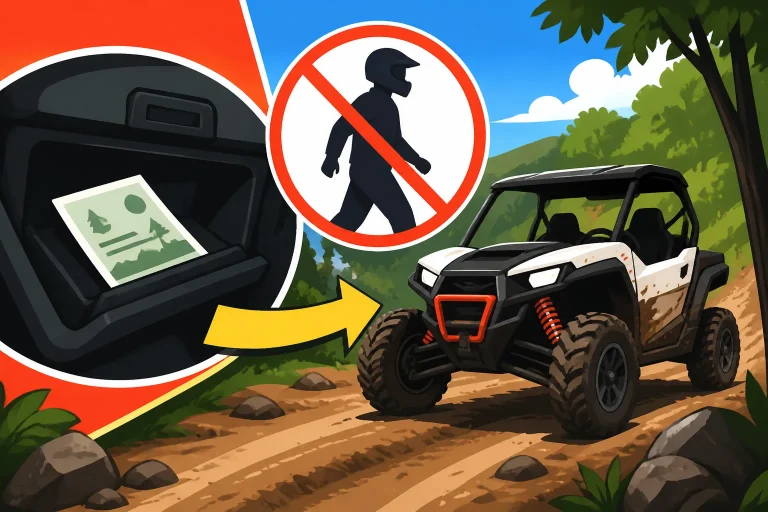
Once a rider completes a qualifying course, keep the completion document accessible when riding in a place where the requirement applies. A certificate left at home may be difficult to produce if an officer or land manager asks to see it. Store a physical card or printed certificate with riding documents, and keep a backup copy in a secure place.
A phone image can be a useful backup, but it is not wise to assume that a photograph will always be accepted in place of the original document. The device could lose power, the image may be unreadable, or the official checking it may require a different form of proof. For a practical discussion of carrying and presenting the card, see Carrying a Safety Card on a North Carolina Ride and Showing a Card to a Forest Officer.
Before leaving home, check that the certificate shows the correct rider’s name and is legible. If a name has changed, a card is damaged or the provider’s records are inaccessible, contact the course provider about replacement documentation before the trip. Do not wait until the day of a ride to resolve a mismatch.
Keep each rider’s proof separate
A family or group may have several machines and several riders, but one certificate does not cover everyone. Each rider who is subject to the requirement should have their own proof of completing an accepted course. A parent’s certificate cannot stand in for a child’s, and one rider’s card does not certify a passenger who later takes the controls.
This matters on group rides where machines are shared. If riders switch vehicles, the training requirement follows the rider, not the ATV. The same principle applies when a machine is borrowed, rented or brought from another state.
A permit and a certificate solve different problems
A forest permit generally relates to access to a particular riding area and may be required for each machine. A safety certificate shows that a rider completed qualifying training. Neither document substitutes for the other.
| Document or requirement | What it generally addresses | What it does not replace |
|---|---|---|
| ATV safety certificate | Required training for riders covered by the state rule | Trail access, a permit or permission to ride |
| Forest OHV permit | Access to a particular managed riding area when required | Rider training or age and supervision rules |
| Title | Ownership documentation for a titled machine | Safety training or permission to ride public land |
| Rental-company orientation | The company’s instructions and rental conditions | Any state certificate requirement that applies |
For information about trail permits, start with Where to Buy a North Carolina OHV Permit. For ownership paperwork, Do You Need a Title for an ATV in North Carolina? explains a separate issue that can arise even when the machine is used only off-road.
Planning training before a trip
If the rider needs a certificate, complete the course well before the ride. This leaves time to verify approval, finish any required assessment, receive the completion document and correct errors in the rider’s information. It also avoids arriving at a trailhead with a course confirmation email but no proof that meets the requirement.
Before booking training, make a short checklist:
- Confirm the rider’s birth date and whether the birth-year rule applies.
- Identify the machine and the place where it will be ridden.
- Check the current official information about course approval.
- Verify that the exact course and format qualify.
- Ask how the provider documents completion and how long delivery takes.
- Save the certificate where it can be shown on the ride.
- Check the riding area’s separate permit and access requirements.
For a ride on a national forest trail, check the forest’s current rules, notices and closures in addition to the certificate. Requirements can differ by riding area, and conditions can change. North Carolina Forest Trail Maps and North Carolina Trail Closures to Check First can help with trip planning, but the managing agency’s current information should take priority.
If the course provider cannot confirm that its program is accepted, pause before enrolling. Ask the state office responsible for the rule or choose a course whose approval can be verified. Completing extra training can still be worthwhile for safety, but only verified approval tells you whether it satisfies the specific certificate requirement.
If you already completed a course
If you have a certificate from a previous course, gather the document and the course details before assuming you need to take training again. Check the exact provider and course name against current official information. If the card only says “ATV safety” without naming the program, contact the issuer for a clearer record.
If you cannot locate the certificate, contact the provider and ask whether it can reissue proof. Keep any confirmation of completion, but verify whether that confirmation is an acceptable substitute for the actual certificate. Do not rely on a memory of completing the course when a written record may be requested.
If a group organizer, rental business or land manager gives you a different answer from the state information, ask which rule or policy they are applying. A business may require training beyond what the state requires, while a public riding area may have its own access conditions. Distinguishing state law from a business policy helps you resolve the issue without assuming one answer covers every situation.
If you are visiting from another state
Out-of-state riders should check both the certificate requirement and the riding area’s permit rules. A valid registration, permit or training card from home does not necessarily transfer to North Carolina. Similarly, completing a North Carolina course does not guarantee that another state will accept it.
Confirm the course and proof requirements before traveling, especially if a group includes riders with different home-state documents. For broader visitor guidance, see [North Carolina Rules for a Visiting Rider]. If a particular public forest requires a permit, verify whether the permit is per rider or per machine and how it must be displayed or carried.
Frequently Asked Questions
Does every ATV rider in North Carolina need an approved safety certificate?
No. The requirement is tied to a birth-year rule and applies in the settings covered by North Carolina law. Riders born on or after January 1, 1990 should verify the current requirement and complete an approved course when it applies.
Does any ATV safety course count?
No. A course should be verified as approved for North Carolina’s requirement. A useful class, online quiz or rental orientation is not automatically a qualifying course just because it includes safety information.
Can I use a certificate from another state?
Do not assume so. Check with the appropriate North Carolina office to confirm that the exact course and certificate are accepted. State reciprocity is not automatic.
Does the safety certificate let me ride without a forest permit?
No. The certificate and a forest permit serve different purposes. A certificate addresses training; a permit may be required for access to a particular riding area.
Disclaimer
This article is for general informational purposes only and does not constitute professional advice. Laws, prices and regulations vary by location and change over time. Consult a qualified professional for guidance on your specific situation.