North Carolina Supervision Rules for Young Riders
Young riders often need more than a helmet and a suitable machine: North Carolina has a supervision rule for ATV operators under 16. The hard part is knowing who can supervise, what “visual” supervision requires, and how that rule fits with age limits, safety gear, and riding-area rules. Here’s how to plan a ride without treating adult presence as a substitute for supervision.
What North Carolina’s supervision rule requires
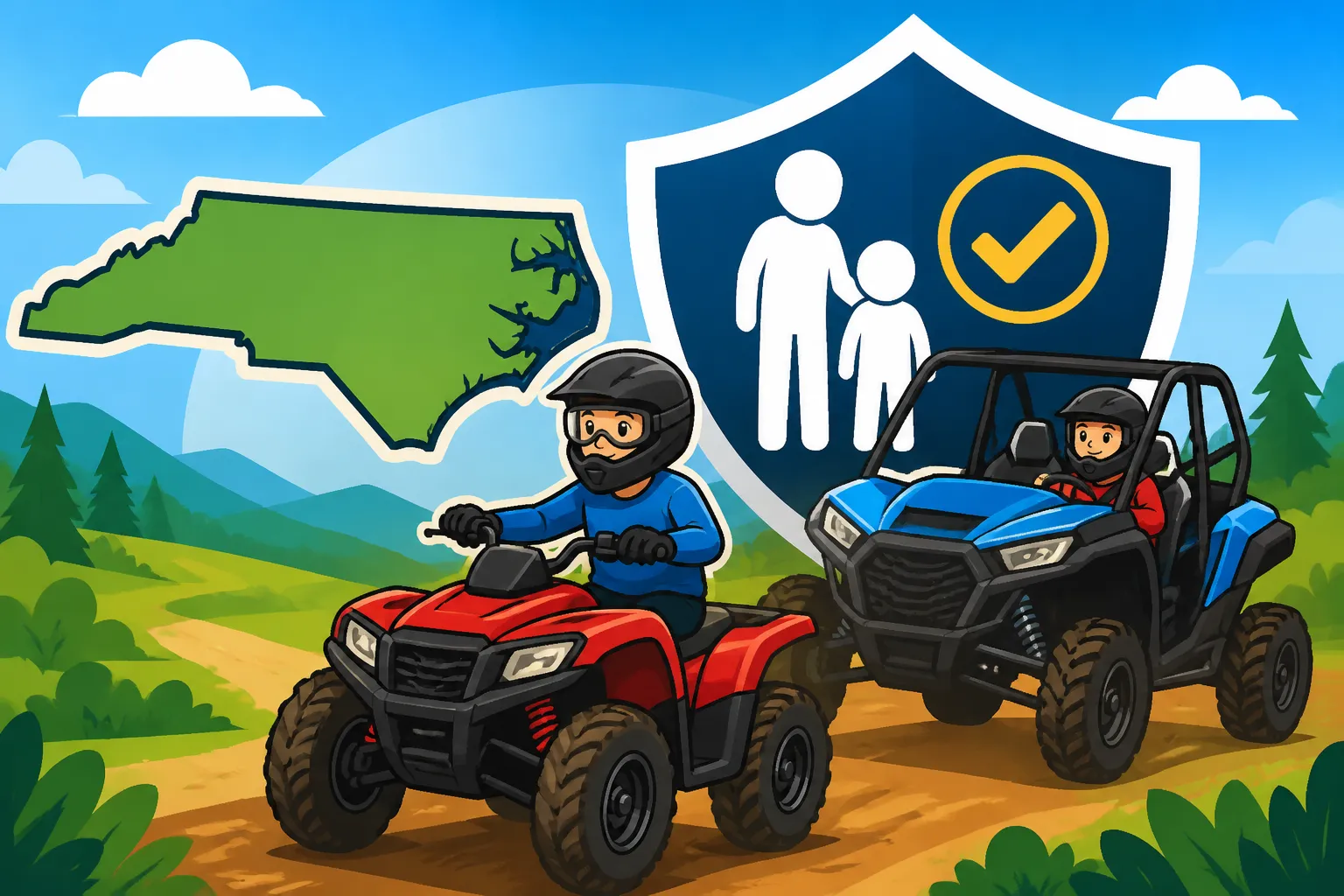
A rider under 16 must be supervised by an adult who is at least 18 years old. The adult must be able to keep the rider under direct visual observation while the ATV is being operated. The requirement is not met simply because an adult is somewhere on the property, at the trailhead, or reachable by phone.
“Direct visual observation” is a practical test: the adult needs to see the young rider, not just know which trail the rider took. Terrain, trees, dust, distance, and other riders can break a clear line of sight. If the adult can no longer see the young rider, they should stop the ride or reposition so they can resume watching.
| Situation | What to consider |
|---|---|
| Adult is riding nearby and can see the young rider | This may allow direct observation, provided the view remains clear and continuous. |
| Adult is riding ahead around a bend or over a hill | The rider may be out of sight; being nearby is not the same as seeing them. |
| Adult is waiting at the trailhead | Waiting there does not provide visual supervision once the rider leaves view. |
| Adult can see the rider but cannot reach them quickly | Visibility is important, but the group should also plan for a breakdown, injury, or separation. |
| Rider is under 16 and riding with friends | Another rider’s presence does not replace supervision by an adult who is at least 18. |
A parent or guardian does not appear to be the only person who can supervise under this rule; the key requirement is that the supervising adult be at least 18 and maintain direct visual observation. Still, families should make the arrangement explicit before starting. Agree on who is responsible for watching the young rider, where the group will stop, and what to do if anyone gets separated.
For a closer look at the wording and how it works in practice, see Continuous Visual Supervision Under North Carolina Law and North Carolina Rules for Riders Under 16.
Supervision does not mean the adult has to ride the same machine
The supervision rule is about observation, not sharing a vehicle. An adult can supervise from another ATV or UTV, or from a safe nearby position, if they can keep the young rider in view. The adult should choose a position that allows them to react without creating another hazard.
A large group can make supervision harder. Riders may spread out, kick up dust, or take different routes at forks. A supervising adult should stay close enough to see the young rider clearly and should not assume that another adult in the group is watching unless that responsibility has been agreed on.
A passenger riding with a child is not automatically a supervisor. A passenger must still be an adult who can observe the rider, and the machine must be designed to carry that passenger safely. A child should not be placed on a one-seat ATV to solve a supervision problem. See North Carolina Passenger Rules on an ATV for the separate passenger issue.
Age limits and supervision are separate rules
The supervision requirement is not the only age-related rule to consider. North Carolina also prohibits children under 8 from operating an ATV. For riders from 8 through 15, supervision by an adult at least 18 is required. A rider who turns 16 is no longer covered by that under-16 supervision rule, but other laws and riding-area restrictions can still apply.
This means the adult’s presence does not make an otherwise prohibited ride legal. An adult cannot supervise a child under 8 into compliance with the age limit. And a rider who is old enough to operate an ATV still needs a machine and riding area suited to their ability.
| Rider’s age | General point to keep in mind |
|---|---|
| Under 8 | The child cannot operate an ATV under North Carolina’s age restriction. |
| 8 through 15 | An adult at least 18 must provide direct visual supervision while the child operates. |
| 16 or 17 | The under-16 supervision rule no longer applies, but age-related equipment and site rules may still apply. |
| 18 or older | The young-rider supervision rule does not apply to the operator, though other requirements remain. |
Older materials may still refer to engine-size limits for young riders, including a 70cc rule. Do not rely on an old handout or online post without checking whether that rule is current. The age restriction, supervision requirement, manufacturer’s guidance, and the machine’s intended use are different questions. Why North Carolina’s Repealed Rule Still Circulates explains why outdated age and engine-size information can be confusing.
The manufacturer’s age label still matters for safe machine choice
A manufacturer’s age recommendation is not the same thing as the state supervision rule. The state rule sets a legal baseline; the machine’s label and owner’s manual describe the rider age, size, experience, and operating conditions the manufacturer considers appropriate.
A child may meet the state’s minimum age and still be too small or inexperienced to operate a particular machine safely. Consider whether the rider can reach and use the controls, sit securely, steer without strain, and stop the ATV reliably. An adult watching from nearby cannot compensate for a machine that is too powerful or physically too large for the rider.
Check the label attached to the ATV and read the owner’s manual, rather than choosing based only on engine size or the child’s confidence. The Manufacturer’s Age Warning Label in North Carolina and Reading an Age Warning Sticker cover how to interpret those warnings.
Helmets, certificates, and riding-area rules still apply
Adult supervision does not replace required protective gear. North Carolina has separate rules for young operators’ helmets and eye protection. Riders under 18 should check that they have the required protective headgear and eye protection before riding; a bicycle helmet or ordinary sunglasses should not be assumed to meet ATV requirements. Confirm the equipment standard and fit, and follow the machine manual and riding-area rules.
A properly fitted helmet should stay secure when the rider moves their head. Eye protection should remain in place and protect against dust, debris, and branches. If a young rider’s goggles fog, slip, or interfere with vision, stop and fix the problem rather than letting them continue. For the legal requirements, see North Carolina Helmet Law for ATV Riders and North Carolina Eye Protection Requirement.
When shopping, check the helmet’s certification and fit information rather than relying on a product title or a seller’s description. Whether buying in a local shop or on Amazon, make sure the item is intended for ATV or motorcycle use and meets the required standard. A helmet that does not fit the rider is not a safe choice, even if its listing describes it as protective.
Check for training and permit rules at the riding site
Some public riding areas have requirements beyond the general supervision rule. A safety certificate or site permit may be required, and a parent’s certificate does not necessarily satisfy a young rider’s own requirement. Permit conditions can also differ by riding area, and a permit for one place may not authorize riding somewhere else.
Before leaving home, check the current rules for the specific forest, trail system, or private park. Confirm whether the young rider needs a safety certificate, whether each machine needs its own permit, what equipment is required, and whether the trail is open to the type of ATV being used. North Carolina ATV Safety Certificate Requirements and North Carolina Forest OHV Permits explain those separate requirements.
Private property does not automatically mean unrestricted riding. The landowner’s permission, local rules, and applicable state requirements still matter. Likewise, a legal place to ride may set its own age, gear, machine, or supervision conditions. Review North Carolina Rules for Riding Private Land before treating a farm, camp, or other private property as a place where any machine or riding arrangement is allowed.
Plan the ride so supervision is realistic
The best way to meet the supervision requirement is to build the ride around the adult’s ability to keep the young rider in view. A plan that works on a wide, open trail may fail on a narrow wooded route with blind turns. Choose a route and pace that match the rider’s experience, the machine, and the adult’s ability to monitor the ride.
Use this checklist before starting:
- Confirm the rider’s age. A child under 8 cannot operate an ATV. For a rider under 16, identify the adult who will provide direct visual supervision.
- Choose an appropriate machine. Check the age label and owner’s manual, then make sure the rider can control the ATV’s size, speed, and controls.
- Fit the protective gear. Check the helmet and eye protection, and make sure the rider can see and hear clearly.
- Choose a route with visibility. Avoid routes where terrain, vegetation, dust, or traffic will repeatedly hide the young rider from the adult.
- Set group rules. Agree that the young rider will stay where the supervising adult can see them, stop at forks, and wait whenever the group becomes separated.
- Check site-specific requirements. Confirm permits, certificates, open status, trail restrictions, and any additional rules for youth riders.
- Make a stop plan. Decide where to regroup and what to do if visibility is lost, a machine has trouble, or someone needs help.
The adult should not take on tasks that prevent them from watching: navigating for the entire group, taking photographs, handling a repair, or leading riders out of sight. Pause the ride when attention is needed elsewhere. If the trail makes continuous observation impractical, choose a different route or stop operating until the adult can see the young rider again.
Common situations that call for a pause
A rider disappearing around a bend for a few seconds can become a repeated pattern on a winding trail. If that happens, slow down, regroup, or have the adult move to a position where the whole group remains visible. On dusty routes, increase spacing enough to avoid collisions but not so much that the young rider disappears in the dust.
If the adult must leave the young rider’s view, the child should stop in a safe location rather than continuing alone. If the group gets separated, do not have the young rider search for the adult on an unfamiliar route. Establish a simple stop-and-wait plan in advance, and make sure the rider knows how to shut off the machine and call for help.
A safety certificate, trail permit, helmet, or adult somewhere nearby cannot substitute for the supervision rule. Each requirement addresses a different part of the ride. Keep the adult in direct view of any operator under 16, choose equipment and trails appropriate to the rider, and verify the current requirements for the exact place where the group plans to ride.
Disclaimer
This article is for general informational purposes only and does not constitute professional advice. Laws, prices and regulations vary by location and change over time. Consult a qualified professional for guidance on your specific situation.