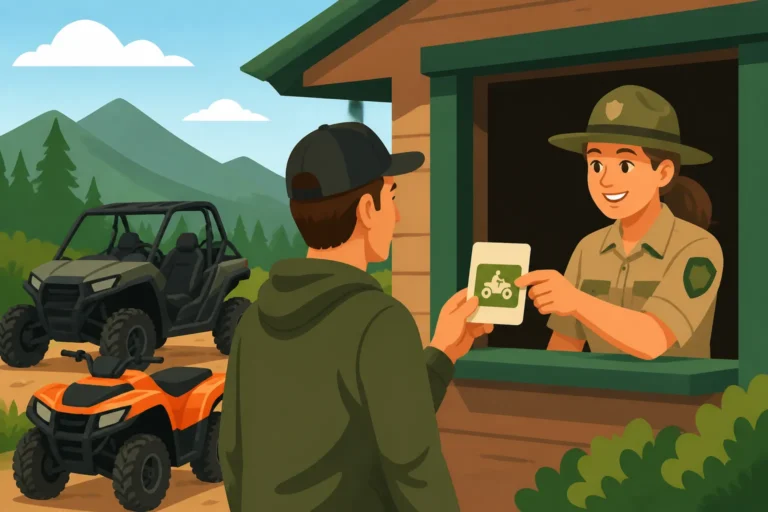
Showing a Card to a Forest Officer
If a forest officer asks for your ATV safety certificate, the key is being able to show that you meet North Carolina’s birth-year requirement—not confusing the certificate with a trail permit. Know who needs the card, what it proves, and what to do if you left it at home.
What the safety certificate card proves
North Carolina requires an ATV safety certificate for riders born on or after January 1, 1990, when they operate an ATV on public land covered by the requirement. The certificate shows that the rider completed a safety course accepted under state rules. It is about the rider’s training, not the machine’s ownership or permission to use a particular trail.
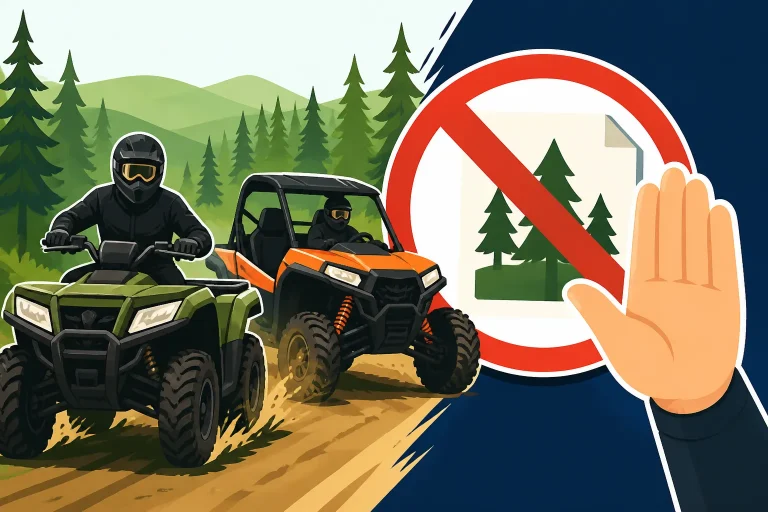
A forest officer checking your certificate may be confirming that you meet this rider requirement. The card does not, by itself, give you permission to ride on a closed trail or replace a permit required for a specific riding area. It also is not vehicle registration, a driver’s license, proof of insurance, or a title.
| Item | What it applies to | What it does not replace |
|---|---|---|
| ATV safety certificate | The qualifying rider’s course completion | A trail permit or machine-specific access requirement |
| Forest OHV permit | Use of a riding area where a permit is required | The rider’s safety certificate |
| ATV title | Ownership documentation, where applicable | Permission to ride a public trail |
| Driver’s license | Driving privileges where required | ATV safety training or an OHV permit |
The certificate requirement is tied to the rider’s birth year, not the model year or purchase date of the ATV. For a closer look at the cutoff, see North Carolina Safety Certificate Birth Year Rule and January 1990 and the North Carolina Line. If a rider was born before the cutoff, the certificate requirement may not apply to that rider, but other safety, age, supervision, and trail rules still can.
The course requirement is separate from the rules that apply to the machine. A rider can have a valid certificate and still be riding an unpermitted vehicle, using a closed trail, or breaking another rule. Likewise, a machine can have the right permit while its operator still needs to carry proof of training.
North Carolina’s course requirement is not the same thing as an ATV operator license. Completing a course and carrying the card does not authorize road use, remove age restrictions, or waive the need for parental supervision where required. The card has a narrow purpose: it documents course completion for riders who fall under the birth-year rule.
What to do when an officer asks to see it
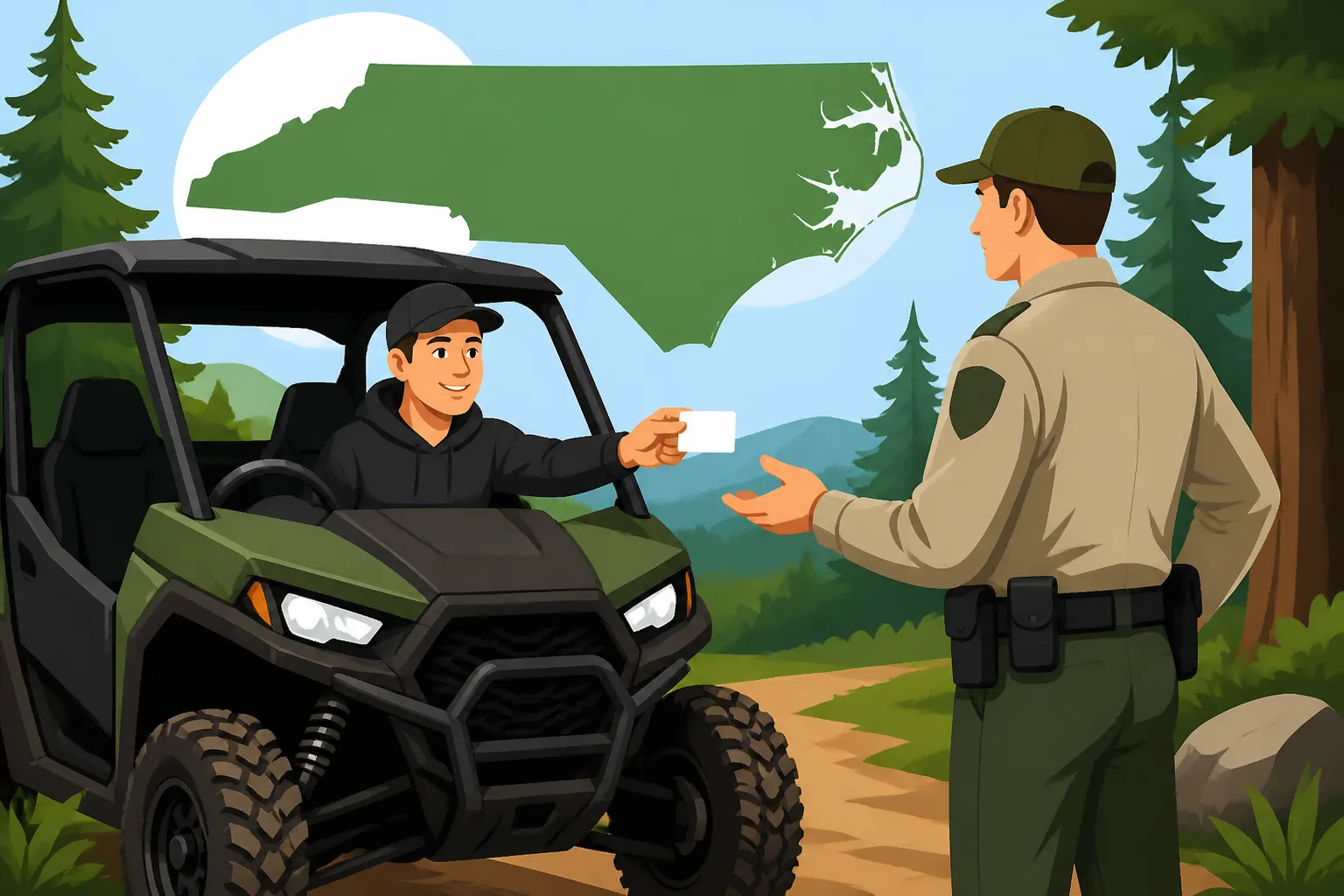
Stay calm, stop in a safe place, and follow the officer’s directions. If asked for your certificate, present it clearly and let the officer read the information. Avoid reaching suddenly into a pack or vehicle compartment; tell the officer where the card is before you retrieve it.
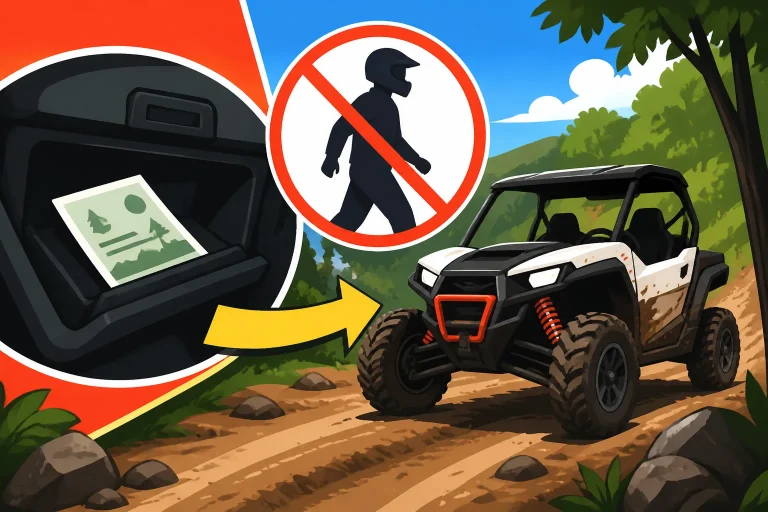
A physical card is the simplest proof to show. Keep it somewhere accessible but protected from water, mud, and damage, such as a sealed pocket in your riding pack. If you carry your card in a wallet, make sure it will still be readable after a wet or dusty ride.
A phone photo or digital copy can be useful as a backup, but do not assume that every officer or riding area will accept it instead of the original card. Requirements and enforcement practices can differ. If you plan to rely on a digital record, check with the relevant land manager or course provider before riding. When in doubt, carry the physical certificate.
The officer may also ask other questions or check separate requirements. For instance, a trail permit may be required for the specific forest riding area even when every rider has a certificate. Permits are often tied to the vehicle rather than the person, so a group with several machines should check the rules for each one. See Why a Permit Is Per Vehicle in North Carolina and Where North Carolina Forest Permits Are Sold for more on that distinction.
If the officer says the certificate is not visible or cannot be verified, be respectful and explain what documentation you have. Show the card or backup copy if available, and answer questions honestly. Do not argue from the assumption that your age, course, or out-of-state documentation automatically settles the matter. If there is a disagreement about whether a course qualifies, ask how to confirm the requirement and follow any instructions given at the scene.
A roadside conversation is not the best time to search through email for a course record or try to establish whether a course is approved. Check that before your trip. A clear image of the card stored on your phone may help you recover information later, but it is not a substitute for confirming what proof is accepted.
Before riding: confirm the card and the trail permit
A short check before loading can prevent a frustrating stop. Confirm that each rider who needs a certificate has completed an accepted course and has the card available. Then check the riding area’s current access rules, including whether a permit is required, where it must be displayed, and whether closures or seasonal restrictions apply.
- Check each rider’s birth year. The certificate requirement applies to riders born on or after January 1, 1990. Do not infer a rider’s status from someone else in the group.
- Verify the course. Confirm that the course provider and certificate meet North Carolina’s requirements. If a rider completed training in another state, check acceptance rather than assuming the card transfers automatically. Does North Carolina Accept an Out-of-State Certificate? covers that question.
- Pack the card. Carry the physical certificate in a protected, easy-to-reach place. Keep a backup image separately if you want one, but do not rely on the image without checking whether it will be accepted.
- Check the riding area’s permit rules. The certificate does not replace a permit. Review where permits are needed and how they must be displayed for your destination. The rules for Which North Carolina Forests Take a Day Permit can help clarify that permits vary by riding area.
- Check for closures and other requirements. A valid certificate and permit do not make a closed trail available. Review official forest notices before driving to the trailhead.
For example, a rider headed to Brown Mountain should think about two separate questions: whether the rider needs a safety certificate and whether the machine has the required access permit. The same distinction matters at Badin Lake and Wayehutta. Requirements can vary by area, so do not assume the process at one trail system applies everywhere. Do You Need a Permit for North Carolina Forest Trails? explains the permit side, while North Carolina Trail Closures to Check First is useful before setting out.
It is also worth checking that the card is legible and belongs to the rider carrying it. A parent’s certificate does not cover a child, and one rider’s training card does not satisfy another rider’s individual requirement. If you are organizing a group, ask each rider to confirm their own documentation before meeting at the trailhead.
If you forgot, lost, or cannot verify the card
If you forgot the card at home, do not assume that explaining you completed a course will be enough. A course provider may be able to confirm completion, but whether a phone record or other substitute works during a check is a separate question. Contact the course provider or the land manager for guidance rather than relying on a guess.
If the certificate is lost or damaged, contact the organization that issued it and ask how to obtain replacement proof. Keep any course-completion email or record while you wait, but confirm whether it can serve as acceptable documentation for your ride. Does a North Carolina Safety Certificate Ever Expire? addresses validity, while [Carrying a Safety Card on a North Carolina Ride] focuses on practical ways to have proof available.
If you took a course outside North Carolina, check the course’s status before riding. The fact that another state issued a card does not necessarily answer whether it meets North Carolina’s requirements. The same applies to a course taken online or through a private organization: verify that it is accepted, and keep the provider’s confirmation with your records.
If you receive a citation or believe an officer misunderstood your documentation, preserve the details. Note the date, location, the rule or issue described, and what proof you presented. Follow the instructions on any paperwork and use the appropriate process to ask questions or contest the citation. Avoid treating an informal roadside explanation as a final ruling on your situation.
The practical takeaway is simple: carry the card if you are required to have one, and keep it separate in your mind from the machine’s trail permit. Both may matter on a ride, but they prove different things. Checking the rider documentation, machine permit, and trail status before leaving is far easier than trying to sort them out at the forest gate.
Disclaimer
This article is for general informational purposes only and does not constitute professional advice. Laws, prices and regulations vary by location and change over time. Consult a qualified professional for guidance on your specific situation.