Why a State Park Turns Machines Away
Showing up at a North Carolina state park with an ATV or UTV can end in a quick turn-around, even if the machine is titled, insured, or permitted somewhere else. The reason is usually access, not ownership: state parks do not generally allow off-road machines on park roads or trails. Here’s how to tell a state park from a legal riding area and plan a better trip.
Why a state park may refuse your ATV or UTV
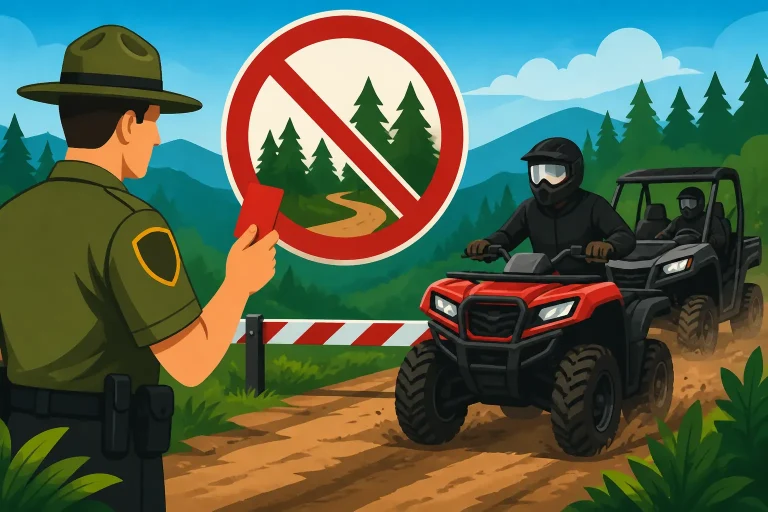
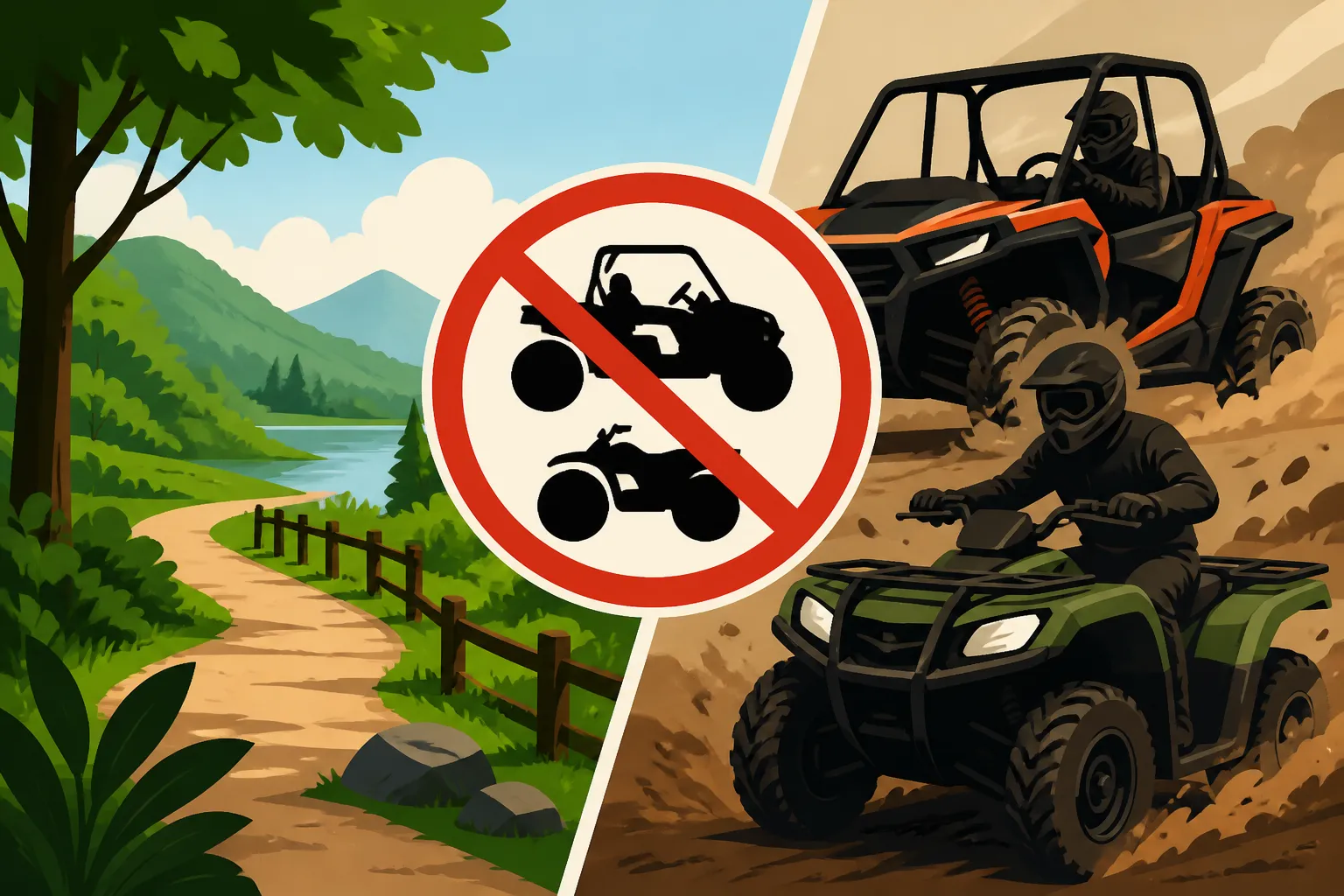
North Carolina state parks prohibit all-terrain vehicles under general vehicle rules that bar unlicensed or off-road motor vehicles from park roads and trails, according to the North Carolina Division of Parks and Recreation. In practical terms, a public park road is not automatically an ATV route, and a trail shown on a park map is not necessarily open to motorized riding.
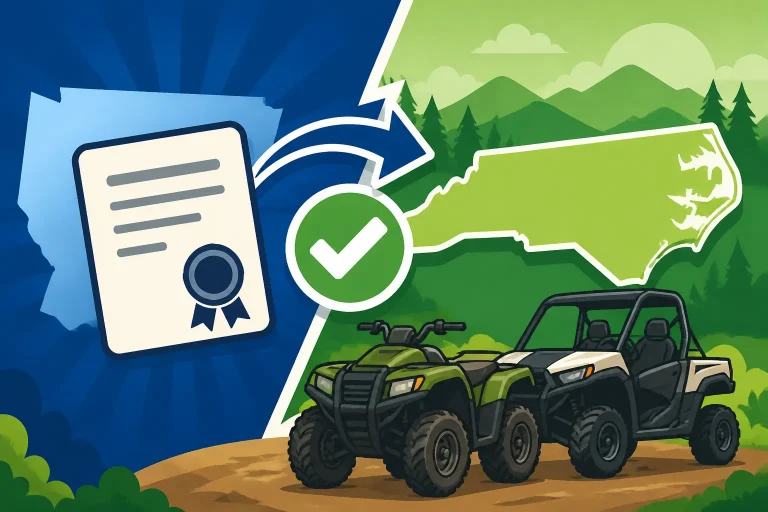
That can feel confusing because a machine may be legally owned and still be barred from a particular property. A title or purchase document helps establish ownership; it does not grant permission to ride wherever you choose. North Carolina Form MVR-60, for example, is designated as the All-Terrain Vehicle Title Affidavit by the North Carolina Department of Transportation Division of Motor Vehicles. That paperwork is about the machine’s title, not access to state-park roads or trails.
The type of land matters. A state park, a national forest, a national seashore, and a private off-road park can each have different rules. A pass or permit for one riding area does not automatically authorize riding at another. The Forest Service requires a valid pass for the specific area where you are recreating, and trail riders must carry it with them while riding. That is a separate access system from state-park rules.
There can also be a mismatch between what an owner calls the machine and how an agency classifies it. The Forest Service defines an ATV as a machine with a seat the operator straddles and handlebars for steering, with three, four, or six wheels and a width under 60 inches. A side-by-side or other off-highway vehicle may fall under a different category, but a different label does not itself create permission to use a state-park road or trail.
Before unloading, check the rules for the exact property and route—not just the county, nearby town, or recreation area. North Carolina Rules for Riding a State Park Road explains the state-park issue in more detail, while What North Carolina Counts as an ATV can help clarify how a machine may be classified.
A state park, a national forest, and a beach are not interchangeable
The most common planning mistake is assuming that a riding permit makes every nearby public property available. It does not. Each site can have its own land manager, allowed vehicle types, designated routes, and permit requirements.
| Location type | What to expect | What to check before unloading |
|---|---|---|
| North Carolina state park | Off-road or unlicensed motor vehicles are not allowed on park roads or trails under the general vehicle rules. | Whether the park has a specifically designated motorized area or route, and whether your vehicle is allowed there. |
| National forest OHV area | Riding is limited to designated areas and trails, with area-specific pass requirements. | The correct pass, current trail status, vehicle eligibility, and route map. |
| National seashore beach route | Vehicle access may be allowed only in designated areas under separate rules. | The current ORV permit, open access points, closures, and beach-driving restrictions. |
| Private off-road park | Access depends on the property’s own rules and operating conditions. | Whether the park accepts your machine and what its entry requirements are. |
North Carolina state parks should not be confused with the National Forests in North Carolina. The Forest Service says there are only four designated OHV areas within those national forests. Those areas are not permission to ride on every forest road: vehicles operated on public roadways, including Forest Service roads, must be registered under state law, and the Forest Service says ATVs cannot be registered and therefore are not allowed on Forest Service roads. ATVs must be trailered to the trailhead.
That distinction matters if you are planning a forest ride. Forest passes are tied to the riding area, and the Forest Service says a valid pass must be carried on the trail. Passes are sold through Recreation.gov, and riders must also have a state driver’s license available during a law-enforcement compliance check. Check the area’s requirements before leaving home; the fact that a machine can be trailered to a forest does not mean it can travel on every road once there.
The beach creates a different kind of confusion. At Fort Fisher State Recreation Area, ATVs are strictly prohibited in the four-wheel-drive beach access area, according to the North Carolina Division of Parks and Recreation. That is a specific restriction at a state recreation area—not a general invitation to ride on other beaches.
Cape Hatteras National Seashore is managed by the National Park Service, not the state parks agency. The National Park Service requires an Off-Road Vehicle permit to drive on the beach there, and its designated beach routes have their own rules. A Cape Hatteras permit does not authorize riding at Fort Fisher, and it does not change the rules at a North Carolina state park. For more on those distinctions, see North Carolina Rules for Riding a Beach and Do You Need a Permit for North Carolina Forest Trails?.
Where to go instead—and what the permit does
If your goal is to ride an ATV or UTV rather than visit a park, choose a designated OHV area or a private off-road park that allows your vehicle. North Carolina has limited public forest riding opportunities, so verify the destination before making the drive. The Forest Service identifies the Brown Mountain OHV area and the Badin Lake OHV Trail Complex among the state’s designated motorized riding areas. See Brown Mountain OHV Trail System and Badin Lake OHV Trail Complex for location-specific planning.
A forest pass is for the area and use it covers. It is not a statewide license, and it does not override closed trails, vehicle restrictions, or general road rules. Forest Service passes remain valid until midnight on the date written on the pass. That timing is worth checking if you are planning a late ride or combining a ride with an overnight stay.
Also confirm what must be displayed or carried. The Forest Service says riders must carry their valid pass while on the trails and have a state driver’s license available for a compliance check. A pass purchased for one vehicle or area should not be assumed to cover another machine or another destination; check the specific area’s instructions before setting out.
For beach driving at Cape Hatteras National Seashore, the National Park Service requires an ORV permit, which must be acquired through Recreation.gov. The National Park Service says the operator’s driver’s license number should be used in place of a license plate when buying a permit for an ATV or UTV, and decals must be placed on the driver’s-side front fender. Those requirements apply to that seashore’s permit system, not to North Carolina state parks or Forest Service trails.
Even where riding is allowed, the route rules still matter. Forest Service OHV riders must stay on designated trails; driving off trail is prohibited. The agency also requires a working spark arrester, and ATV and motorcycle operators and passengers must wear compliant helmets and eye protection. The rules can vary by area and vehicle, so consult the destination’s official information rather than relying on a permit receipt or a general map.
A practical way to find an appropriate destination is to start with Where to Ride an ATV in North Carolina, then confirm the specific trail system’s current access details. If your plan involves a national forest, look at North Carolina Forest OHV Permits as well. Do not treat a nearby state park as a substitute riding area just because it is close to the trailhead.
How to avoid a wasted trip
A little checking before you load the trailer can prevent a frustrating arrival. Use this process:
- Identify the land manager. Confirm whether the destination is a state park, national forest, national seashore, or private park. Similar names and nearby boundaries can make it easy to confuse one property with another.
- Check the exact route. Look for a rule that names your vehicle type and the road, trail, or beach access you plan to use. General permission to visit a property is not the same as permission to ride an ATV or UTV.
- Confirm permits and pass conditions. Make sure the pass applies to the correct area and vehicle, and find out whether it must be carried or attached to the machine.
- Check closures and operating conditions. A destination that normally allows OHV use may still have a closed route or other temporary restriction. Verify current conditions before you drive.
- Review equipment and rider rules. Confirm helmet, eye-protection, passenger, age, and supervision requirements for that destination. Forest Service rules, state law, and National Park Service requirements are not interchangeable.
- Plan transport to the trailhead. The Forest Service says ATVs cannot be registered and are not allowed on Forest Service roads, so a machine may need to be trailered to the designated riding area rather than driven there.
- Ask if anything is unclear. Contact the land manager directly and describe the machine and the route you intend to use. A clear answer about that specific combination is more useful than assuming an old online post applies.
Remember that a park may turn a machine away even when the owner has done nothing wrong. The machine can be properly owned and maintained, but the land manager can still prohibit it on that property. Conversely, an OHV area may welcome riders but require a particular pass, trail route, safety equipment, or transport plan.
If you are planning a family outing, check rider requirements as well as location rules. The Forest Service says children under 16 must be under continuous visual supervision by an adult over 18 in the areas covered by its OHV rules. North Carolina law also requires a safety certificate for ATV operators born on or after January 1, 1990. The North Carolina General Assembly specifies that qualifying courses must be sponsored or approved by the All-Terrain Vehicle Safety Institute or approved by the Commissioner of Insurance. For the certificate details, see North Carolina ATV Safety Certificate Requirements.
The simplest rule is to treat every riding destination as its own permission question. A state park is for the activities its rules allow; a forest OHV area has designated trails and passes; a beach route has its own access system. Check the exact site before you load up, and you are far less likely to find out at the entrance that your machine is not allowed.
Sources
- North Carolina Department of Transportation Division of Motor Vehicles — NCDMV: Vehicle Registration Forms (checked November 3, 2026)
- Forest Service — National Forests in North Carolina | Off-Highway Vehicles (OHV) | Forest Service (checked November 3, 2026)
- OSFM — ATV Safety | OSFM (checked November 3, 2026)
- Forest Service — National Forests in North Carolina | Black Swamp OHV Trailhead | Forest Service (checked November 3, 2026)
- Forest Service — National Forests in North Carolina | Brown Mountain OHV Trail System | Forest Service (checked November 3, 2026)
- Forest Service — National Forests in North Carolina | Off-Highway Vehicles (OHV) | Forest Service (checked November 3, 2026)
- USDA Forest Service — National Forests in North Carolina | Off-Highway Vehicles (OHV) | Forest Service (checked November 3, 2026)
Disclaimer
This article is for general informational purposes only and does not constitute professional advice. Laws, prices and regulations vary by location and change over time. Consult a qualified professional for guidance on your specific situation.